2018 Goal Update
Books read: 27
Words on BRUSHSTROKES: 5900/? (probably 80-85K)
Remember that last week of March when I wrote about 5,000 words in that one week?
Yeah, that didn't happen in the last couple weeks. I didn't even manage to get in last week's blog post (um... sorry about that).
I expect productivity to fluctuate. I know some weeks I'll get more done than others. There are natural dips.
That's not what's been going on.
I've mentioned before that I'm in the process of switching jobs. Adjunct life has been interesting, but it's time for me to move on to work that's more reliable (and comes with better pay and benefits--I love you, academia, but you've got to pay your workers what they're worth). I found a new job that's pretty great and that's willing to wait until the end of the semester to bring me on full-time, so long as I work part-time hours until then.
It's a good deal. Except for one thing: it means that I, right now, have four part-time jobs.
It's been an exhausting couple of weeks. I'm not great at the whole work-life balance thing to begin with, and adding another job to the mix has taken its toll. I've been burning the candle at every conceivable end, and it's drained my writing mojo.
This four-job situation is temporary--at the end of the semester, just a couple of weeks from now, my three teaching jobs end and I'll be down to one full-time job with normal hours. A few low-productivity writing weeks isn't so bad a trade off in the long run. Predictable hours and a decrease in the emotional labor I'll have to do on a daily basis will free up more brain space for creative work. In light of that, a few low-productivity writing weeks aren't a bad trade.
But, oh man, do I feel awful about it.
I'm sort of a slow-producer when it comes to words. Sure, I can crank out over a thousand on a day when I'm on a deadline, but in general it's a slower process for me. Since most of my writer friends are more prolific, I'm pretty insecure about my tiny daily wordcounts under the best of circumstances. It's not as bad when I'm able to squeeze in several writing days in a week. The cumulative wordcount lessens the feeling of inadequacy.
The past two weeks, though, I've been lucky to get in a single 250 word day. A two-week wordcount of fewer than 500 words is a gut-punch.
One of the ways that my brain lies to me is that it constantly tells me that I'm lazy. No matter how much I get done or how many hours of work I put in, there's a voice in my head that's telling me I'm not trying hard enough. I know that this is objectively not true, but it's hard to ignore that voice in times like this when I'm not getting words on the page.
It's a struggle to keep my expectations reasonable this week. There's only so much time in a day, and I only have so much mental space. If my productivity is low now, that's not so bad. This overwhelming situation is temporary, and once things settle, I should be able to get back on my feet--maybe not back to that end-of-March-I-had-a-whole-week-off level, but to somewhere reasonable.
In the meantime, I guess I have to take some time. Allow myself to recharge. Write what I can, when I can, but not get caught up in the numbers.
Showing posts with label imposter syndrome. Show all posts
Showing posts with label imposter syndrome. Show all posts
Sunday, April 15, 2018

Sunday, April 1, 2018
Uncharted
2018 Goals Update
Books read: 25 (my original goal was 50...I think I'm gonna make it)
Words on BRUSHSTROKES: 5,506/?
My Spring Break, such as it is, is drawing to a close. All three schools had their break on the same week this year, for once, so I actually did have a full week away from my day jobs. But I wouldn't exactly call it a week off.
Even with classes not in session, there were still emails from students to field. I did all the pre-screenings and onboarding paperwork for my new day job, which starts on a part-time basis next week. I'll shift to full-time when the semester ends, and my days as an adjunct will be over.
In spite of the flurry of activity, I managed to have some pretty productive writing days. I wrote to keep my mind off of waiting for Author Mentor Match results, and I wrote to distract myself from the disappointment when I didn't get chosen. But mostly, I wrote because this idea won't let go of me.
The beginning of a project is always weird. You go from looking at something that you've trimmed the fat from and polished and smoothed to looking at the rambling, incoherent slop that is a first draft.
My favorite part of writing is revision. I like tinkering with the story once it's down, looking at the bits and pieces and doing a diagnostic. Working and reworking the sections. I like the part where the shambling mess of a manuscript starts to look like an actual book.
Which means that writing a first draft can be a reeeeeeal challenge. First drafts are, by nature, imperfect. And, when it comes to my writing, I have a tendency to be a perfectionist.

Not all first drafts are alike. Not even all of my first drafts are alike. Some are..draftier, for lack of a better word. Some are more polished. But they're all kinda bad.
Most of my first drafts are solid stories. My tendency to outline serves me pretty well in that way.
But this story is different.
I don't have a plan for BRUSHSTROKES in the way that I had one for CANUS. I have a couple of paragraphs of a summary and a list of the major characters. I know, sort of, where the story will eventually go. I have a pretty solid idea of what the first handful of chapters look like. And that's pretty much it.
Not having a plan has definitely made the process more stressful. There's nothing for me to look to if I get stuck or lose the thread of the story. It makes things feel messy.
Phoebe, my main character in the new MS is messy. She's complicated. And this MS requires a close perspective--BRUSHSTROKES is my first real attempt at first person narration.
I'm hoping that the lack of form, the lack of my usual structure will let me dig a little deeper into Phoebe. It'll mean more revision on the back end, I'm sure, but if I can find her voice, I think it'll be worth it.
But boy, is the process ugly. I'm trying to embrace the crap. I'm really trying.
Long term, I can't say how this experiment will work out. It's certainly let me put a lot of words on the page pretty quickly, but that might have more to do with the week off than anything. We'll see if the wordcount keeps up next week.
When's the last time you shook up your process or wrote something out of your comfort zone? How did it go? Let me know in the comments.
Books read: 25 (my original goal was 50...I think I'm gonna make it)
Words on BRUSHSTROKES: 5,506/?
My Spring Break, such as it is, is drawing to a close. All three schools had their break on the same week this year, for once, so I actually did have a full week away from my day jobs. But I wouldn't exactly call it a week off.
Even with classes not in session, there were still emails from students to field. I did all the pre-screenings and onboarding paperwork for my new day job, which starts on a part-time basis next week. I'll shift to full-time when the semester ends, and my days as an adjunct will be over.
In spite of the flurry of activity, I managed to have some pretty productive writing days. I wrote to keep my mind off of waiting for Author Mentor Match results, and I wrote to distract myself from the disappointment when I didn't get chosen. But mostly, I wrote because this idea won't let go of me.
The beginning of a project is always weird. You go from looking at something that you've trimmed the fat from and polished and smoothed to looking at the rambling, incoherent slop that is a first draft.
My favorite part of writing is revision. I like tinkering with the story once it's down, looking at the bits and pieces and doing a diagnostic. Working and reworking the sections. I like the part where the shambling mess of a manuscript starts to look like an actual book.
Which means that writing a first draft can be a reeeeeeal challenge. First drafts are, by nature, imperfect. And, when it comes to my writing, I have a tendency to be a perfectionist.
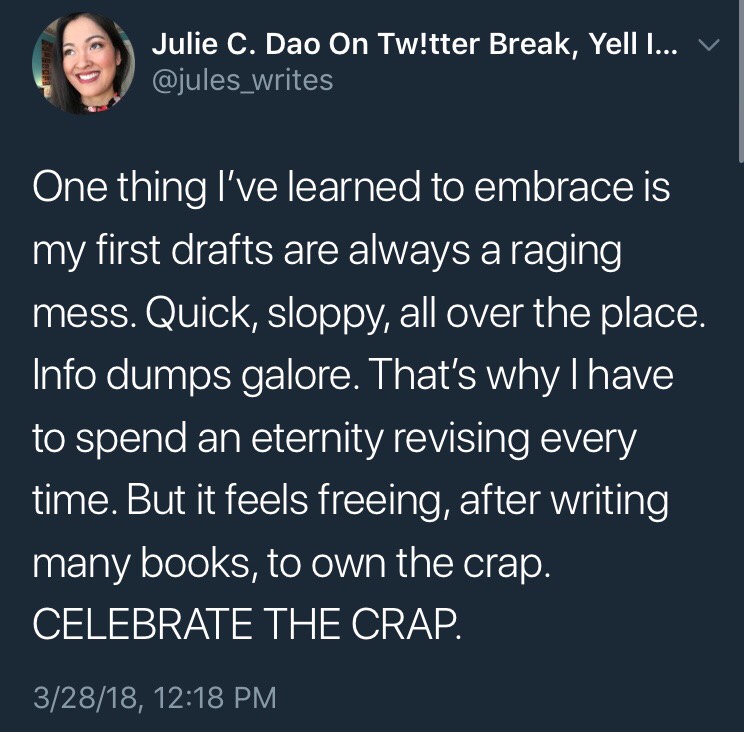
Not all first drafts are alike. Not even all of my first drafts are alike. Some are..draftier, for lack of a better word. Some are more polished. But they're all kinda bad.
Most of my first drafts are solid stories. My tendency to outline serves me pretty well in that way.
But this story is different.
I don't have a plan for BRUSHSTROKES in the way that I had one for CANUS. I have a couple of paragraphs of a summary and a list of the major characters. I know, sort of, where the story will eventually go. I have a pretty solid idea of what the first handful of chapters look like. And that's pretty much it.
Not having a plan has definitely made the process more stressful. There's nothing for me to look to if I get stuck or lose the thread of the story. It makes things feel messy.
Phoebe, my main character in the new MS is messy. She's complicated. And this MS requires a close perspective--BRUSHSTROKES is my first real attempt at first person narration.
I'm hoping that the lack of form, the lack of my usual structure will let me dig a little deeper into Phoebe. It'll mean more revision on the back end, I'm sure, but if I can find her voice, I think it'll be worth it.
But boy, is the process ugly. I'm trying to embrace the crap. I'm really trying.
Long term, I can't say how this experiment will work out. It's certainly let me put a lot of words on the page pretty quickly, but that might have more to do with the week off than anything. We'll see if the wordcount keeps up next week.
When's the last time you shook up your process or wrote something out of your comfort zone? How did it go? Let me know in the comments.
Sunday, March 18, 2018
Personal Narrative
2018 goals update
Books read: 21
Words on LIBRARIUM: 3000/?--5000 maximum (this is more impressive when you consider that I started this week by cutting about 200 words from the story).
It's been a hectic couple of weeks.
I've been trying for the past few months to find a different day job. Adjuncting is stressful and not particularly lucrative, and the balance between how many classes I have to teach to pay my bills and how many classes I can teach effectively...doesn't really work out in my favor. I spruced up my resume and went on the hunt for new work. I finally found it, but some of the advice that I found along the way stuck with me.
I'm in a query mindset--CANUS is so close (*so close*) to being ready to go, so I'm trying to put together a great pitch letter. I'm finding that it's really not unlike looking for a job.
Books read: 21
Words on LIBRARIUM: 3000/?--5000 maximum (this is more impressive when you consider that I started this week by cutting about 200 words from the story).
It's been a hectic couple of weeks.
I've been trying for the past few months to find a different day job. Adjuncting is stressful and not particularly lucrative, and the balance between how many classes I have to teach to pay my bills and how many classes I can teach effectively...doesn't really work out in my favor. I spruced up my resume and went on the hunt for new work. I finally found it, but some of the advice that I found along the way stuck with me.
I'm in a query mindset--CANUS is so close (*so close*) to being ready to go, so I'm trying to put together a great pitch letter. I'm finding that it's really not unlike looking for a job.
The specific piece of advice that's sticking with me is this: your resume should tell a story. Whatever your work has been, you should be able to frame your work history as a story of what you want to achieve and how you hope to achieve it.
This is... complicated.
My work history doesn't make a lot of sense. I've gone from radio and television, to academics, to administration without much of a plan. I don't know what I want to be when I grow up. Well, I do, but there's not really a set path that leads to "financially independent author." My strategy has always sort of been "do what I have to so I can do what I want to." Helpful for keeping up with writing, but not great for presenting as a purposeful narrative to a potential employer.
You find ways, though. Tying something you witnessed in radio and TV to an academic curiosity; demonstrating the way that teaching experiences prepare you to deal with deadlines and crises in administrating. But it takes some mental acrobatics.
One of the elements in a query is the bio: just a few sentences that give the agent a sense of who you are, what you'd be like to work with, and what business you have telling this particular story.
It's that last part that trips me up--for the same reason as the "your resume should be a narrative" advice. CANUS takes place in the distant future. And in space. With alien species. How can I draw a line from that to my teaching job? How does my experience make me "uniquely qualified" to tell this particular story?
I get why it's important, obviously. You bring yourself to every story that you write. Who you are and what you've experienced shape what stories you tell and how you tell them. But those lines can be tough to draw. Especially when you're writing genre fiction.
There's nothing in my work history that ties to space travel, and I've never met an alien species. But I have studied the way that economic relationships shape power structures. I've studied the ways that access to particular technologies can change daily life and who gets the final say in a conversation over the direction of resources. I've studied relationships between colonized and colonizers. And all of that comes with me to my story, my world, and my characters.
Sometimes it's hard to see how the threads of your own story tie together--even when you spend a considerable amount of your time weaving together the stories of others. But once you see the connection, you can point it out to others. And you can go into your own work knowing why you should tell the story; what you can give that someone else can't.
Sunday, February 25, 2018
Contests and a Giveaway
2018 Goal Update
Chapters left to revise: NONE! The MS is now with test readers.
Books read: 16
Words on LIBRARIUM: 1800
Words on WD Contest story: 200
I've managed to complete one of my goals for the year. It's been about a five month process, but this round of revisions for my manuscript is complete. As I told the two readers who are looking over the book for me now, I hate it again, so it's time to put it in someone else's hands.
With that big goal complete, it's time to work on other things. I'm hesitant to devote too much time to my Librarium story before the first round of feedback from the writing group, and I don't want to dive into BRUSHSTROKES until the semester ends and I can give it full focus. So, I thought I'd take a swing at one of my other goals--enter a writing contest.
To say that I've never entered a writing contest wouldn't be entirely accurate. My school district ran a yearly arts competition with a creative writing category. I placed a couple of times in elementary school. I entered a poetry contest at my junior high when I was in ninth grade. That one I won. There's a plaque in the school with my name on it and everything.
But that's really it as far as competition goes.
I don't really have a good explanation for what's stopped me from entering contests. I mean, imposter syndrome is the easy answer: deep down, I don't think I'm a real writer or a talented one, so I don't enter contests because losing one would give weight to those insecurities. But honestly, the same thing could be said about submitting work for publication--rejections aren't exactly great for self-esteem, either. I pitch to publishers and query agents pretty regularly (and get a fair share of rejections).
Maybe it's the winning thing that gets me? With pitches and queries, I'm not really being assessed in comparison. The agent or publisher looks at the work and decides if they want it pretty much independent of what other writers are doing. A contest, though, has a ranking system. There's a comparison.
I subscribe to the belief that comparison is the enemy of progress--I try not to compare myself to anyone other than the writer I was yesterday. It helps me keep my momentum. If I compare my work to the stuff I find on the shelves, my sense of my ability may be skewed one way or another, but I can pretty easily compare my older work and my current work and get a sense of how I've improved. A contest, though, is about that comparison. Was your story better than the others?
And I get that it's subjective. That good and great stories still lose. But my ego is fragile. I already feel like I'm faking my way through this whole writing thing. The last thing I need is something to topple my already precarious balance.
Ultimately, though, I can't get better if I don't take risks, if I'm not willing to put myself out there. So, this week, I started work on a piece for a contest. I don't know what will come of it, but I think the chance will be worthwhile.
In celebration of this risk (and of the Amazon Author Central page I finally got around to setting up), I'm giving away two copies of one of my favorite reads from 2017, This Savage Song.
 To enter, click this link and follow me on Amazon. Winners will be chosen on March 26. While you're there, check out my list of available works.
Chapters left to revise: NONE! The MS is now with test readers.
Books read: 16
Words on LIBRARIUM: 1800
Words on WD Contest story: 200
I've managed to complete one of my goals for the year. It's been about a five month process, but this round of revisions for my manuscript is complete. As I told the two readers who are looking over the book for me now, I hate it again, so it's time to put it in someone else's hands.
With that big goal complete, it's time to work on other things. I'm hesitant to devote too much time to my Librarium story before the first round of feedback from the writing group, and I don't want to dive into BRUSHSTROKES until the semester ends and I can give it full focus. So, I thought I'd take a swing at one of my other goals--enter a writing contest.
To say that I've never entered a writing contest wouldn't be entirely accurate. My school district ran a yearly arts competition with a creative writing category. I placed a couple of times in elementary school. I entered a poetry contest at my junior high when I was in ninth grade. That one I won. There's a plaque in the school with my name on it and everything.
But that's really it as far as competition goes.
I don't really have a good explanation for what's stopped me from entering contests. I mean, imposter syndrome is the easy answer: deep down, I don't think I'm a real writer or a talented one, so I don't enter contests because losing one would give weight to those insecurities. But honestly, the same thing could be said about submitting work for publication--rejections aren't exactly great for self-esteem, either. I pitch to publishers and query agents pretty regularly (and get a fair share of rejections).
Maybe it's the winning thing that gets me? With pitches and queries, I'm not really being assessed in comparison. The agent or publisher looks at the work and decides if they want it pretty much independent of what other writers are doing. A contest, though, has a ranking system. There's a comparison.
I subscribe to the belief that comparison is the enemy of progress--I try not to compare myself to anyone other than the writer I was yesterday. It helps me keep my momentum. If I compare my work to the stuff I find on the shelves, my sense of my ability may be skewed one way or another, but I can pretty easily compare my older work and my current work and get a sense of how I've improved. A contest, though, is about that comparison. Was your story better than the others?
And I get that it's subjective. That good and great stories still lose. But my ego is fragile. I already feel like I'm faking my way through this whole writing thing. The last thing I need is something to topple my already precarious balance.
Ultimately, though, I can't get better if I don't take risks, if I'm not willing to put myself out there. So, this week, I started work on a piece for a contest. I don't know what will come of it, but I think the chance will be worthwhile.
In celebration of this risk (and of the Amazon Author Central page I finally got around to setting up), I'm giving away two copies of one of my favorite reads from 2017, This Savage Song.

Sunday, January 28, 2018
Writing is Rewriting is Rewriting is Rewriting
2018 Goal Update:
Books read this year: 9
Chapters left to revise: 5
At this point, I should get "revision is taking longer than I expected" printed on a t-shirt. Life gets in the way--both for me and for my critique partner. The job that pays my bills takes up big chunks of my time and leaves me drained. I still manage to work on revisions five or six days out of seven, but the amount that I'm able to get done is a session is less than I want it to be. There is a light at the end of the tunnel. My CP has the final two chapters. More of the manuscript has been through revision than hasn't. A couple of the chapters coming up are going to require fewer major structural changes.
But it's still a slog.

Memory is a weird thing. I've written and revised projects before--novellas, novels, shorts, even my graduate thesis. I've done this before. But the process feels so new.
When it comes to my work, I remember the beginnings. The first sit-downs with an idea are tucked into my brain like photographs in a scrapbook. I remember the pitches. I remember the proofs, my last look at the piece before it's finalized. I remember the whirlwind of releases.
Revisions, though, exist as a huge black void in my memory. Which might be why this process has felt like a fresh new hell.
If I'm being fair, I've never done revisions as extensive as the ones I'm doing now. EVIN got accepted with very few changes (in hindsight, I should have held onto it longer and done more work, but the whole process was very new at the time and I was sort of flying blind). I don't typically do revisions on shorter pieces, so "Red Snow" and "Smoke" were both published looking more or less the same as they did in first draft. "Lady or the Dagger" required only some changes in blocking.
CANUS, though, is a beast. It's more complicated than previous work I've done. There are more moving pieces, more points of view, more threads to tie together. It's more ambitious. Every part of it has stretched my abilities. So it makes sense that fixing it--taking the ideas and the moments and the lines and smoothing them into an actual book--would be more complicated.
I'm getting close, I think. The first sixteen chapters are stronger than they were, and I've hope that the last five can be whipped into shape. But I have lately been thinking about the days when I thought writing was easy: come up with a cool idea and throw it on a page. Boom, done. I know now that it's not that simple; that I only thought it was because I didn't really know what I was doing.
Do I wish it was easier? Yeah, sometimes. It'd be nice to be done with the revisions, to have a gleaming manuscript to send out on query. Still, I think the struggle, the process, the work has been and continues to be worthwhile. It'll make this manuscript better. It'll make starting the next all the sweeter.
In the meantime, I have to put away the cookie dough and get off the floor. This book's not gonna fix itself.
Books read this year: 9
Chapters left to revise: 5
At this point, I should get "revision is taking longer than I expected" printed on a t-shirt. Life gets in the way--both for me and for my critique partner. The job that pays my bills takes up big chunks of my time and leaves me drained. I still manage to work on revisions five or six days out of seven, but the amount that I'm able to get done is a session is less than I want it to be. There is a light at the end of the tunnel. My CP has the final two chapters. More of the manuscript has been through revision than hasn't. A couple of the chapters coming up are going to require fewer major structural changes.
But it's still a slog.

Memory is a weird thing. I've written and revised projects before--novellas, novels, shorts, even my graduate thesis. I've done this before. But the process feels so new.
When it comes to my work, I remember the beginnings. The first sit-downs with an idea are tucked into my brain like photographs in a scrapbook. I remember the pitches. I remember the proofs, my last look at the piece before it's finalized. I remember the whirlwind of releases.
Revisions, though, exist as a huge black void in my memory. Which might be why this process has felt like a fresh new hell.
If I'm being fair, I've never done revisions as extensive as the ones I'm doing now. EVIN got accepted with very few changes (in hindsight, I should have held onto it longer and done more work, but the whole process was very new at the time and I was sort of flying blind). I don't typically do revisions on shorter pieces, so "Red Snow" and "Smoke" were both published looking more or less the same as they did in first draft. "Lady or the Dagger" required only some changes in blocking.
CANUS, though, is a beast. It's more complicated than previous work I've done. There are more moving pieces, more points of view, more threads to tie together. It's more ambitious. Every part of it has stretched my abilities. So it makes sense that fixing it--taking the ideas and the moments and the lines and smoothing them into an actual book--would be more complicated.
 |
| Revision notes for chapters 16 and 17--zoomed out because spoilers |
I'm getting close, I think. The first sixteen chapters are stronger than they were, and I've hope that the last five can be whipped into shape. But I have lately been thinking about the days when I thought writing was easy: come up with a cool idea and throw it on a page. Boom, done. I know now that it's not that simple; that I only thought it was because I didn't really know what I was doing.
Do I wish it was easier? Yeah, sometimes. It'd be nice to be done with the revisions, to have a gleaming manuscript to send out on query. Still, I think the struggle, the process, the work has been and continues to be worthwhile. It'll make this manuscript better. It'll make starting the next all the sweeter.
In the meantime, I have to put away the cookie dough and get off the floor. This book's not gonna fix itself.
Monday, December 18, 2017
Reflection
This year has been a strange one for writing. In 2017, my workload at my three day jobs was heavier than it has ever been-- teaching six courses across three campuses is no joke. Some health issues that had been pretty well in hand flared up worse than they ever have. And the general social-political climate has been a dumpster fire. I laid plans for what I wanted to accomplish this year, but most of them have had to be set aside or reworked, for better or worse.
But, even amid the chaos, 2017 has been a productive year. My single shot "Smoke Gets In Your Eyes" finally hit digital shelves. My Mata Hari short story got picked up for an anthology, and final proofs are in. I sold a 20k word novella to a publisher, and it should be out sometime in 2018. MY writing group published our short story anthology. Most of these things weren't part of the plan, but I'm chalking them up as successes anyway.
If I really sit and think about it, I probably made at least as much progress this year as last year. I got words on the page and honed my revision skills. I (mostly) kept writing a habit--not writing every day, but writing more days than not, which is in the end the best I can ask for considering my schedule. I finished the things I started. I met my deadlines, if only just. But 2017's progress looks very different from 2016's.
Last year was all about getting a novel first draft to completion. The words that I put down in 2016 were all aimed at getting a solid draft one of Project 2016 pinned down. This year has lacked that single-minded focus, at least until the last couple of months. I suppose 2017 was an exploration in shorter fiction. Most of this year's output was on the shorter end. I completed three projects this year: the 20K novella, the 12K Mata Hari story, and the 5K story for the writing group anthology--this compared to the 85K of words initially written for Project 2016 last year.
It exercises a different part of my brain to write shorter fiction. I'm able to be a little more experimental. Even though I still like going in with a plan, I usually don't have solid outlines for shorter work. I take my pitch and pin down a few specific plot points or set pieces from there and pants my way through. More often than not, I end up having to go in a direction that I didn't anticipate (usually because I forgot to include some aspect from the pitch until way late). This practice in rolling with the punches has been helpful in the Project 2016 revision process--but more on that later.
This year also marks the first time I've written characters that I didn't create--outside of fanfiction, that is. It's an interesting challenge to mold how you approach a character to the expectations of someone else. I'm not sure I always did it successfully, but writing with a set of restraints has made me more aware of how well I'm sticking to the established code for a character.
I wrote some new work this year, but if I really had to say what the biggest writing challenge for 2017 has been, I'd say it was revision. Project 2016 has seen a pretty serious overhaul this year, starting in October after a first-ten-pages review through Manuscript Academy (I cannot recommend this site enough--I've gotten so much valuable insight through using it). This led to a restructuring of chapter 1, which led me to seek out a critique partner. Author Wendy Heard manages a great service for writers seeking a critique partner: someone with a similar level of experience who writes in similar categories who will look through your entire manuscript to help you figure out what aspects need fixing. You just fill out the google form in the link above, and she and her partners find a match for you. I found a great CP through this (shout out to Colleen!) who's helped me make Project 2016 a stronger piece.
I'm not new to revising. This isn't even close to the first round of revisions that Project 2016 has been through. But where I've struggled in the past is the depth of revisions. I'm really good at making cosmetic changes--adding a new coat of paint, essentially. Most of the time, though, the revisions that I really need to make are more structural--not just sprucing up the surface, but changing something in the foundation. That roll-with-the-punches skill I talked about developing with short fiction has been essential here. There have been sections that have had to undergo blank-page rewrites: I've had to scrap whole scenes, sometimes whole chapters, and write them again from scratch. It's the hardest work I've ever done, and I'm not always happy about doing it, but there's no arguing with the results.
I've also figured out my process for dealing with critique. It's a weird thing--I know my work isn't perfect. I even know that it has serious flaws in some places. But I don't like someone pointing the flaws out, even though that's the whole point of having a critique partner. I've gotten really upset about some of the revisions that have been suggested. I've griped and moaned and complained. And then I've soldiered on.
What usually happens is that I take an initial look at the comments. I get mad and huffy. I complain. But I don't cross any of the comments out. I leave them and come back, usually after a day or two. Then I'm able to take a step back and ask some questions. Did I bump against this because I don't want to do all the work it would require? Did my CP miss a small item earlier in the chapter/story and how much of that is quick reading or gaps between seeing chapters and how much of it is a hint that I didn't drop well enough? Does this comment indicate that I didn't describe what was going on with a character well enough? Does this suggestion go against the planned thread of the story, and does that suggest that I didn't set up something well enough earlier?
More often than not, I end up making the suggested changes, at least in part. One of my most common conclusions is something like, "Yeah, okay, this is a problem, but that's not the solution I want to go with." It's been a lot of work. A LOT of work, and I'm just over halfway done. But the work's been worth it. When I sent in my first 50 pages for an agent critique, the comments were overwhelmingly positive. Even if they did lead to (another) rewrite of chapter 1.
I feel like I've done so much work this year, but it also seems like I've had less to show for it. In 2016, my first novel was published, and it was a big deal. I've seen two projects through to publication in 2017, and I'm relatively proud of both--I'd argue that both are better written than my first novel, at least. But I've watched some of my fellow writers outpace me, publish two or three books in the time it's taken me to get to a point where I'm ready to move forward with this one. It's not a race, I know, and my work will ultimately benefit from the time I've taken with it. Still, 2017 has left me feeling a little stuck in the mud.
The year's almost over, and there's still work to be done. I hope to be query-ready in early 2018. Once Project 2016 is querying, I'm ready to start something new. I'd like to finish an alpha draft of my next book in 2018, and I know I'll have a few shorter pieces that'll need writing. Maybe next year I'll be able to find a better balance. Either way, the writing's not done. It never will be.
But, even amid the chaos, 2017 has been a productive year. My single shot "Smoke Gets In Your Eyes" finally hit digital shelves. My Mata Hari short story got picked up for an anthology, and final proofs are in. I sold a 20k word novella to a publisher, and it should be out sometime in 2018. MY writing group published our short story anthology. Most of these things weren't part of the plan, but I'm chalking them up as successes anyway.
If I really sit and think about it, I probably made at least as much progress this year as last year. I got words on the page and honed my revision skills. I (mostly) kept writing a habit--not writing every day, but writing more days than not, which is in the end the best I can ask for considering my schedule. I finished the things I started. I met my deadlines, if only just. But 2017's progress looks very different from 2016's.
Last year was all about getting a novel first draft to completion. The words that I put down in 2016 were all aimed at getting a solid draft one of Project 2016 pinned down. This year has lacked that single-minded focus, at least until the last couple of months. I suppose 2017 was an exploration in shorter fiction. Most of this year's output was on the shorter end. I completed three projects this year: the 20K novella, the 12K Mata Hari story, and the 5K story for the writing group anthology--this compared to the 85K of words initially written for Project 2016 last year.
It exercises a different part of my brain to write shorter fiction. I'm able to be a little more experimental. Even though I still like going in with a plan, I usually don't have solid outlines for shorter work. I take my pitch and pin down a few specific plot points or set pieces from there and pants my way through. More often than not, I end up having to go in a direction that I didn't anticipate (usually because I forgot to include some aspect from the pitch until way late). This practice in rolling with the punches has been helpful in the Project 2016 revision process--but more on that later.
This year also marks the first time I've written characters that I didn't create--outside of fanfiction, that is. It's an interesting challenge to mold how you approach a character to the expectations of someone else. I'm not sure I always did it successfully, but writing with a set of restraints has made me more aware of how well I'm sticking to the established code for a character.
I wrote some new work this year, but if I really had to say what the biggest writing challenge for 2017 has been, I'd say it was revision. Project 2016 has seen a pretty serious overhaul this year, starting in October after a first-ten-pages review through Manuscript Academy (I cannot recommend this site enough--I've gotten so much valuable insight through using it). This led to a restructuring of chapter 1, which led me to seek out a critique partner. Author Wendy Heard manages a great service for writers seeking a critique partner: someone with a similar level of experience who writes in similar categories who will look through your entire manuscript to help you figure out what aspects need fixing. You just fill out the google form in the link above, and she and her partners find a match for you. I found a great CP through this (shout out to Colleen!) who's helped me make Project 2016 a stronger piece.
I'm not new to revising. This isn't even close to the first round of revisions that Project 2016 has been through. But where I've struggled in the past is the depth of revisions. I'm really good at making cosmetic changes--adding a new coat of paint, essentially. Most of the time, though, the revisions that I really need to make are more structural--not just sprucing up the surface, but changing something in the foundation. That roll-with-the-punches skill I talked about developing with short fiction has been essential here. There have been sections that have had to undergo blank-page rewrites: I've had to scrap whole scenes, sometimes whole chapters, and write them again from scratch. It's the hardest work I've ever done, and I'm not always happy about doing it, but there's no arguing with the results.
I've also figured out my process for dealing with critique. It's a weird thing--I know my work isn't perfect. I even know that it has serious flaws in some places. But I don't like someone pointing the flaws out, even though that's the whole point of having a critique partner. I've gotten really upset about some of the revisions that have been suggested. I've griped and moaned and complained. And then I've soldiered on.
What usually happens is that I take an initial look at the comments. I get mad and huffy. I complain. But I don't cross any of the comments out. I leave them and come back, usually after a day or two. Then I'm able to take a step back and ask some questions. Did I bump against this because I don't want to do all the work it would require? Did my CP miss a small item earlier in the chapter/story and how much of that is quick reading or gaps between seeing chapters and how much of it is a hint that I didn't drop well enough? Does this comment indicate that I didn't describe what was going on with a character well enough? Does this suggestion go against the planned thread of the story, and does that suggest that I didn't set up something well enough earlier?
More often than not, I end up making the suggested changes, at least in part. One of my most common conclusions is something like, "Yeah, okay, this is a problem, but that's not the solution I want to go with." It's been a lot of work. A LOT of work, and I'm just over halfway done. But the work's been worth it. When I sent in my first 50 pages for an agent critique, the comments were overwhelmingly positive. Even if they did lead to (another) rewrite of chapter 1.
I feel like I've done so much work this year, but it also seems like I've had less to show for it. In 2016, my first novel was published, and it was a big deal. I've seen two projects through to publication in 2017, and I'm relatively proud of both--I'd argue that both are better written than my first novel, at least. But I've watched some of my fellow writers outpace me, publish two or three books in the time it's taken me to get to a point where I'm ready to move forward with this one. It's not a race, I know, and my work will ultimately benefit from the time I've taken with it. Still, 2017 has left me feeling a little stuck in the mud.
The year's almost over, and there's still work to be done. I hope to be query-ready in early 2018. Once Project 2016 is querying, I'm ready to start something new. I'd like to finish an alpha draft of my next book in 2018, and I know I'll have a few shorter pieces that'll need writing. Maybe next year I'll be able to find a better balance. Either way, the writing's not done. It never will be.
Sunday, November 5, 2017
Radio Silence
November is my least favorite month of the year. The days get shorter, so my mood loses its buoyancy. End-of-semester fatigue drags me down. A few painful anniversaries steal my energy.
In spite of all that, November is usually my most productive writing month. One of my coping mechanisms is to throw myself into work. This isn't always healthy, necessarily, but it does let me get shit done. And I'm in a position now where I really need to get shit done.
I'm a little behind on my writing goals for the year. I wanted to have my contract novella wrapped up by now. I wanted to be through revisions for the first book of project 2016. I wanted to be well on my way to a completed first draft of my next manuscript. I'm not there yet on any of those goals.
Not being where I want to be always gets my imposter syndrome working overtime, telling me that I'm not where I need to be--that I'll never be where I need to be.
It's easy to forget that I was here last year, too: behind on my goals, floundering to finish the fist draft of a project for myself and to get the work done on projects for other people.
I've managed before. I'll be able to manage again.
But it will mean have to rearrange my priorities.
This blog is important to me. It represents my personal commitment to my writing--a promise that I'm going to treat writing as a job, as a commitment rather than just working "when I feel like it." It's also the longest I've ever blogged with any kind of regularity. This weekly commitment is part of how I've kept my writing work habitual.
I'm at a point right now, though, where I need to use the time I spend on this blog doing other things. I love writing these posts, but I'm not gonna get paid if I don't finish my projects.
So, Practice and Procrastination is going to go silent for a while. Not long--hopefully only through the month of November, but possibly until the end of the semester in the middle of December.
I've still got a couple of interviews and guest posts pending. If those come along during my break, I'll get them posted. Otherwise, I've got to be in the writing/editing cave until I get the work done.
If you start to really miss me during the break, you can always find me elsewhere on the internet. My website will still be updated with appearances and announcements (I've got a couple of projects that should be seeing the light of day in the next few months), I'll pop by the Facebook page and Twitter now and then, and you can find some updates (and lots of cat and dog pictures) on my instagram.
Thanks for sticking with me. See you in December.
In spite of all that, November is usually my most productive writing month. One of my coping mechanisms is to throw myself into work. This isn't always healthy, necessarily, but it does let me get shit done. And I'm in a position now where I really need to get shit done.
I'm a little behind on my writing goals for the year. I wanted to have my contract novella wrapped up by now. I wanted to be through revisions for the first book of project 2016. I wanted to be well on my way to a completed first draft of my next manuscript. I'm not there yet on any of those goals.
Not being where I want to be always gets my imposter syndrome working overtime, telling me that I'm not where I need to be--that I'll never be where I need to be.
It's easy to forget that I was here last year, too: behind on my goals, floundering to finish the fist draft of a project for myself and to get the work done on projects for other people.
I've managed before. I'll be able to manage again.
But it will mean have to rearrange my priorities.
This blog is important to me. It represents my personal commitment to my writing--a promise that I'm going to treat writing as a job, as a commitment rather than just working "when I feel like it." It's also the longest I've ever blogged with any kind of regularity. This weekly commitment is part of how I've kept my writing work habitual.
I'm at a point right now, though, where I need to use the time I spend on this blog doing other things. I love writing these posts, but I'm not gonna get paid if I don't finish my projects.
So, Practice and Procrastination is going to go silent for a while. Not long--hopefully only through the month of November, but possibly until the end of the semester in the middle of December.
I've still got a couple of interviews and guest posts pending. If those come along during my break, I'll get them posted. Otherwise, I've got to be in the writing/editing cave until I get the work done.
If you start to really miss me during the break, you can always find me elsewhere on the internet. My website will still be updated with appearances and announcements (I've got a couple of projects that should be seeing the light of day in the next few months), I'll pop by the Facebook page and Twitter now and then, and you can find some updates (and lots of cat and dog pictures) on my instagram.
Thanks for sticking with me. See you in December.
Sunday, August 27, 2017
Tough Advice
Over the past year, I've focused my energy on my writing. I picked a lane. My limited free time is devoted finding resources on the publishing industry, learning more about the craft of writing, and actually getting words on the page.
When it comes to my writing, I'm generally optimistic--or at least tenacious. I know this is what I want, and I know how much work goes into it (or at least, as much as someone with my level of experience can). But now and then the advice and the information bog me down.
The thing I've been bumping against recently is the advice that a writer's space needs to be sacred.
There's nothing wrong with this advice, really. There's something to be said for ritualizing the writing process. Building a habit makes it easier to keep in the swing of things. Turning writing into a habit has certainly increased my word output this past year--and the practice has increased the quality of my work. Still, though, something about this advice always rubs me the wrong way.
The advice about making a writer's space sacred usually goes something like this: a writer needs a specific space set aside for their work. This space needs to be theirs, a place where they can set up and organize without having to pick it up at the end of every writing session. The members of the writer's family need to respect this space. It needs to have a door. To be a retreat for the writer.
All of that sounds great. It really does. I would love to have a writing nook, a place where I can shut out the rest of the noise of the house and focus or read my work aloud (which sounds dumb but is the best way to catch something that's not working).
That's not feasible for me. The physical space of my home and the number of residents in it doesn't allow for a specific writing space, at least not in its current condition--and it's current condition has been the same more or less since we moved in.
I write where I can--usually at the kitchen table or on the couch. And it works for me--it's not ideal, but I get the work done. Not having a writing space set aside specifically for my work doesn't keep me from working. Nor should it, not if I'm really dedicated to writing. I know that this advice is a suggestion, not a rule, as most advice about writing is.
But damn, does not being able to follow it make me feel like a fake.
It's a stupid little thing, but sometimes writing advice like this gets at me. The advice is well-intentioned, and it's good advice for the people who can follow it. Sometimes, though, it can feel like one more thing that's keeping me from being a "real" writer.
A lot of this kind of advice--stuff like having a specific, private space or having a set time for writing or traveling or paying for conferences and meet ups--comes from people with a different set of experiences. For them, it's probably a simple--or at least simpler thing to set a side the space or time or money. For me, it's not. But that doesn't mean that I can't do some of those things. That I can't adapt and make things work. That I can't get the work done. It still gets in my head.
It can feel like there's a checklist for being a writer that I can't complete. Imposter syndrome is an on-going battle. And I see enough posts and comments from established authors that are variations of "I still don't feel like I know what I'm doing" to know that this is normal. I'm able to keep going--more importantly, I want to--need to--keep going.
This kind of advice that I can't follow isn't going to stop me. But, you know, maybe think twice before telling me to create my own sacred writing space.
When it comes to my writing, I'm generally optimistic--or at least tenacious. I know this is what I want, and I know how much work goes into it (or at least, as much as someone with my level of experience can). But now and then the advice and the information bog me down.
The thing I've been bumping against recently is the advice that a writer's space needs to be sacred.
There's nothing wrong with this advice, really. There's something to be said for ritualizing the writing process. Building a habit makes it easier to keep in the swing of things. Turning writing into a habit has certainly increased my word output this past year--and the practice has increased the quality of my work. Still, though, something about this advice always rubs me the wrong way.
The advice about making a writer's space sacred usually goes something like this: a writer needs a specific space set aside for their work. This space needs to be theirs, a place where they can set up and organize without having to pick it up at the end of every writing session. The members of the writer's family need to respect this space. It needs to have a door. To be a retreat for the writer.
 |
| Behold, the Writer's Lair--birthplace of fiction. |
That's not feasible for me. The physical space of my home and the number of residents in it doesn't allow for a specific writing space, at least not in its current condition--and it's current condition has been the same more or less since we moved in.
I write where I can--usually at the kitchen table or on the couch. And it works for me--it's not ideal, but I get the work done. Not having a writing space set aside specifically for my work doesn't keep me from working. Nor should it, not if I'm really dedicated to writing. I know that this advice is a suggestion, not a rule, as most advice about writing is.
But damn, does not being able to follow it make me feel like a fake.
It's a stupid little thing, but sometimes writing advice like this gets at me. The advice is well-intentioned, and it's good advice for the people who can follow it. Sometimes, though, it can feel like one more thing that's keeping me from being a "real" writer.
A lot of this kind of advice--stuff like having a specific, private space or having a set time for writing or traveling or paying for conferences and meet ups--comes from people with a different set of experiences. For them, it's probably a simple--or at least simpler thing to set a side the space or time or money. For me, it's not. But that doesn't mean that I can't do some of those things. That I can't adapt and make things work. That I can't get the work done. It still gets in my head.
It can feel like there's a checklist for being a writer that I can't complete. Imposter syndrome is an on-going battle. And I see enough posts and comments from established authors that are variations of "I still don't feel like I know what I'm doing" to know that this is normal. I'm able to keep going--more importantly, I want to--need to--keep going.
This kind of advice that I can't follow isn't going to stop me. But, you know, maybe think twice before telling me to create my own sacred writing space.
Sunday, June 25, 2017
Schedule
I have been really bad at keeping up with my schedule this summer.
I guess that's not really surprising. During the school year, my days are highly regimented. My time is so limited that, if I want to get anything done at all, I have to carve out a specific time to spend on each task. The level of "get up and go" I have in me doesn't matter all that much, because the schedule itself is unforgiving. My 300 or so students don't care so much about my energy level or about the fact that there are so many of them--they want their grades; they need me to lead class. So I do. And I jealously guard the time I have for my writing--for the work that I love.
But things are different in the summer. I'm still working. I have one class that I'm leading over the summer--but it's one class of 16 compared to six classes of 40 plus.
This opens up so much time. At the start of the summer, I had the best intentions. I'd spend my days writing--wrap up a short story for a local anthology, start re-drafting the second book in my trilogy, outline book three, spruce up my submission packet, and send out new queries. I'd prewrite and schedule blog posts to give me more time on the weekends. I'd use my mornings for marketing work for Evin and "Smoke," and my afternoons for new projects. And I've done some of these things: a couple of interviews and guest posts on other blogs, a promotion through IWIC, some query refining and some new submissions. I've got about 600 words on the anthology project, which is turning out to be more of a struggle than I'd anticipated.
But by and large, I've not kept up with my schedule. I've had to fight to pull myself out of bed most mornings, and by the time I do, the time that I planned to spend working is half gone. So, rather than work, I loaf around. I promise myself that I'll work in the afternoon. And I do, about two thirds of the time, but lost days are much less infrequent now than they usually are.
Some of this might just be recovery. My schedule this spring was unforgiving. My three jobs are technically all part-time, but when you add it all together, my work weeks were well over 40 hours, and that's before we get to the hours spent working on Canus and other parts of project 2016. In the past year and a half, I've treated writing as another job--one I love, but one that requires a lot of work and a sizable time commitment. I'm still getting things done, though the pace has slowed down. Maybe a few lazy days in a week during the only time of year when lazy days are an option isn't such a bad thing. And I've been able (willing?) to take the time to read both in and out of my genre, which is both relaxing and helpful in terms of improving and focusing my own writing.
But it makes me feel miserable. I feel like every moment that I'm not working is a wasted one. If I were a real, serious writer, I'd me making use of every minute of this time (I guess that Daily Beast article got to me more than I thought--though I still think the piece was misguided and ultimately harmful).
There has to be a balance. I can't procrastinate--there's too much to do, and by mid-August, the time I'll be able to devote to it will be limited. But I also can't beat myself up every time I take a break, and I shouldn't fault myself for trying to relax a little during a time when I've got a lighter load to carry. Figuring out how my process has to work in these different circumstances is a struggle, but if I can manage to find the sweet spot between productivity and rest, this could be a great time.
I guess that's not really surprising. During the school year, my days are highly regimented. My time is so limited that, if I want to get anything done at all, I have to carve out a specific time to spend on each task. The level of "get up and go" I have in me doesn't matter all that much, because the schedule itself is unforgiving. My 300 or so students don't care so much about my energy level or about the fact that there are so many of them--they want their grades; they need me to lead class. So I do. And I jealously guard the time I have for my writing--for the work that I love.
But things are different in the summer. I'm still working. I have one class that I'm leading over the summer--but it's one class of 16 compared to six classes of 40 plus.
This opens up so much time. At the start of the summer, I had the best intentions. I'd spend my days writing--wrap up a short story for a local anthology, start re-drafting the second book in my trilogy, outline book three, spruce up my submission packet, and send out new queries. I'd prewrite and schedule blog posts to give me more time on the weekends. I'd use my mornings for marketing work for Evin and "Smoke," and my afternoons for new projects. And I've done some of these things: a couple of interviews and guest posts on other blogs, a promotion through IWIC, some query refining and some new submissions. I've got about 600 words on the anthology project, which is turning out to be more of a struggle than I'd anticipated.
But by and large, I've not kept up with my schedule. I've had to fight to pull myself out of bed most mornings, and by the time I do, the time that I planned to spend working is half gone. So, rather than work, I loaf around. I promise myself that I'll work in the afternoon. And I do, about two thirds of the time, but lost days are much less infrequent now than they usually are.
Some of this might just be recovery. My schedule this spring was unforgiving. My three jobs are technically all part-time, but when you add it all together, my work weeks were well over 40 hours, and that's before we get to the hours spent working on Canus and other parts of project 2016. In the past year and a half, I've treated writing as another job--one I love, but one that requires a lot of work and a sizable time commitment. I'm still getting things done, though the pace has slowed down. Maybe a few lazy days in a week during the only time of year when lazy days are an option isn't such a bad thing. And I've been able (willing?) to take the time to read both in and out of my genre, which is both relaxing and helpful in terms of improving and focusing my own writing.
But it makes me feel miserable. I feel like every moment that I'm not working is a wasted one. If I were a real, serious writer, I'd me making use of every minute of this time (I guess that Daily Beast article got to me more than I thought--though I still think the piece was misguided and ultimately harmful).
There has to be a balance. I can't procrastinate--there's too much to do, and by mid-August, the time I'll be able to devote to it will be limited. But I also can't beat myself up every time I take a break, and I shouldn't fault myself for trying to relax a little during a time when I've got a lighter load to carry. Figuring out how my process has to work in these different circumstances is a struggle, but if I can manage to find the sweet spot between productivity and rest, this could be a great time.
Monday, June 12, 2017
Team Building
A few weeks ago, there was a Daily Beast article that made the rounds on creative Twitter. I'm not going to name names, but this is what I typed into Google when I was trying to find when it was published.


The part of the article that bothered me--the part that convinced me to write this post--was the part where the author said that he hated other writers.
I'm not paraphrasing there. "What is certain is that on that same day [when I start writing my novel], whichever one it is, one thousand other people will start their novels. In order to publish mine, it has to be better than theirs. So, forgive me—I pretty much hate them."
I had two initial reactions to this statement.
1. Yikes.
2. That's the most self-sabotaging thing I've every heard.
The article's author isn't wrong on one point: thousands of people do start writing novels, and plenty of them don't finish. But where this goes awry is with the creation of this needless sense of competition. It flat out doesn't make sense. From a reader's point of view, reading one good book doesn't stop me from reading another. That I read one person's book doesn't mean that I won't read someone else's. In fact, good books usually make me hungry for more books. Someone else's success doesn't hurt your own chances, because it's not like there's a finite number of books that will be read. People will keep reading new books as long as there are new books to read.
From a writer's standpoint, I can't imagine viewing everyone else who's trying to write a novel as my enemy in no small part because working with and building friendships with other writers has been one of the biggest factors in my growth as a writer. I've written a couple of times about some of the ways that other writers have helped me. With longer projects, there's always a point where I can no longer see the forest for the trees, and there's nothing better than having another person who's familiar with storycraft to take a peek and see where things might have gone off the rails. Apart from reading and critiquing with writer friends, I've also found my local writer's group to be a boon.
It's not just about having someone else look through your work to help you improve it. Reading and critiquing others' work helps you figure out where some of the common pitfalls are (pretty much all of us in my local group have a hard time with beginning hooks, for example).
And other writers have different experiences. If I want to write a story with a military setting, I know three or four writers off the top of my head that I can go to for advice. I'm not limited to pulling from my knowledge and experience--there are other people who know how stories work who can help me cut through the material I find in research.
On top of that, there's value in listening to people with varying levels of publication experience. I can talk queries with people who've had success. I can hash out the costs and benefits of self-publication with people who have tried it out. I can compare experiences with small presses to find the best fits for my work. Being able to talk shop with other writers has encouraged me to try new things with my process. And some of those new things have made me a better writer than I ever would have been on my own.
Other writers aren't--and shouldn't be--the enemy. For me, writing has always been about community. Yeah, I do a lot of work by myself, but I rely on others that are in the trenches with me.
I guess what I'm saying is: if you want to write, do it. But don't view other writers as your competition--view them as a resource. They're people you can learn from and people you can teach. And that is what's great about it.

Look, there are a lot of issues with this article. Most attention has been given to taking apart the premise that someone who isn't writing everyday should just hang it up and stop trying. I don't intend to retread that ground too much. Yes, having a writing habit is important--for me, it's crucial--but everyone works in different ways, and as long as you're getting the work done, it ultimately doesn't matter if you're writing every day or a few days a month.
There were a lot of smart people who gave some pretty excellent takes on that aspect of the article. Literary agent and blogger Eric Smith (who I had the pleasure of seeing at ALAWW back in February) gave one of my favorites.

The part of the article that bothered me--the part that convinced me to write this post--was the part where the author said that he hated other writers.
I'm not paraphrasing there. "What is certain is that on that same day [when I start writing my novel], whichever one it is, one thousand other people will start their novels. In order to publish mine, it has to be better than theirs. So, forgive me—I pretty much hate them."
1. Yikes.
2. That's the most self-sabotaging thing I've every heard.
The article's author isn't wrong on one point: thousands of people do start writing novels, and plenty of them don't finish. But where this goes awry is with the creation of this needless sense of competition. It flat out doesn't make sense. From a reader's point of view, reading one good book doesn't stop me from reading another. That I read one person's book doesn't mean that I won't read someone else's. In fact, good books usually make me hungry for more books. Someone else's success doesn't hurt your own chances, because it's not like there's a finite number of books that will be read. People will keep reading new books as long as there are new books to read.
From a writer's standpoint, I can't imagine viewing everyone else who's trying to write a novel as my enemy in no small part because working with and building friendships with other writers has been one of the biggest factors in my growth as a writer. I've written a couple of times about some of the ways that other writers have helped me. With longer projects, there's always a point where I can no longer see the forest for the trees, and there's nothing better than having another person who's familiar with storycraft to take a peek and see where things might have gone off the rails. Apart from reading and critiquing with writer friends, I've also found my local writer's group to be a boon.
It's not just about having someone else look through your work to help you improve it. Reading and critiquing others' work helps you figure out where some of the common pitfalls are (pretty much all of us in my local group have a hard time with beginning hooks, for example).
And other writers have different experiences. If I want to write a story with a military setting, I know three or four writers off the top of my head that I can go to for advice. I'm not limited to pulling from my knowledge and experience--there are other people who know how stories work who can help me cut through the material I find in research.
On top of that, there's value in listening to people with varying levels of publication experience. I can talk queries with people who've had success. I can hash out the costs and benefits of self-publication with people who have tried it out. I can compare experiences with small presses to find the best fits for my work. Being able to talk shop with other writers has encouraged me to try new things with my process. And some of those new things have made me a better writer than I ever would have been on my own.
Other writers aren't--and shouldn't be--the enemy. For me, writing has always been about community. Yeah, I do a lot of work by myself, but I rely on others that are in the trenches with me.
I guess what I'm saying is: if you want to write, do it. But don't view other writers as your competition--view them as a resource. They're people you can learn from and people you can teach. And that is what's great about it.
Monday, May 15, 2017
Cafe Diem
I have an unusual amount of free time right now. The Spring semester ended last week, and Summer term doesn't start for another week. I wrapped up my story for the Mata Hari anthology and even finished up the first round of edits. There aren't any friends or family visiting from out of town at the moment. Where I normally only have a few hours a night to work on my writing, I've now got full days.
It's great, and I'm getting things done. But I've definitely been going a little stir crazy.
While I love spending time with my cats and dog, and working from home is a great option, considering how anxious I get in even the most benign social situations, even I can only stay at the house so long. By late last week, I needed to get out.
Though I wanted to get out of the house, I didn't want to give up my working time. So, I decided to camp out at a coffee shop for a few hours--a place with lots of windows, an outside seating option, and a staff that wouldn't be concerned about a patron claiming a table for an undetermined length of time, since so much of the traffic is drive through or carry out.
 Not pictured: The guy that didn't understand that my headphones meant I was not interested in a conversation.
There are all manner of sneering stereotypes about people that write in cafes. It's not something I've done much of, myself. It's always struck me as a little performative, and my imposter syndrome is generally unwilling to let me perform the role of writer in public--at least, outside of times when I've been invited to. And being a woman in a public place comes with the burden of being assumed to be available for chit chat. Even if you're clearly working on something. And have headphones in.
But I wanted a change of pace. Not just to look at something other than my house's walls, but also to shake loose some of the blocks I've had. The last few problems that I'm trying to patch up in Project 2016 have proven to be somewhat difficult to untangle. I'd hoped that changing my setting might shake things up enough to reveal new avenues.
And it did help a bit. I've been able to work out some of the major issues, and I have the beginnings of new solutions for most of the rest. I managed a blank-page rewrite of the center of a chapter that's been giving me trouble since the beginning, and now the sequence of events makes more sense. I've been able to trim some fat from a few chapters so that I can add in more important bits of story. I visited the cafe twice last week, and did some good work both times.
But I'm not sure I want to make a habit, however temporary, of cafe writing.
I can see the appeal, in some ways. There is something about a cafe setting that sharpens the brain (or at least my brain). And if you get stuck, there are goodies--never underestimate the power of goodies. If you're the type that gets energized by being around other people, it's a great workspace.
All that said, it doesn't really work for me. I mean, I'm all about tasty baked goods and coffee, but there are some issues. First and most obvious is the expense. Cafe coffee ain't cheap. And, if you're like me, you feel like an asshole sitting somewhere for hours after your coffee and croissant have been consumed so you buy another coffee and croissant.
And then there's the music. I went to a chain cafe, so I expected that I'd hear some pretty generic tunes--whispery-voiced indie singers and soft guitar strumming. I can work through most music, so I thought I'd be fine. The days that I went to the cafe, though, the music of the day was apparently "whales screaming."

Not exactly conducive to work. I guess some people find it relaxing?
And then there are the people. I'm sure others' mileage varies on this, but I work best when I'm allowed to do my own thing without interruptions. For most of my stay at the coffee shop, I was able to do this reasonably well. But now and then, someone tap at my shoulders to ask about the other chair at my table (and then to put it back). And once, someone asked me to move (my body, my laptop, my laptop bag, my coffee and my croissant) to another table. Worst was the man who decided that I must have come out in public to be talked to by a stranger (pro tip: if someone has headphones on, they're not interested in talking--if they're not in danger, leave them alone).
It was a good experiment. I'm glad I did it. But I don't expect that cafe writing is going to somehow become my thing.
Are any of you cafe writers? If you're not, what do you do when you want to write somewhere other than your usual office or writing nook?
It's great, and I'm getting things done. But I've definitely been going a little stir crazy.
While I love spending time with my cats and dog, and working from home is a great option, considering how anxious I get in even the most benign social situations, even I can only stay at the house so long. By late last week, I needed to get out.
Though I wanted to get out of the house, I didn't want to give up my working time. So, I decided to camp out at a coffee shop for a few hours--a place with lots of windows, an outside seating option, and a staff that wouldn't be concerned about a patron claiming a table for an undetermined length of time, since so much of the traffic is drive through or carry out.

There are all manner of sneering stereotypes about people that write in cafes. It's not something I've done much of, myself. It's always struck me as a little performative, and my imposter syndrome is generally unwilling to let me perform the role of writer in public--at least, outside of times when I've been invited to. And being a woman in a public place comes with the burden of being assumed to be available for chit chat. Even if you're clearly working on something. And have headphones in.
But I wanted a change of pace. Not just to look at something other than my house's walls, but also to shake loose some of the blocks I've had. The last few problems that I'm trying to patch up in Project 2016 have proven to be somewhat difficult to untangle. I'd hoped that changing my setting might shake things up enough to reveal new avenues.
And it did help a bit. I've been able to work out some of the major issues, and I have the beginnings of new solutions for most of the rest. I managed a blank-page rewrite of the center of a chapter that's been giving me trouble since the beginning, and now the sequence of events makes more sense. I've been able to trim some fat from a few chapters so that I can add in more important bits of story. I visited the cafe twice last week, and did some good work both times.
But I'm not sure I want to make a habit, however temporary, of cafe writing.
I can see the appeal, in some ways. There is something about a cafe setting that sharpens the brain (or at least my brain). And if you get stuck, there are goodies--never underestimate the power of goodies. If you're the type that gets energized by being around other people, it's a great workspace.
All that said, it doesn't really work for me. I mean, I'm all about tasty baked goods and coffee, but there are some issues. First and most obvious is the expense. Cafe coffee ain't cheap. And, if you're like me, you feel like an asshole sitting somewhere for hours after your coffee and croissant have been consumed so you buy another coffee and croissant.
And then there's the music. I went to a chain cafe, so I expected that I'd hear some pretty generic tunes--whispery-voiced indie singers and soft guitar strumming. I can work through most music, so I thought I'd be fine. The days that I went to the cafe, though, the music of the day was apparently "whales screaming."

Not exactly conducive to work. I guess some people find it relaxing?
And then there are the people. I'm sure others' mileage varies on this, but I work best when I'm allowed to do my own thing without interruptions. For most of my stay at the coffee shop, I was able to do this reasonably well. But now and then, someone tap at my shoulders to ask about the other chair at my table (and then to put it back). And once, someone asked me to move (my body, my laptop, my laptop bag, my coffee and my croissant) to another table. Worst was the man who decided that I must have come out in public to be talked to by a stranger (pro tip: if someone has headphones on, they're not interested in talking--if they're not in danger, leave them alone).
It was a good experiment. I'm glad I did it. But I don't expect that cafe writing is going to somehow become my thing.
Are any of you cafe writers? If you're not, what do you do when you want to write somewhere other than your usual office or writing nook?
Sunday, February 26, 2017
ALAWW
Normally my Fridays are spent in my office grading papers, doing course prep, meeting with students, and doing other generic academic grunt work.
But this week I took a day off--from academic work, at least.
As I mentioned in last week's post, I signed up for the Alabama Writing Workshop. The meeting was Friday, so I rescheduled my office hours and, instead of spending the day on campus, I spent it at a hotel in Birmingham, schmoozing with other writers and meeting industry professionals.
I'm a nervous person in general. My anxiety brain never stops coming up with potential scenarios for disaster--which can be great for writing, but is considerably less great when it comes to trying to make a good first impression. I spent a pretty significant portion of the day reminding myself that the goal was to learn more and if that was all I accomplished that would be a victory. I also spent a pretty significant portion of the day reminding myself that I had to do things like breathe and blink and maybe drink some water. My hands shook when I met new people. I tripped over my words and stuttered.
It was awesome.
As someone who's spent the better part of fifteen years trying to make something of my ambitions to write professionally and to get my stories out into the world, I went in with a solid body of background knowledge. I knew about some of the resources mention (I've actually plugged some of them in different blog posts--I'll go back through and make a full list to post soon). I had done a fair bit of the recommended prep work. But even at that, hearing the professionals name check the resources I've been using was encouraging. I frequently feel--and I imagine other writers in positions similar to mine also feel--like I'm treading water. Now, though, I've got a sense that I'm at least treading the right water.
The seminars were led by agents and editors. They dealt with topic ranging from seeking out representation for work, improving writing, making use of social media, and what happens after a book deal is signed. It was a ton of information, and I took pages of notes (and, thankfully, the speakers provided outlines and resources for their talks, so I should be able to review and find what I inevitably missed). And those were just the talks.
The session that met right after lunch was, to me, one of the most informative. It wasn't so much a talk as it was a review. Attendees were told they could bring copies of their first page (sans names, of course) and the panel of agents would read through them--or parts of them--and give critiques. Essentially, the panel members would indicate when a page lost them, when they'd stop reading. My page didn't get read (and I'm actually glad it didn't since this panel was before my scheduled pitching time), but the issues that were pointed out in the pages that were read gave me some insight into how to improve mine.
It was a fantastic insight into how quickly some of these decisions can get made--how vital a strong first page is. It was also an opportunity to learn where the mileage varied for the specific agents on the panel. When they found something that didn't work, they said why. Sometimes it was an issue with the structure, but sometimes it was more subjective. And when panel members disagreed, they said so and explained why.
To me, though, valuable as all of the sessions were, the best part was meeting in-person for a one-on-one session with an agent.
The one-on-one was an addition to the conference--an extra event with an extra fee, and each instance of the fee got one sit-down with one agent. This was another instance where my background research came in handy--adjunct pay isn't great, so I only had enough funds to sit down with one agent. I reviewed the list, checked their websites and MSWL and Publisher's Marketplace (and availability--I registered last minute, so some slots were sold out). The sit-down was a ten-minute conversation, an opportunity to do a quick elevator pitch of the project and to ask and answer questions.
I spent the whole day nervous, but this is where the butterflies got out of hand. I managed--I made it through my pitch without too much word vomit. My hands (and voice) shook the whole time, but not so much that I couldn't be understood. I lost the thread of what I was saying for a second, but I got back on track, and the conversation didn't seem to suffer for it. The agent that I spoke with really did more than politeness demanded to ease my nerves (seriously, she was the nicest person I talked to through the conference--which made pitching that much more pleasant).
I didn't walk away with an offer of representation or a full manuscript request--I didn't expect to. But I did get an invitation to send a sample of Project 2016. And, after my pitch, she asked about other projects related to Project 2016 (some of the things I said in my pitch, she said, suggested that there were more stories)--which she asked for brief pitches for in my submission packet. There are never any guarantees--she liked the idea of the story, but it's still totally possible that my writing style won't be what she's looking for or that the draft flat-out isn't strong enough. But I am so glad--so glad--that I took the chance to talk to her face to face about the project.
It's the most promising lead that I've got so far, and even if it doesn't work out, I know where the strengths and weaknesses of my pitch are better now than ever before. I've got new tools to use as I keep working.
I won't be able to do many of these conferences--again, adjunct pay leaves a lot to be desired--but if I have the chance to go to another, I think I will. If you've been working on a project and are considering a conference, I hope you go. Worst case scenario, you still win--you still come out with more than you had when you went in.
But this week I took a day off--from academic work, at least.
As I mentioned in last week's post, I signed up for the Alabama Writing Workshop. The meeting was Friday, so I rescheduled my office hours and, instead of spending the day on campus, I spent it at a hotel in Birmingham, schmoozing with other writers and meeting industry professionals.
I'm a nervous person in general. My anxiety brain never stops coming up with potential scenarios for disaster--which can be great for writing, but is considerably less great when it comes to trying to make a good first impression. I spent a pretty significant portion of the day reminding myself that the goal was to learn more and if that was all I accomplished that would be a victory. I also spent a pretty significant portion of the day reminding myself that I had to do things like breathe and blink and maybe drink some water. My hands shook when I met new people. I tripped over my words and stuttered.
It was awesome.
As someone who's spent the better part of fifteen years trying to make something of my ambitions to write professionally and to get my stories out into the world, I went in with a solid body of background knowledge. I knew about some of the resources mention (I've actually plugged some of them in different blog posts--I'll go back through and make a full list to post soon). I had done a fair bit of the recommended prep work. But even at that, hearing the professionals name check the resources I've been using was encouraging. I frequently feel--and I imagine other writers in positions similar to mine also feel--like I'm treading water. Now, though, I've got a sense that I'm at least treading the right water.
The seminars were led by agents and editors. They dealt with topic ranging from seeking out representation for work, improving writing, making use of social media, and what happens after a book deal is signed. It was a ton of information, and I took pages of notes (and, thankfully, the speakers provided outlines and resources for their talks, so I should be able to review and find what I inevitably missed). And those were just the talks.
The session that met right after lunch was, to me, one of the most informative. It wasn't so much a talk as it was a review. Attendees were told they could bring copies of their first page (sans names, of course) and the panel of agents would read through them--or parts of them--and give critiques. Essentially, the panel members would indicate when a page lost them, when they'd stop reading. My page didn't get read (and I'm actually glad it didn't since this panel was before my scheduled pitching time), but the issues that were pointed out in the pages that were read gave me some insight into how to improve mine.
It was a fantastic insight into how quickly some of these decisions can get made--how vital a strong first page is. It was also an opportunity to learn where the mileage varied for the specific agents on the panel. When they found something that didn't work, they said why. Sometimes it was an issue with the structure, but sometimes it was more subjective. And when panel members disagreed, they said so and explained why.
To me, though, valuable as all of the sessions were, the best part was meeting in-person for a one-on-one session with an agent.
The one-on-one was an addition to the conference--an extra event with an extra fee, and each instance of the fee got one sit-down with one agent. This was another instance where my background research came in handy--adjunct pay isn't great, so I only had enough funds to sit down with one agent. I reviewed the list, checked their websites and MSWL and Publisher's Marketplace (and availability--I registered last minute, so some slots were sold out). The sit-down was a ten-minute conversation, an opportunity to do a quick elevator pitch of the project and to ask and answer questions.
I spent the whole day nervous, but this is where the butterflies got out of hand. I managed--I made it through my pitch without too much word vomit. My hands (and voice) shook the whole time, but not so much that I couldn't be understood. I lost the thread of what I was saying for a second, but I got back on track, and the conversation didn't seem to suffer for it. The agent that I spoke with really did more than politeness demanded to ease my nerves (seriously, she was the nicest person I talked to through the conference--which made pitching that much more pleasant).
I didn't walk away with an offer of representation or a full manuscript request--I didn't expect to. But I did get an invitation to send a sample of Project 2016. And, after my pitch, she asked about other projects related to Project 2016 (some of the things I said in my pitch, she said, suggested that there were more stories)--which she asked for brief pitches for in my submission packet. There are never any guarantees--she liked the idea of the story, but it's still totally possible that my writing style won't be what she's looking for or that the draft flat-out isn't strong enough. But I am so glad--so glad--that I took the chance to talk to her face to face about the project.
It's the most promising lead that I've got so far, and even if it doesn't work out, I know where the strengths and weaknesses of my pitch are better now than ever before. I've got new tools to use as I keep working.
I won't be able to do many of these conferences--again, adjunct pay leaves a lot to be desired--but if I have the chance to go to another, I think I will. If you've been working on a project and are considering a conference, I hope you go. Worst case scenario, you still win--you still come out with more than you had when you went in.
Sunday, February 19, 2017
Writers' Conference
This week, I took a big step in furthering my writing career.
I signed up for my first writers' conference.
I've been to conventions before, of course, places where indie authors host panels on different aspects of writing and publishing (self-publishing and small press publishing, usually) and sell their wares.
These experiences have certainly been valuable, but more often than not, the people I've met at conventions are in the same place I am. They've been writing for years. They've sold a few pieces to presses of various sizes, usually on the smaller end of the spectrum. They aren't agented, usually--in fact, I think I've only met one author with an agent at a convention. I've made some good connections at these events, and they're how I first heard of my two current publishers.
But as far as making the transition from being an indie author selling to small presses to deals with larger publishers that won't review a submission from an unagented author, conventions haven't given me what I need.
I've written in the past about my attempts to get an agent so far, where my struggles and successes have been and what I've learned from the process. I've been largely self-educating through this process. I look up articles on how to pitch, I dig through lists of agents trying to find ones who represent my genre and who sound like they might be on the same wavelength as I am. I peruse Manuscript Wish List and I keep up with the Writer's Digest blog looking for new ideas of people to query and tips on refining my pitches.
I've been doing what I can, but what I really want, what I think I need, is guidance. A chance to talk with the people on the other end--to the agents and editors I'm trying to get my work in front of. I want a chance to hear what they themselves have to say and to ask questions, maybe even to sit one-on-one and talk about my pitch, specifically.
There are meetings all over the country that offer opportunities like this--writers' conferences (conferences, not conventions--one's focused more on the craft where the other is a little more sales and entertainment oriented) and writers' workshops hosted by agents and editors that offer panels on querying and critiques and short sit-downs with agents.
But these events tend to end up where there are communities to support them--which tends to translate to larger cities or places that tend to draw a lot of tourists and conventions (and so tend to have better infrastructure for dealing with the influx of people). Which is fine.
Unless you can't afford to travel and live in places that aren't exactly hot spots for convention hosting. Most of these meetings have been out of my price range and too far out of town for me to reasonably make the trip.
So I was pretty excited when the Alabama Writers Workshop was announced. It's close enough to me that I can get to it and, because it's a slightly smaller meeting, it's price tag isn't as big. And it happened to coincide with a pay increase (also a workload increase, but that's another story).
I signed up. I paid my registration fee. I dropped the extra money to get a one-on-one with one of the agents that will be there. Now I've got a little less than a week to iron out my verbal pitch, print copies of my first page for review, do more background research on the agent I'm meeting, and figure out what specific questions I'm going to focus on finding answers to.
I'm not anticipating that I'll walk out of the convention next week with a manuscript request (though wouldn't that be awesome?). But I hope I'll at least leave with a better sense of where I am and what work I need to do to get my project out into the world at the level that I want. I don't know what exactly the experience will bring, but I'm looking forward to it.
And I imagine I'll tell you all about it next week.
I signed up for my first writers' conference.
I've been to conventions before, of course, places where indie authors host panels on different aspects of writing and publishing (self-publishing and small press publishing, usually) and sell their wares.
These experiences have certainly been valuable, but more often than not, the people I've met at conventions are in the same place I am. They've been writing for years. They've sold a few pieces to presses of various sizes, usually on the smaller end of the spectrum. They aren't agented, usually--in fact, I think I've only met one author with an agent at a convention. I've made some good connections at these events, and they're how I first heard of my two current publishers.
But as far as making the transition from being an indie author selling to small presses to deals with larger publishers that won't review a submission from an unagented author, conventions haven't given me what I need.
I've written in the past about my attempts to get an agent so far, where my struggles and successes have been and what I've learned from the process. I've been largely self-educating through this process. I look up articles on how to pitch, I dig through lists of agents trying to find ones who represent my genre and who sound like they might be on the same wavelength as I am. I peruse Manuscript Wish List and I keep up with the Writer's Digest blog looking for new ideas of people to query and tips on refining my pitches.
I've been doing what I can, but what I really want, what I think I need, is guidance. A chance to talk with the people on the other end--to the agents and editors I'm trying to get my work in front of. I want a chance to hear what they themselves have to say and to ask questions, maybe even to sit one-on-one and talk about my pitch, specifically.
There are meetings all over the country that offer opportunities like this--writers' conferences (conferences, not conventions--one's focused more on the craft where the other is a little more sales and entertainment oriented) and writers' workshops hosted by agents and editors that offer panels on querying and critiques and short sit-downs with agents.
But these events tend to end up where there are communities to support them--which tends to translate to larger cities or places that tend to draw a lot of tourists and conventions (and so tend to have better infrastructure for dealing with the influx of people). Which is fine.
Unless you can't afford to travel and live in places that aren't exactly hot spots for convention hosting. Most of these meetings have been out of my price range and too far out of town for me to reasonably make the trip.
So I was pretty excited when the Alabama Writers Workshop was announced. It's close enough to me that I can get to it and, because it's a slightly smaller meeting, it's price tag isn't as big. And it happened to coincide with a pay increase (also a workload increase, but that's another story).
I signed up. I paid my registration fee. I dropped the extra money to get a one-on-one with one of the agents that will be there. Now I've got a little less than a week to iron out my verbal pitch, print copies of my first page for review, do more background research on the agent I'm meeting, and figure out what specific questions I'm going to focus on finding answers to.
I'm not anticipating that I'll walk out of the convention next week with a manuscript request (though wouldn't that be awesome?). But I hope I'll at least leave with a better sense of where I am and what work I need to do to get my project out into the world at the level that I want. I don't know what exactly the experience will bring, but I'm looking forward to it.
And I imagine I'll tell you all about it next week.
Monday, February 6, 2017
That Point
I don't know how it is for other people, but with everything I write, I hit that point. If you do, too, then I don't have to explain what that point is.
If you don't, then let me first say that I am incredibly envious of you.
When I start work on a project, I'm excited and energetic. I've never started a story that I didn't love--because, to me, if you don't love it why bother writing it in the first place? And the first part of the process is an enthusiastic flurry of activity. I'm outlining, researching, taking notes. I start pounding out a draft at an impressive pace, especially compared to what I normally end up falling to later on in the work.
I'm able to keep this up for a while. The first third of a draft, usually--the first half if I'm lucky. In the beginning, it's like being in love. I'm never more excited than when I'm writing the first chapters of a new novel or the first pages of a short story.
But somewhere along the way, it always sours.
There comes a point--that point--in every piece that I work on where I hate every bit of it. I look at my work and see nothing worth liking. The characters are flat. The setting is blank. The plot has holes big enough to drive a truck through. Every sentence feels clunky and aimless. I can't make myself care about what happens to the characters or how the plot resolves--and if I can't make myself care, how can I expect anyone else to?
It's never fun to get to this place with my work. This is part of why I let finished drafts sit for a while before I go back and revise. By the time I finish a draft, I typically hate it. I'm not able to revise it without wanting to more or less burn the thing to the ground and start all over. I have to leave it alone for a while so that I can come at it with a clearer eyes. (The work is never as bad as I think it is. It's usually not as good, either.)
I'm just starting a new project--the pitch I mentioned a few posts ago that got picked up for publication--so I'm pretty far from that point right now, but my writing partner seems like she might be there now.
I used to think that I was the only one that got to that point. That other writers knew their work's value all along--that a good writer always felt like their writing was good.
In hindsight, that's a pretty ridiculous thing to believe. Creating anything is a trial-and-error process, and a perfectionist is never satisfied. But it's easy to forget that, to compare your draft with someone else's final product.
I think that's really what that point is. You can't see how you're going to get you imperfect, lumpy mess to become a smooth, beautiful narrative. I think that's why it's important to take a step back sometimes, to get fresh eyes on the work. Your own perspective is always going to be skewed--a can't-see-the-forest-for-the-trees kind of thing. It's hard to keep going when you hit that point. But it's a normal part of the process--and, like I said, the work is never as bad as we tend to think.
If you don't, then let me first say that I am incredibly envious of you.
When I start work on a project, I'm excited and energetic. I've never started a story that I didn't love--because, to me, if you don't love it why bother writing it in the first place? And the first part of the process is an enthusiastic flurry of activity. I'm outlining, researching, taking notes. I start pounding out a draft at an impressive pace, especially compared to what I normally end up falling to later on in the work.
I'm able to keep this up for a while. The first third of a draft, usually--the first half if I'm lucky. In the beginning, it's like being in love. I'm never more excited than when I'm writing the first chapters of a new novel or the first pages of a short story.
But somewhere along the way, it always sours.
There comes a point--that point--in every piece that I work on where I hate every bit of it. I look at my work and see nothing worth liking. The characters are flat. The setting is blank. The plot has holes big enough to drive a truck through. Every sentence feels clunky and aimless. I can't make myself care about what happens to the characters or how the plot resolves--and if I can't make myself care, how can I expect anyone else to?
It's never fun to get to this place with my work. This is part of why I let finished drafts sit for a while before I go back and revise. By the time I finish a draft, I typically hate it. I'm not able to revise it without wanting to more or less burn the thing to the ground and start all over. I have to leave it alone for a while so that I can come at it with a clearer eyes. (The work is never as bad as I think it is. It's usually not as good, either.)
I'm just starting a new project--the pitch I mentioned a few posts ago that got picked up for publication--so I'm pretty far from that point right now, but my writing partner seems like she might be there now.
I used to think that I was the only one that got to that point. That other writers knew their work's value all along--that a good writer always felt like their writing was good.
In hindsight, that's a pretty ridiculous thing to believe. Creating anything is a trial-and-error process, and a perfectionist is never satisfied. But it's easy to forget that, to compare your draft with someone else's final product.
I think that's really what that point is. You can't see how you're going to get you imperfect, lumpy mess to become a smooth, beautiful narrative. I think that's why it's important to take a step back sometimes, to get fresh eyes on the work. Your own perspective is always going to be skewed--a can't-see-the-forest-for-the-trees kind of thing. It's hard to keep going when you hit that point. But it's a normal part of the process--and, like I said, the work is never as bad as we tend to think.
Sunday, January 1, 2017
Wrap It Up
Well, 2016 was certainly a hell of a ride.
In a lot of ways, this past year was not a great one for me. I lost a great many idols and inspirations. I saw the appalling reversal of trends that I thought couldn't help but continue to march forward. I went through a semester of teaching that turned out to be more complicated and difficult than the last few have been. I had to find ways to cope with anxiety and depression without the aid of the healthcare system--which frequently meant not coping very well at all.
Let's just say it's been a rough one.
But, in spite of all of that, 2016 might have been the best year ever as far as my writing is concerned.
I don't say that to romanticize suffering in the way that some might. Sure, struggle can sometimes lead to the creation of great art, but it's really hard to create art when you're so deep in a pit of depression that a managing to get up and get a shower feels like a feat worthy of an Olympic medal. This glamorized image of the suffering artist is a problem in a lot of ways, and I could go one about the issues for hours, but that's for another day. What I mean is that, despite (despite and not because of) the difficulties I faced this year, I still managed to do.
I've mentioned before that one of my (many) stumbling blocks with writing has been momentum. I'll come up with an idea, steam ahead for a while, and then lose interest or stop making the time to work. Projects not only got moved to the back burner, but taken off of the stove all together and shoved into the back corner of the freezer.
That didn't happen this year. I committed to setting aside time for my writing work. I got shit done, and it felt pretty glorious. When I look at the list of achievements for 2016, it's actually pretty impressive.
So, yeah. As far as writing goes, 2016 was one for the books. But I don't want to rest on my laurels. I don't want this to be the one productive year that I get.
I've been thinking about what I want for my writing career, such as it is, and what I can do in 2017 to keep the momentum and to get closer to my dreams for my writing.
I'm compiling a list of goals for this year. I'm sure the list will change as the months go by, but I wanted to share some of what I plan to do to keep myself on track this year. Maybe these goals are relevant to you, too.
As difficult as 2016 was, it was the turning of a new leaf for me as far as my writing goes. I have high hopes for 2017.
In the meantime, I have work to do.
Happy New Year.
In a lot of ways, this past year was not a great one for me. I lost a great many idols and inspirations. I saw the appalling reversal of trends that I thought couldn't help but continue to march forward. I went through a semester of teaching that turned out to be more complicated and difficult than the last few have been. I had to find ways to cope with anxiety and depression without the aid of the healthcare system--which frequently meant not coping very well at all.
Let's just say it's been a rough one.
But, in spite of all of that, 2016 might have been the best year ever as far as my writing is concerned.
I don't say that to romanticize suffering in the way that some might. Sure, struggle can sometimes lead to the creation of great art, but it's really hard to create art when you're so deep in a pit of depression that a managing to get up and get a shower feels like a feat worthy of an Olympic medal. This glamorized image of the suffering artist is a problem in a lot of ways, and I could go one about the issues for hours, but that's for another day. What I mean is that, despite (despite and not because of) the difficulties I faced this year, I still managed to do.
I've mentioned before that one of my (many) stumbling blocks with writing has been momentum. I'll come up with an idea, steam ahead for a while, and then lose interest or stop making the time to work. Projects not only got moved to the back burner, but taken off of the stove all together and shoved into the back corner of the freezer.
That didn't happen this year. I committed to setting aside time for my writing work. I got shit done, and it felt pretty glorious. When I look at the list of achievements for 2016, it's actually pretty impressive.
- I finished the polishes on Evin
- Evin got published--my first ever published novel
- Had semi-regular writing group meetings
- I re-outlined and redrafted Delphinus
- And outlined and drafted its prequel
- I finished two rounds of revisions on Delphinus
- According to my Magic Spreadsheet count, I wrote almost 150,000 words
- I managed to keep up with this blog for most of the year (and I'm notoriously bad about abandoning blogs)
So, yeah. As far as writing goes, 2016 was one for the books. But I don't want to rest on my laurels. I don't want this to be the one productive year that I get.
I've been thinking about what I want for my writing career, such as it is, and what I can do in 2017 to keep the momentum and to get closer to my dreams for my writing.
I'm compiling a list of goals for this year. I'm sure the list will change as the months go by, but I wanted to share some of what I plan to do to keep myself on track this year. Maybe these goals are relevant to you, too.
- Finish the next round of edits for Delphinus and send it back out to test readers
- Attend at least one writing conference and try to do some in-person pitching
- Continue writing group meetings and participate in more local writer events
- Do author events--a couple of signings are already in the works, but I want to make it to at least one convention in 2017 as well
- Send out more queries in batches of four. Review the manuscript and responses after rejections to determine if there are patterns in how agents/editors are responding
- Do round one revisions on the prequel and get it sent to beta readers
- Outline trilogy's third book
- Draft trilogy's third book
- Finish drafts of two short stories
- Continue regular blog posts
As difficult as 2016 was, it was the turning of a new leaf for me as far as my writing goes. I have high hopes for 2017.
In the meantime, I have work to do.
Happy New Year.
Sunday, December 18, 2016
The "It" Factor
By the time I had figured out that Project 2016 was part of a larger project, I had already sent out a handful of queries. Most of them had gotten responses before I went back to work, but a couple were still outstanding.
I went ahead and got back to writing because, for one thing, I needed to keep myself busy and stay in the habit of working and, for another, I didn't want to hang all my hopes on this version of Project 2016 being the one that got picked up.
It's been long enough that I'd actually forgotten about all but one outstanding query (as an aside, those auto-response receipts are a godsend as far as keeping up with who has what and where). I've been working on other things, and the emails I sent back in early October are fuzzy.
So I was surprised this week when I found a response from an agent in my email.
Before anyone gets too excited, the email wasn't a manuscript request. It was a rejection. The sixth for this project so far.
I'm not generally bothered by rejections. What makes good fiction is pretty subjective, and sometimes your work just isn't someone's style. Frankly, you don't want someone who isn't one hundred percent about your work to represent it. And I'm not bothered by the number of rejections. Harry Potter was famously rejected a dozen times before it found a home. All manner of famous authors have seen rejections--Orwell, Faulkner, Stein, L'Engle, Alcott, Christie, Joyce--the list goes on. I've heard authors talk about seeing upwards of 50 rejections before finding the right match (though, I'll admit--I'm not sure I'd still be unbothered by rejections at that point).
The responses I've received from the people I've queried, thought they haven't been what I wanted, have all been kind and helpful. None of them have made me feel like I'm wasting my time with this project. In fact, from the way some of the rejections have been worded, I think I might have come pretty close to success once or twice--phrases like "excited by the query" and "interested in the premise," stuff that suggests that, if nothing else, there was something that gave the reader pause or piqued interest.
And that's great--it's really, really great. It means there's something in the story that people are into.
But it's also so frustrating that I want to pull my hair out.
In addition to these more promising statements, the emails I've gotten have mostly included some variation of "I didn't fall in love with it the way I need to to represent it."
Again, in the long run, that's a good thing for me to know. Whoever is going to champion my book needs to love it at least as much as I do. If someone can't reach that level of enthusiasm, they won't be able to fight for it. And my work not being someone's cup of tea is no big thing--there are plenty of books that are great that I'm just not that into. It happens.
None of this experience is abnormal. But it has left me asking questions.
What's the "it" factor? What makes someone fall in love with a book? What might my book be missing?
Obviously, there's not a hard-and-fast answer to any of those questions. What makes a person fall in love with a book is going to depend on the reader. The "it" factor can be anything from a particularly compelling character to a detailed and expansive world with thorough lore, to a timely conflict or the introduction of a fascinating piece of technology. My book may not be missing anything--or it may be missing a lot.
The process is a roller coaster. People have joked that being an artist is simultaneously feeling absolute narcissism and crippling self-doubt. That doesn't seem far off the mark. This question of what makes people fall in love with a book (which is really me asking "why aren't people falling in love with my book?" if I'm being honest) has got me on a bit of a downswing. But it's temporary. It always is. And at least I know that there is something worth keeping in this project.
I've still got two queries out. I have no idea what to expect from them, but I do have a plan for what I need to do next, which is about the best I can ask for.
I'll be taking next week off from the blog for the holiday. The blog will be back January 1 with a 2016 recap and, if there's news, updates.
Happy holidays, folks. Thanks for reading.
I went ahead and got back to writing because, for one thing, I needed to keep myself busy and stay in the habit of working and, for another, I didn't want to hang all my hopes on this version of Project 2016 being the one that got picked up.
It's been long enough that I'd actually forgotten about all but one outstanding query (as an aside, those auto-response receipts are a godsend as far as keeping up with who has what and where). I've been working on other things, and the emails I sent back in early October are fuzzy.
So I was surprised this week when I found a response from an agent in my email.
Before anyone gets too excited, the email wasn't a manuscript request. It was a rejection. The sixth for this project so far.
I'm not generally bothered by rejections. What makes good fiction is pretty subjective, and sometimes your work just isn't someone's style. Frankly, you don't want someone who isn't one hundred percent about your work to represent it. And I'm not bothered by the number of rejections. Harry Potter was famously rejected a dozen times before it found a home. All manner of famous authors have seen rejections--Orwell, Faulkner, Stein, L'Engle, Alcott, Christie, Joyce--the list goes on. I've heard authors talk about seeing upwards of 50 rejections before finding the right match (though, I'll admit--I'm not sure I'd still be unbothered by rejections at that point).
The responses I've received from the people I've queried, thought they haven't been what I wanted, have all been kind and helpful. None of them have made me feel like I'm wasting my time with this project. In fact, from the way some of the rejections have been worded, I think I might have come pretty close to success once or twice--phrases like "excited by the query" and "interested in the premise," stuff that suggests that, if nothing else, there was something that gave the reader pause or piqued interest.
And that's great--it's really, really great. It means there's something in the story that people are into.
But it's also so frustrating that I want to pull my hair out.
In addition to these more promising statements, the emails I've gotten have mostly included some variation of "I didn't fall in love with it the way I need to to represent it."
Again, in the long run, that's a good thing for me to know. Whoever is going to champion my book needs to love it at least as much as I do. If someone can't reach that level of enthusiasm, they won't be able to fight for it. And my work not being someone's cup of tea is no big thing--there are plenty of books that are great that I'm just not that into. It happens.
None of this experience is abnormal. But it has left me asking questions.
What's the "it" factor? What makes someone fall in love with a book? What might my book be missing?
Obviously, there's not a hard-and-fast answer to any of those questions. What makes a person fall in love with a book is going to depend on the reader. The "it" factor can be anything from a particularly compelling character to a detailed and expansive world with thorough lore, to a timely conflict or the introduction of a fascinating piece of technology. My book may not be missing anything--or it may be missing a lot.
The process is a roller coaster. People have joked that being an artist is simultaneously feeling absolute narcissism and crippling self-doubt. That doesn't seem far off the mark. This question of what makes people fall in love with a book (which is really me asking "why aren't people falling in love with my book?" if I'm being honest) has got me on a bit of a downswing. But it's temporary. It always is. And at least I know that there is something worth keeping in this project.
I've still got two queries out. I have no idea what to expect from them, but I do have a plan for what I need to do next, which is about the best I can ask for.
I'll be taking next week off from the blog for the holiday. The blog will be back January 1 with a 2016 recap and, if there's news, updates.
Happy holidays, folks. Thanks for reading.
Tuesday, December 6, 2016
NaNoWriMo Plus
Ho boy, what a month.
For those that maybe missed the memo, I spent the month of November (and the last ten days of October) participating in National Novel Writing Month 2016. The goal NaNoWriMo official goal is to write a 50,000 word novel (or, for most folks, 50,000 of a novel) during the month of November. This shakes out to writing about 1,667 words a day. Tough, but doable, provided you make the time to do the work.
I did things a little differently. In the course of working on Project 2016, it expanded into a trilogy. I decided to use NaNoWriMo to pin down a first draft for the first third of the project. (In case there's still confusion: Project 2016 is not only suddenly a trilogy; it's a trilogy that I started writing out of order. The whole process has been sorta a mess--glorious, but a mess.) Based on my outline, I knew that 50,000 words wouldn't complete the draft, so I gave myself a different goal and a different timeline. I started work around October 20 with the idea that it would take about 75,000 words to complete the draft.
I found out that I was wrong pretty quickly.
By November 10 or 11, it was pretty clear that 75,000 words was an underestimation. The trend for Project 2016 seems to continue to be "This is more story than I thought it would be." I refigured for 80,000--which put me at an average of 2000 words a day.

For those that maybe missed the memo, I spent the month of November (and the last ten days of October) participating in National Novel Writing Month 2016. The goal NaNoWriMo official goal is to write a 50,000 word novel (or, for most folks, 50,000 of a novel) during the month of November. This shakes out to writing about 1,667 words a day. Tough, but doable, provided you make the time to do the work.
I did things a little differently. In the course of working on Project 2016, it expanded into a trilogy. I decided to use NaNoWriMo to pin down a first draft for the first third of the project. (In case there's still confusion: Project 2016 is not only suddenly a trilogy; it's a trilogy that I started writing out of order. The whole process has been sorta a mess--glorious, but a mess.) Based on my outline, I knew that 50,000 words wouldn't complete the draft, so I gave myself a different goal and a different timeline. I started work around October 20 with the idea that it would take about 75,000 words to complete the draft.
I found out that I was wrong pretty quickly.
By November 10 or 11, it was pretty clear that 75,000 words was an underestimation. The trend for Project 2016 seems to continue to be "This is more story than I thought it would be." I refigured for 80,000--which put me at an average of 2000 words a day.

Actual image of me around November 15
Still doable. A bit much, when balanced with two day jobs and a few days of migraines that left me completely sidelined.
Beyond the issues of not-enough-hours-in-the-day, other difficulties presented themselves. I've written before about imposter syndrome and how I frequently feel like I'm not a writer--or in the least like I'm not a good one. Nothing brings those feelings of inadequacy to the fore like trying to put together a first draft on a deadline.
First drafts are bad enough. They're messy and half-formed and full of cliches and redundancies and really repetitive body language (really, AJ, you're gonna shrug again? Can't think of anything else to do?). First drafts written under a time constraint--even a self-imposed one like NaNoWriMo--feel a little bit like falling down a flight of stairs. You're going to make it to the end goal eventually, but it's going to be ugly and a few things are going to be knocked out of place or broken. I spent most of my forty days of writing battling to keep from giving up, reminding myself that this story is worth telling. I didn't always believe myself, and there are some days where, when I look back on the work I did, it shows.
But I made it through--or close enough. I made it to the goal of 80,000 words at 12:05 AM on December 1, technically five minutes after the end of NaNoWriMo. I counted that as a victory, whatever the official timing might say.
The problem was, 80,000 words didn't finish the draft either.
As a point of reference, Evin runs about 85,000 words, so it's not as though a story spinning out this long is unheard of for me. But it did feel like the finish line kept moving on me, and that got frustrating pretty quickly.
I finished the draft yesterday. In total, it's just over 85,000 words. Some of this won't make it to the next draft--I already know that one character and their scenes are going to be dropped, and I've got a few ideas on how to do some streamlining. But for now, I'm going to let it sit. I've got a couple of short projects to wrap up, and I want to outline the third book in the trilogy that is Project 2016.
The draft is longer than I thought. It took longer than I thought, and it's ugly and messy. But it's done, and that in and of itself is a victory.
Did any of you do NaNoWriMo this year? Did you meet your goals? Tell me about it in the comments.
Sunday, September 25, 2016
Querying
Project 2016 is at the part of the process that I may hate more than anything else.
Querying.
I think I've explained before that, with this project, I'm trying to get wider distribution--I want, for example, to be able to pick up my book at a big box bookstore rather than just being able to order it online. Meeting this goal means that I'll have to get my manuscript picked up by a larger publishing house--one of the "big five" publishing houses, maybe.
The thing with bigger publishing houses is that everyone wants to get picked up by them. Dreams of the seven-figure book deal start with signing a contract at a HarperCollins or a Macmillan. Given the option, almost everyone who writes would send their manuscripts to them.
So they don't give people that option.
There are two types of submission that an author can make to a publisher or agent: solicited and unsolicited. The second is pretty much what all unagented authors are sending out (with the exception of, like, if you talk to an agent at a conference and the agent asks them to send a query or something like PitMad, where an agent makes a request for a particular project). An unsolicited submission is essentially a cold call. Hey, here's my work--you interested? Smaller publishing houses accept unsolicited submissions from unagented authors. But the big five don't. If you're sending a submission to one of the big five, it's either because they asked you to or because you have an agent that's convinced them to take a look.
And so, since an agent is more or less required for me to take the next step up, I'm trying to find one with Project 2016. For the sake of full disclosure, I should say that this isn't my first time trying to make this happen. I tried to find an agent with Evin for a while, but, for various reasons, I didn't have success. I'll get to that in a minute.
Finding an agent is in part about matchmaking. Project 2016 is YA speculative fiction, so the genre of the book has to guide my search. I've made use of Manuscript Wishlist and Writer's Digest (in addition to generic Google searches) to try to find agents that are looking for work like mine. I find the name, I look at the agent/agency page to try to determine if I think I will want to work with them, and, if I think I want to query them, I add them to my list. My list right now has 15 agents on it. I might go back and add more later, but I think this is good to start with.
I organized my list according to which agents I was most excited about. I don't want to send out all 15 queries at once (what if one of the agents has feedback that might help with my next query?), so I set a loose order for sending out queries.
Queries are hard. Your query is meant to sell your story in a paragraph or two. It's not a summary--not exactly--but a short pitch. It's got to introduce your protagonist(s) and set up the stakes. For me, this is always pretty complicated. How do I pick the most important part of the manuscript when, to me, it's all important? Which characters absolutely have to be in the query? Of all of the conflicts that are in the manuscript, which is the conflict? It usually takes me a couple of drafts to get a query down--and I'm usually unhappy with it no matter how long I work on it.
I started with three agents. I tailored the opening paragraph of my query for each agent--making note of what the agent has said s/he is looking for and what I think my manuscript has to offer. Then, I follow up with my two-ish paragraphs about the manuscript and a paragraph about my publication history.
Depending on the agent, I add sample pages (usually they ask for the first 5-10 pages) and a synopsis (and oh my God, writing a synopsis is an ordeal worthy of its own post).
And then off it goes. The query packet is sent to the agent, and I wait for a response.
This is the point where I start checking my email every five minutes.
I call this phase of the process the land of a million rejections. When I was querying with Evin, I got discouraged pretty early. I sent out maybe five queries total and got five rejections.
It's worth noting that this isn't uncommon. Rejections--several rejections--are part of the deal. Sometimes the work isn't ready, and if that's the case, you need to find out. Even if the work is great, the agent might not feel like they're the work's best advocate. But rejection always stings.
Two weeks ago, I sent out my first three queries. And within three days, I had already gotten back my first rejection. It was very polite, and I don't think it was a form letter (which is encouraging, even though it's still not the outcome that I wanted), but I can't deny that I felt pretty bad about it.
Last time, this might have been enough to derail me. This time, though, I've got my list of agents. I got a rejection, so I sent out another query (and got another rejection--this one was a form letter, I'm pretty sure). The let down of a rejection sucks, but having an action that I can take in response--sending another query--helps keep me from getting too bogged down.
I've still got three queries out--two of them from the first batch I sent. I have eleven agents left on the list as it is. I'll probably add more as I do more research.
The querying roller coaster is rough and certainly isn't my favorite part of the process, but this time, I'm not going to give up--or at least, I won't give up so soon. And who knows? Maybe I'll find someone who is as excited about Project 2016 as I am.
Querying.
I think I've explained before that, with this project, I'm trying to get wider distribution--I want, for example, to be able to pick up my book at a big box bookstore rather than just being able to order it online. Meeting this goal means that I'll have to get my manuscript picked up by a larger publishing house--one of the "big five" publishing houses, maybe.
The thing with bigger publishing houses is that everyone wants to get picked up by them. Dreams of the seven-figure book deal start with signing a contract at a HarperCollins or a Macmillan. Given the option, almost everyone who writes would send their manuscripts to them.
So they don't give people that option.
There are two types of submission that an author can make to a publisher or agent: solicited and unsolicited. The second is pretty much what all unagented authors are sending out (with the exception of, like, if you talk to an agent at a conference and the agent asks them to send a query or something like PitMad, where an agent makes a request for a particular project). An unsolicited submission is essentially a cold call. Hey, here's my work--you interested? Smaller publishing houses accept unsolicited submissions from unagented authors. But the big five don't. If you're sending a submission to one of the big five, it's either because they asked you to or because you have an agent that's convinced them to take a look.
And so, since an agent is more or less required for me to take the next step up, I'm trying to find one with Project 2016. For the sake of full disclosure, I should say that this isn't my first time trying to make this happen. I tried to find an agent with Evin for a while, but, for various reasons, I didn't have success. I'll get to that in a minute.
Finding an agent is in part about matchmaking. Project 2016 is YA speculative fiction, so the genre of the book has to guide my search. I've made use of Manuscript Wishlist and Writer's Digest (in addition to generic Google searches) to try to find agents that are looking for work like mine. I find the name, I look at the agent/agency page to try to determine if I think I will want to work with them, and, if I think I want to query them, I add them to my list. My list right now has 15 agents on it. I might go back and add more later, but I think this is good to start with.
I organized my list according to which agents I was most excited about. I don't want to send out all 15 queries at once (what if one of the agents has feedback that might help with my next query?), so I set a loose order for sending out queries.
Queries are hard. Your query is meant to sell your story in a paragraph or two. It's not a summary--not exactly--but a short pitch. It's got to introduce your protagonist(s) and set up the stakes. For me, this is always pretty complicated. How do I pick the most important part of the manuscript when, to me, it's all important? Which characters absolutely have to be in the query? Of all of the conflicts that are in the manuscript, which is the conflict? It usually takes me a couple of drafts to get a query down--and I'm usually unhappy with it no matter how long I work on it.
I started with three agents. I tailored the opening paragraph of my query for each agent--making note of what the agent has said s/he is looking for and what I think my manuscript has to offer. Then, I follow up with my two-ish paragraphs about the manuscript and a paragraph about my publication history.
Depending on the agent, I add sample pages (usually they ask for the first 5-10 pages) and a synopsis (and oh my God, writing a synopsis is an ordeal worthy of its own post).
And then off it goes. The query packet is sent to the agent, and I wait for a response.
This is the point where I start checking my email every five minutes.
I call this phase of the process the land of a million rejections. When I was querying with Evin, I got discouraged pretty early. I sent out maybe five queries total and got five rejections.
It's worth noting that this isn't uncommon. Rejections--several rejections--are part of the deal. Sometimes the work isn't ready, and if that's the case, you need to find out. Even if the work is great, the agent might not feel like they're the work's best advocate. But rejection always stings.
Two weeks ago, I sent out my first three queries. And within three days, I had already gotten back my first rejection. It was very polite, and I don't think it was a form letter (which is encouraging, even though it's still not the outcome that I wanted), but I can't deny that I felt pretty bad about it.
Last time, this might have been enough to derail me. This time, though, I've got my list of agents. I got a rejection, so I sent out another query (and got another rejection--this one was a form letter, I'm pretty sure). The let down of a rejection sucks, but having an action that I can take in response--sending another query--helps keep me from getting too bogged down.
I've still got three queries out--two of them from the first batch I sent. I have eleven agents left on the list as it is. I'll probably add more as I do more research.
The querying roller coaster is rough and certainly isn't my favorite part of the process, but this time, I'm not going to give up--or at least, I won't give up so soon. And who knows? Maybe I'll find someone who is as excited about Project 2016 as I am.
Sunday, August 7, 2016
Anticipation
Evin comes out tomorrow.
And it all seems kind of unreal, even though the announcement is up on the publisher's website.

But I still don't quite believe it.
I'm essentially a ball of nerves doused in coffee even under the best of circumstances, so the prospect of this thing that I've created going out into the world has me feeling--well, feeling. Lots of things.
I'm excited. I've dreamed of being a "real author" ever since I figured out what an author was. This is the fruition of years of work learning the craft, piecing together the narrative, writing and rewriting. And this thing that I threw so much time and effort into has seen success. People who don't know me, who have never met me, have put their confidence in my work and are trying to get it in front of other people's eyes. I can't say that I'm not looking forward to adding published author to my list of accomplishments.
I'm also terrified. There is a part of me that is convinced that this is all a mistake. This part of me has been waiting for an email saying "Sorry, this was all a mistake" since I signed the contract back in May, waiting for something to indicate a loss of confidence from the publisher. And all of those nerves are nothing compared to the nightmare scenarios I've been imagining about readers.
It all comes back to one question I've been asking myself over and over: what if my book actually sucks?
I'm pretty proud of Evin. It's not perfect--no book is. It's not the best thing I could write now, but it was at the time that I wrote it. The handful of people that have already read it have reacted positively. And the publisher accepted it without asking for story changes.
But my imposter syndrome tends to shove all of that out of my mind. I convince myself that the book is going to fail. That I'll never be able to get anything I write taken seriously again.
There's no way for me to predict what will happen after Evin hits the figurative shelves tomorrow. It probably won't be as bad as I fear. It probably won't be as good as I hope. That I'll be a nervous mess through today and tomorrow is really the only thing that's guaranteed. But, if I make it through--and, if I'm being honest, I expect I will--then I plan to keep at it.
My first book comes out tomorrow. With any luck, it won't be my last.
And it all seems kind of unreal, even though the announcement is up on the publisher's website.

But I still don't quite believe it.
I'm essentially a ball of nerves doused in coffee even under the best of circumstances, so the prospect of this thing that I've created going out into the world has me feeling--well, feeling. Lots of things.
I'm excited. I've dreamed of being a "real author" ever since I figured out what an author was. This is the fruition of years of work learning the craft, piecing together the narrative, writing and rewriting. And this thing that I threw so much time and effort into has seen success. People who don't know me, who have never met me, have put their confidence in my work and are trying to get it in front of other people's eyes. I can't say that I'm not looking forward to adding published author to my list of accomplishments.
I'm also terrified. There is a part of me that is convinced that this is all a mistake. This part of me has been waiting for an email saying "Sorry, this was all a mistake" since I signed the contract back in May, waiting for something to indicate a loss of confidence from the publisher. And all of those nerves are nothing compared to the nightmare scenarios I've been imagining about readers.
It all comes back to one question I've been asking myself over and over: what if my book actually sucks?
I'm pretty proud of Evin. It's not perfect--no book is. It's not the best thing I could write now, but it was at the time that I wrote it. The handful of people that have already read it have reacted positively. And the publisher accepted it without asking for story changes.
But my imposter syndrome tends to shove all of that out of my mind. I convince myself that the book is going to fail. That I'll never be able to get anything I write taken seriously again.
There's no way for me to predict what will happen after Evin hits the figurative shelves tomorrow. It probably won't be as bad as I fear. It probably won't be as good as I hope. That I'll be a nervous mess through today and tomorrow is really the only thing that's guaranteed. But, if I make it through--and, if I'm being honest, I expect I will--then I plan to keep at it.
My first book comes out tomorrow. With any luck, it won't be my last.
Sunday, July 17, 2016
Beta Reading
This week has been all about beta reading.
My writing group partner has gotten back to me with her notes for project 2016, so I'm working my way through those.
I also decided--mostly on a whim--that I would beta read someone's novel. Normally, that's not something that I do for people that I don't know well, but I'm trying to build a network, and I figure the best way for me to do that is to prove myself willing to help out.
Beta reading is an interesting part of the writing process. Most of the writing work, for me at least, is done privately--no input from anyone other than my writing partner, and even that is relatively rare. I build the outline on my own, I sketch the scenes and characters in my personal notebooks, and I pound out the first draft on my laptop at my house with on one but my cats looking in. The beta reader (or beta readers, as the case sometimes is) is the first person to see the work aside from me and the person meant to be the first to tell me what's gone wrong.
It's an uncomfortable situation all around, even when the readers are the same people each time. And it's uncomfortable on both sides. I, as a writer, go into this with the understanding that my work isn't perfect and that I will have made mistakes. I, as a human being, though, am not always excited for those mistakes to be pointed out. It's necessary, and in the end I'm always grateful, but it's still a rough ride for my ego (and, even with my imposter syndrome, I definitely have an ego).
The position for the reader isn't a whole lot better--and it's especially awkward when the reader doesn't know the writer that well (this, incidentally, is the position that my aforementioned whim has put me in). The reader has to make a sizable time commitment to go through hundreds of pages of prose to point out the lumps and flaws to a writer who may or may not be receptive.
There aren't really hard and fast rules for either side of the process. But, in the times that I've been on both sides, I've come up with a few guidelines that I make use of.
For the writer:
My writing group partner has gotten back to me with her notes for project 2016, so I'm working my way through those.
I also decided--mostly on a whim--that I would beta read someone's novel. Normally, that's not something that I do for people that I don't know well, but I'm trying to build a network, and I figure the best way for me to do that is to prove myself willing to help out.
Beta reading is an interesting part of the writing process. Most of the writing work, for me at least, is done privately--no input from anyone other than my writing partner, and even that is relatively rare. I build the outline on my own, I sketch the scenes and characters in my personal notebooks, and I pound out the first draft on my laptop at my house with on one but my cats looking in. The beta reader (or beta readers, as the case sometimes is) is the first person to see the work aside from me and the person meant to be the first to tell me what's gone wrong.
It's an uncomfortable situation all around, even when the readers are the same people each time. And it's uncomfortable on both sides. I, as a writer, go into this with the understanding that my work isn't perfect and that I will have made mistakes. I, as a human being, though, am not always excited for those mistakes to be pointed out. It's necessary, and in the end I'm always grateful, but it's still a rough ride for my ego (and, even with my imposter syndrome, I definitely have an ego).
The position for the reader isn't a whole lot better--and it's especially awkward when the reader doesn't know the writer that well (this, incidentally, is the position that my aforementioned whim has put me in). The reader has to make a sizable time commitment to go through hundreds of pages of prose to point out the lumps and flaws to a writer who may or may not be receptive.
There aren't really hard and fast rules for either side of the process. But, in the times that I've been on both sides, I've come up with a few guidelines that I make use of.
For the writer:
- Ask for more readers than you need. Look, people are busy. Everyone is busy. If you say you have a novel draft that you want people to read, you're going to have friends and family and maybe strangers saying that they want to read for you, and they'll say it with enthusiasm. But then you'll send a 300-page manuscript draft, and they'll realize how much work it's actually going to be. Some of the folks you send it to will muscle through and send you thorough feedback. And some of them will never get back to you. It happens. It's no reflection on you or on them--but you still need feedback, so ask for more than you need.
- Find honest readers. It's nice to hear gushing praise of your work. But it's not really helpful. If you've decided to find beta readers, then you know that your work isn't perfect. Find people who are going to tell you what you need to fix. Relatedly, don't limit yourself to people with degrees in English or to people who read and/or write your genre. Their input is valuable, and if you can find an English major or a fellow genre writer to be a reader that's great, but most of your readers aren't going to have that background. Get a mix of honest readers.
- Don't shut down in the face of criticism. At some point or another, someone is going to give a critique that you don't like. They'll suggest altering a plot point that you were excited about. Or they'll think a bit of dialogue that you love is hokey or cliche. Or they'll say that you should really drop that 5,000+ word prologue that was the first bit you wrote of this story and the reason that you fell in love with the world of the novel because it's not really a strong start to your novel. (Yes, that happened to me, and yes, I was devastated). The thing is, unless you've chosen really awful readers--and you probably haven't--these critiques aren't mean spirited. Your readers are trying to help you make your work better. You may not like the things they point out, but don't dismiss them. That prologue that I loved so much? The reader was right. It did need to go. And the finished product of that piece is so much better.
- Just because someone says it, doesn't mean you have to change it. By the same token, you have to use your own judgement. Don't dismiss criticism out of hand, but don't change something if you feel strongly about it. If you try the edit, and it doesn't feel right (and I know how nebulous that sounds, but a lot of writing is like that), then don't make the change. Your reader won't hold it against you.
- Find something to distract you while you wait. Waiting for feedback is terrible. You've sent your work, a little piece of you, out to be judged and now you have to wait to see what the reaction is. If you let it, the anxiety will tear you up. So don't let it. Find something else to do--start another project, take some time for a different hobby, anything. Step away for a while and let it stew. Not only will you be refreshed by the time the work gets back to you, you might have a clearer view of the project yourself.
- Be honest. You don't want to hurt anyone's feelings, but just saying that you love the piece isn't really helping anyone. Your job as a beta reader is to point out when something doesn't work--when a piece of the puzzle is missing or a scene gets too confusing to follow or when the author is circling for a landing. If a writer sent you their work, they know there's room for improvement. They can more than likely take what you have to say--so long as you aren't a snot about it.
- Say what you like. Just as important as saying what you don't like or don't think works is telling the author what you do like. For one thing, a little bit of praise makes the criticism easier to handle. For another, pointing out what the author is getting right helps them figure out where their strengths are. All my beta readers say they like a quiet character scene in chapter 3? I may make use of that in the next project. It also points out the things we ought to keep in the next draft. In my view, nothing from draft one is guaranteed to make the next draft--unless the readers latch onto it. If it hooked my betas, it stands a reason that it will hook the book's readers.
- Be thorough. You just read 200-300 pages for someone. They want more feedback than a couple of sentences. Take notes while you read. Ask the writer what specific things they're concerned about with the draft you're reading. That will give you an idea of what to spend your time on and encourage the writer to consider where their weaknesses are. Good for everybody.
- Be timely. From the moment the writer hits send on the email that contains their draft or puts the hard copy in your hands, they are going to be fretting. Waiting for feedback is nervy--especially when you're waiting for feedback on something that you've poured significant time and effort into. Don't make the writer suffer longer than they have to. Aside from that, the writer maybe on a deadline themselves, so your delays may translate to actual financial consequences for them. When a writer sets a deadline for a beta reading, do your best to honor it. If you're going to miss the deadline, let the writer know so that they can adjust.
Subscribe to:
Posts (Atom)