2018 Goals Update:
Books read: 30 (last week should have been 29, but I guess I got too excited)
Space Frankenstein: Outlined
Words on Space Frankenstein: 400/?
This has been a week of changes for me. I started my new job full-time. I still have a few odds and ends to take care of for my teaching gigs, but they're not my day to day anymore (and emails from students have slowed down--now I'm mostly seeing "can you round up my grade/can I do extra credit" emails that I don't have to respond to).
It's a little amazing how immediately this change trickled into other parts of my life. My level of energy has changed. I mean, I'm not suddenly out here running marathons, but I'm still able to focus at the end of the day. I still have some emotional reserves left to pull from.
I haven't been able to get many words on paper this week. Part of this is a time issue--in the early week, I was doing a lot of grading. But mostly I've been more focused on digging into the planning.
I had originally planned for the next long project I worked on to be BRUSHSTROKES--my take on YA Contemporary. But no matter what I did, I couldn't make it work.
I wasn't ready to make it a book yet, and I think, because so much of my mental and emotional energy was tied up with teaching and the stresses that go along with it, I wasn't able to see that I wasn't ready.
I've mentioned several times that I'm mostly a planner. I don't know everything that happens every step of the way before I go in, and I still do pretty extensive revisions. But making an outline is my clue-- "Hey, there's enough here for me to make this idea a whole book." That may not sound like much, but it gets me through the drafting process. When I'm wandering in the middle and can't figure out what I'm trying to do--when I'm starting to think that maybe the whole writing thing isn't for me--being able to look at that plan and see that I've got the pieces I need keeps me going.
With BRUSHSTROKES, I was never able to put together an outline. I thought of it as trying something new--shaking up my process. But the lack of guidance wasn't freeing. It didn't let me create something in a different way. It just stressed me out.
On top of the general background of stress in my life.
It was a bad combination.
This week, I've been able to clear my head. I've shelved BRUSHSTROKES. I still want to write it, but I'm going to leave it for a while until I'm sure I can make a book of it. And I've started work on another idea. I've written a shoddy synopsis and a rough outline. I've sketched out a couple of scenes. I think I'll be able to get to the end of this one.
And all because I have the brain space now.
Sometimes I forget that writing is work--it's mentally and emotionally taxing. I can't draw from the well if the well is empty, and, in the last couple months, it's been empty pretty frequently.
Now, I'm feeling refilled. I'm excited to dig into something new. It's good to be back.
Showing posts with label struggle. Show all posts
Showing posts with label struggle. Show all posts
Sunday, April 29, 2018

Sunday, April 22, 2018
Restart
2018 Goal Update
Books read:29
Words on BRUSHSTROKES: 250/ ?
Words on UNTITLED: 750/?
Starting new projects is always a little weird for me. It think it's rough for everyone, honestly. You're basically going from a near-finished product that you've been polishing for ages to a place where you're pretty much throwing words at a page to see if they stick--like checking to see if pasta is done. First drafts always start pretty slow for me because I can't stop comparing the new thing to the old thing. I get past it eventually, but it makes getting off the ground rough.
I expected these issues when I started BRUSHSTROKES, so I wasn't terribly surprised when I decided to scrap the 5000 plus words I had and start over.
I love the idea for BRUSHSTROKES. I think it'll be a pretty great book when I sit down to write it.
But I'm starting to think maybe now isn't the right time for me to work on it.
I'm in sort of a weird place. CANUS has taken up so much of my creative space over the last couple of years. I've worked on other things, sure, but not in what I think of as my usual way. Each time I've switched to a new project, I've gone in with a pitch, a contract, and a deadline. There was more structure to my writing. Now, I'm a little normless. I want to write another novel--it's time to write another novel--but there's no outside timeline. There's no prepared pitch.
It's been difficult to focus on much of anything in the last two weeks, but BRUSHSTROKES has been a particular nightmare. I can't get deep enough into the POV. I can't organize the scenes. I thought it was the usual new-project-slow start.
But a couple nights ago, I got caught up in another idea. I jotted down a couple paragraphs of a summary. Yesterday, I sat down and put some words on paper. They weren't great--first drafts and all--but they felt good.
So, for now, I'm going to work on the project that feels good. Or at least, feels better. First drafts are generally a hellscape for me, but I think I might be able to get this one on the page.
And that's the important part.
Books read:29
Words on BRUSHSTROKES: 250/ ?
Words on UNTITLED: 750/?
Starting new projects is always a little weird for me. It think it's rough for everyone, honestly. You're basically going from a near-finished product that you've been polishing for ages to a place where you're pretty much throwing words at a page to see if they stick--like checking to see if pasta is done. First drafts always start pretty slow for me because I can't stop comparing the new thing to the old thing. I get past it eventually, but it makes getting off the ground rough.
I expected these issues when I started BRUSHSTROKES, so I wasn't terribly surprised when I decided to scrap the 5000 plus words I had and start over.
I love the idea for BRUSHSTROKES. I think it'll be a pretty great book when I sit down to write it.
But I'm starting to think maybe now isn't the right time for me to work on it.
I'm in sort of a weird place. CANUS has taken up so much of my creative space over the last couple of years. I've worked on other things, sure, but not in what I think of as my usual way. Each time I've switched to a new project, I've gone in with a pitch, a contract, and a deadline. There was more structure to my writing. Now, I'm a little normless. I want to write another novel--it's time to write another novel--but there's no outside timeline. There's no prepared pitch.
It's been difficult to focus on much of anything in the last two weeks, but BRUSHSTROKES has been a particular nightmare. I can't get deep enough into the POV. I can't organize the scenes. I thought it was the usual new-project-slow start.
But a couple nights ago, I got caught up in another idea. I jotted down a couple paragraphs of a summary. Yesterday, I sat down and put some words on paper. They weren't great--first drafts and all--but they felt good.
So, for now, I'm going to work on the project that feels good. Or at least, feels better. First drafts are generally a hellscape for me, but I think I might be able to get this one on the page.
And that's the important part.
Sunday, April 15, 2018
Cool Down
2018 Goal Update
Books read: 27
Words on BRUSHSTROKES: 5900/? (probably 80-85K)
Remember that last week of March when I wrote about 5,000 words in that one week?
Yeah, that didn't happen in the last couple weeks. I didn't even manage to get in last week's blog post (um... sorry about that).
I expect productivity to fluctuate. I know some weeks I'll get more done than others. There are natural dips.
That's not what's been going on.
I've mentioned before that I'm in the process of switching jobs. Adjunct life has been interesting, but it's time for me to move on to work that's more reliable (and comes with better pay and benefits--I love you, academia, but you've got to pay your workers what they're worth). I found a new job that's pretty great and that's willing to wait until the end of the semester to bring me on full-time, so long as I work part-time hours until then.
It's a good deal. Except for one thing: it means that I, right now, have four part-time jobs.
It's been an exhausting couple of weeks. I'm not great at the whole work-life balance thing to begin with, and adding another job to the mix has taken its toll. I've been burning the candle at every conceivable end, and it's drained my writing mojo.
This four-job situation is temporary--at the end of the semester, just a couple of weeks from now, my three teaching jobs end and I'll be down to one full-time job with normal hours. A few low-productivity writing weeks isn't so bad a trade off in the long run. Predictable hours and a decrease in the emotional labor I'll have to do on a daily basis will free up more brain space for creative work. In light of that, a few low-productivity writing weeks aren't a bad trade.
But, oh man, do I feel awful about it.
I'm sort of a slow-producer when it comes to words. Sure, I can crank out over a thousand on a day when I'm on a deadline, but in general it's a slower process for me. Since most of my writer friends are more prolific, I'm pretty insecure about my tiny daily wordcounts under the best of circumstances. It's not as bad when I'm able to squeeze in several writing days in a week. The cumulative wordcount lessens the feeling of inadequacy.
The past two weeks, though, I've been lucky to get in a single 250 word day. A two-week wordcount of fewer than 500 words is a gut-punch.
One of the ways that my brain lies to me is that it constantly tells me that I'm lazy. No matter how much I get done or how many hours of work I put in, there's a voice in my head that's telling me I'm not trying hard enough. I know that this is objectively not true, but it's hard to ignore that voice in times like this when I'm not getting words on the page.
It's a struggle to keep my expectations reasonable this week. There's only so much time in a day, and I only have so much mental space. If my productivity is low now, that's not so bad. This overwhelming situation is temporary, and once things settle, I should be able to get back on my feet--maybe not back to that end-of-March-I-had-a-whole-week-off level, but to somewhere reasonable.
In the meantime, I guess I have to take some time. Allow myself to recharge. Write what I can, when I can, but not get caught up in the numbers.
Books read: 27
Words on BRUSHSTROKES: 5900/? (probably 80-85K)
Remember that last week of March when I wrote about 5,000 words in that one week?
Yeah, that didn't happen in the last couple weeks. I didn't even manage to get in last week's blog post (um... sorry about that).
I expect productivity to fluctuate. I know some weeks I'll get more done than others. There are natural dips.
That's not what's been going on.
I've mentioned before that I'm in the process of switching jobs. Adjunct life has been interesting, but it's time for me to move on to work that's more reliable (and comes with better pay and benefits--I love you, academia, but you've got to pay your workers what they're worth). I found a new job that's pretty great and that's willing to wait until the end of the semester to bring me on full-time, so long as I work part-time hours until then.
It's a good deal. Except for one thing: it means that I, right now, have four part-time jobs.
It's been an exhausting couple of weeks. I'm not great at the whole work-life balance thing to begin with, and adding another job to the mix has taken its toll. I've been burning the candle at every conceivable end, and it's drained my writing mojo.
This four-job situation is temporary--at the end of the semester, just a couple of weeks from now, my three teaching jobs end and I'll be down to one full-time job with normal hours. A few low-productivity writing weeks isn't so bad a trade off in the long run. Predictable hours and a decrease in the emotional labor I'll have to do on a daily basis will free up more brain space for creative work. In light of that, a few low-productivity writing weeks aren't a bad trade.
But, oh man, do I feel awful about it.
I'm sort of a slow-producer when it comes to words. Sure, I can crank out over a thousand on a day when I'm on a deadline, but in general it's a slower process for me. Since most of my writer friends are more prolific, I'm pretty insecure about my tiny daily wordcounts under the best of circumstances. It's not as bad when I'm able to squeeze in several writing days in a week. The cumulative wordcount lessens the feeling of inadequacy.
The past two weeks, though, I've been lucky to get in a single 250 word day. A two-week wordcount of fewer than 500 words is a gut-punch.
One of the ways that my brain lies to me is that it constantly tells me that I'm lazy. No matter how much I get done or how many hours of work I put in, there's a voice in my head that's telling me I'm not trying hard enough. I know that this is objectively not true, but it's hard to ignore that voice in times like this when I'm not getting words on the page.
It's a struggle to keep my expectations reasonable this week. There's only so much time in a day, and I only have so much mental space. If my productivity is low now, that's not so bad. This overwhelming situation is temporary, and once things settle, I should be able to get back on my feet--maybe not back to that end-of-March-I-had-a-whole-week-off level, but to somewhere reasonable.
In the meantime, I guess I have to take some time. Allow myself to recharge. Write what I can, when I can, but not get caught up in the numbers.
Sunday, April 1, 2018
Uncharted
2018 Goals Update
Books read: 25 (my original goal was 50...I think I'm gonna make it)
Words on BRUSHSTROKES: 5,506/?
My Spring Break, such as it is, is drawing to a close. All three schools had their break on the same week this year, for once, so I actually did have a full week away from my day jobs. But I wouldn't exactly call it a week off.
Even with classes not in session, there were still emails from students to field. I did all the pre-screenings and onboarding paperwork for my new day job, which starts on a part-time basis next week. I'll shift to full-time when the semester ends, and my days as an adjunct will be over.
In spite of the flurry of activity, I managed to have some pretty productive writing days. I wrote to keep my mind off of waiting for Author Mentor Match results, and I wrote to distract myself from the disappointment when I didn't get chosen. But mostly, I wrote because this idea won't let go of me.
The beginning of a project is always weird. You go from looking at something that you've trimmed the fat from and polished and smoothed to looking at the rambling, incoherent slop that is a first draft.
My favorite part of writing is revision. I like tinkering with the story once it's down, looking at the bits and pieces and doing a diagnostic. Working and reworking the sections. I like the part where the shambling mess of a manuscript starts to look like an actual book.
Which means that writing a first draft can be a reeeeeeal challenge. First drafts are, by nature, imperfect. And, when it comes to my writing, I have a tendency to be a perfectionist.

Not all first drafts are alike. Not even all of my first drafts are alike. Some are..draftier, for lack of a better word. Some are more polished. But they're all kinda bad.
Most of my first drafts are solid stories. My tendency to outline serves me pretty well in that way.
But this story is different.
I don't have a plan for BRUSHSTROKES in the way that I had one for CANUS. I have a couple of paragraphs of a summary and a list of the major characters. I know, sort of, where the story will eventually go. I have a pretty solid idea of what the first handful of chapters look like. And that's pretty much it.
Not having a plan has definitely made the process more stressful. There's nothing for me to look to if I get stuck or lose the thread of the story. It makes things feel messy.
Phoebe, my main character in the new MS is messy. She's complicated. And this MS requires a close perspective--BRUSHSTROKES is my first real attempt at first person narration.
I'm hoping that the lack of form, the lack of my usual structure will let me dig a little deeper into Phoebe. It'll mean more revision on the back end, I'm sure, but if I can find her voice, I think it'll be worth it.
But boy, is the process ugly. I'm trying to embrace the crap. I'm really trying.
Long term, I can't say how this experiment will work out. It's certainly let me put a lot of words on the page pretty quickly, but that might have more to do with the week off than anything. We'll see if the wordcount keeps up next week.
When's the last time you shook up your process or wrote something out of your comfort zone? How did it go? Let me know in the comments.
Books read: 25 (my original goal was 50...I think I'm gonna make it)
Words on BRUSHSTROKES: 5,506/?
My Spring Break, such as it is, is drawing to a close. All three schools had their break on the same week this year, for once, so I actually did have a full week away from my day jobs. But I wouldn't exactly call it a week off.
Even with classes not in session, there were still emails from students to field. I did all the pre-screenings and onboarding paperwork for my new day job, which starts on a part-time basis next week. I'll shift to full-time when the semester ends, and my days as an adjunct will be over.
In spite of the flurry of activity, I managed to have some pretty productive writing days. I wrote to keep my mind off of waiting for Author Mentor Match results, and I wrote to distract myself from the disappointment when I didn't get chosen. But mostly, I wrote because this idea won't let go of me.
The beginning of a project is always weird. You go from looking at something that you've trimmed the fat from and polished and smoothed to looking at the rambling, incoherent slop that is a first draft.
My favorite part of writing is revision. I like tinkering with the story once it's down, looking at the bits and pieces and doing a diagnostic. Working and reworking the sections. I like the part where the shambling mess of a manuscript starts to look like an actual book.
Which means that writing a first draft can be a reeeeeeal challenge. First drafts are, by nature, imperfect. And, when it comes to my writing, I have a tendency to be a perfectionist.
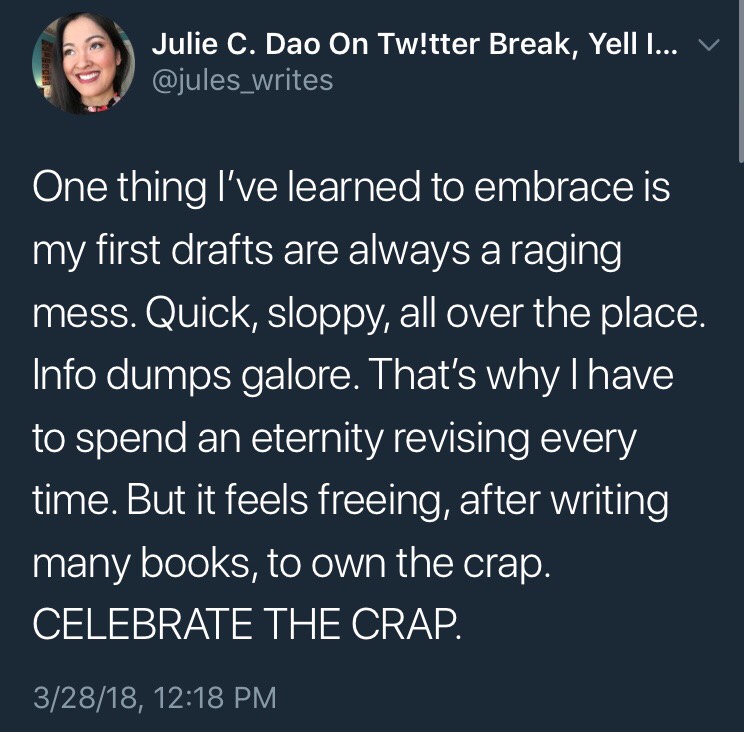
Not all first drafts are alike. Not even all of my first drafts are alike. Some are..draftier, for lack of a better word. Some are more polished. But they're all kinda bad.
Most of my first drafts are solid stories. My tendency to outline serves me pretty well in that way.
But this story is different.
I don't have a plan for BRUSHSTROKES in the way that I had one for CANUS. I have a couple of paragraphs of a summary and a list of the major characters. I know, sort of, where the story will eventually go. I have a pretty solid idea of what the first handful of chapters look like. And that's pretty much it.
Not having a plan has definitely made the process more stressful. There's nothing for me to look to if I get stuck or lose the thread of the story. It makes things feel messy.
Phoebe, my main character in the new MS is messy. She's complicated. And this MS requires a close perspective--BRUSHSTROKES is my first real attempt at first person narration.
I'm hoping that the lack of form, the lack of my usual structure will let me dig a little deeper into Phoebe. It'll mean more revision on the back end, I'm sure, but if I can find her voice, I think it'll be worth it.
But boy, is the process ugly. I'm trying to embrace the crap. I'm really trying.
Long term, I can't say how this experiment will work out. It's certainly let me put a lot of words on the page pretty quickly, but that might have more to do with the week off than anything. We'll see if the wordcount keeps up next week.
When's the last time you shook up your process or wrote something out of your comfort zone? How did it go? Let me know in the comments.
Wednesday, March 7, 2018
#AMMConnect Post
I'm gearing up to try to get a mentor spot in the upcoming round of Author Mentor Match, so my weekly blog post is happening early. Consider this my #AMMConnect profile.
And forgive my overall lack of images. I'm new to the whole "create an aesthetic" thing.
Who am I?
In my day job, I'm an adjunct instructor (which is basically the teacher version of contract work--hired per class). I teach sociology classes, so I spend a lot of time trying to get my students to connect the dots between structure and individual. How does the way that our society chooses to do things shape what options are available to people at different societal positions? This ends up being a theme I play with in a lot of the work I do; my current WIP is no exception.
I made the decision to actively pursue writing in 2016. That year, I sent a novel I'd trunked to a small press, and it got picked up. Since then, I've had a couple of shorter works picked up by small presses (you can see the stuff I've got out on my website). The manuscript I'm submitting for AMM is a piece that's been in my head since high school, and I think I've finally got it close to where it needs to be.
What is my book?
My book is essentially what you'd get if Mass Effect spent less time on Reapers and more time examining colonialism and gentrification.
CANUS is an upper YA space opera in which humanity's reach has expanded across the galaxy. The Draconin Group is the corporation that made it possible--their faster-than-light technology isn't just the human's gateway to the galaxy; it's how all the species in the galaxy get things done.
Humans might be the powerhouse species in the galaxy, but that doesn't mean that things are sunshine and roses for all of them. AJ, narrator number one, is a human colonist who suspects that Draconin has been up to some shady--and murderous--business to get their hands on more land. Her search for proof lands her on Draconin's most wanted list. She has to run. Luckily for her, she manages to find a ship and a few people who share her interest in putting an end to Draconin's control of the galaxy.
Narrator number two is Hermes, an Arvian (one of my alien species) lives on a planet near the edges of the galaxy--one that desperately needs Draconin's flight tech. His homeworld's economy is collapsing, and the Draconin Group are the only ones offering options for Arvians to improve their standing. Hermes follows his older brother into Draconin's prestigious Hunter program. His assignment: to help capture and bring down AJ.
So: humans, aliens, spaceships, a dangerous colonizing power, complicated sibling relationships, and two people doing their best to navigate a situation where even the best options might end up destroying someone's life.
What's the catch?
Mmmm. Well, I've been through a handful of rounds of revision with this project. It's close, I know. The current draft is good (I've had some fantastic critique partners), but there are a handful of things that aren't clicking along the way that they could.
Why are you doing AMM?
Honestly, I want some help from a publishing insider. Again, I've had some awesome help getting this far, but my partners have been in the same position I am. I'd like to get some insight from someone who's further on their publication journey, who might have knowledge and resources that I lack.
Graphics
Look, I'll give you a few images here, but this is not a thing I'm good at.


(There is a lot more black in this than I thought. I promise there are colorful things in the MS.)
I'm looking forward to getting to know the other mentee hopefuls. If you want to find me elsewhere online, here's where to find me.
Twitter: @authorascrowder
Instagram: @ascrowder
And forgive my overall lack of images. I'm new to the whole "create an aesthetic" thing.
Who am I?
In my day job, I'm an adjunct instructor (which is basically the teacher version of contract work--hired per class). I teach sociology classes, so I spend a lot of time trying to get my students to connect the dots between structure and individual. How does the way that our society chooses to do things shape what options are available to people at different societal positions? This ends up being a theme I play with in a lot of the work I do; my current WIP is no exception.
I made the decision to actively pursue writing in 2016. That year, I sent a novel I'd trunked to a small press, and it got picked up. Since then, I've had a couple of shorter works picked up by small presses (you can see the stuff I've got out on my website). The manuscript I'm submitting for AMM is a piece that's been in my head since high school, and I think I've finally got it close to where it needs to be.
What is my book?
My book is essentially what you'd get if Mass Effect spent less time on Reapers and more time examining colonialism and gentrification.
CANUS is an upper YA space opera in which humanity's reach has expanded across the galaxy. The Draconin Group is the corporation that made it possible--their faster-than-light technology isn't just the human's gateway to the galaxy; it's how all the species in the galaxy get things done.
Humans might be the powerhouse species in the galaxy, but that doesn't mean that things are sunshine and roses for all of them. AJ, narrator number one, is a human colonist who suspects that Draconin has been up to some shady--and murderous--business to get their hands on more land. Her search for proof lands her on Draconin's most wanted list. She has to run. Luckily for her, she manages to find a ship and a few people who share her interest in putting an end to Draconin's control of the galaxy.
Narrator number two is Hermes, an Arvian (one of my alien species) lives on a planet near the edges of the galaxy--one that desperately needs Draconin's flight tech. His homeworld's economy is collapsing, and the Draconin Group are the only ones offering options for Arvians to improve their standing. Hermes follows his older brother into Draconin's prestigious Hunter program. His assignment: to help capture and bring down AJ.
So: humans, aliens, spaceships, a dangerous colonizing power, complicated sibling relationships, and two people doing their best to navigate a situation where even the best options might end up destroying someone's life.
What's the catch?
Mmmm. Well, I've been through a handful of rounds of revision with this project. It's close, I know. The current draft is good (I've had some fantastic critique partners), but there are a handful of things that aren't clicking along the way that they could.
Why are you doing AMM?
Honestly, I want some help from a publishing insider. Again, I've had some awesome help getting this far, but my partners have been in the same position I am. I'd like to get some insight from someone who's further on their publication journey, who might have knowledge and resources that I lack.
Graphics
Look, I'll give you a few images here, but this is not a thing I'm good at.


(There is a lot more black in this than I thought. I promise there are colorful things in the MS.)
I'm looking forward to getting to know the other mentee hopefuls. If you want to find me elsewhere online, here's where to find me.
Twitter: @authorascrowder
Instagram: @ascrowder
Sunday, January 28, 2018
Writing is Rewriting is Rewriting is Rewriting
2018 Goal Update:
Books read this year: 9
Chapters left to revise: 5
At this point, I should get "revision is taking longer than I expected" printed on a t-shirt. Life gets in the way--both for me and for my critique partner. The job that pays my bills takes up big chunks of my time and leaves me drained. I still manage to work on revisions five or six days out of seven, but the amount that I'm able to get done is a session is less than I want it to be. There is a light at the end of the tunnel. My CP has the final two chapters. More of the manuscript has been through revision than hasn't. A couple of the chapters coming up are going to require fewer major structural changes.
But it's still a slog.

Memory is a weird thing. I've written and revised projects before--novellas, novels, shorts, even my graduate thesis. I've done this before. But the process feels so new.
When it comes to my work, I remember the beginnings. The first sit-downs with an idea are tucked into my brain like photographs in a scrapbook. I remember the pitches. I remember the proofs, my last look at the piece before it's finalized. I remember the whirlwind of releases.
Revisions, though, exist as a huge black void in my memory. Which might be why this process has felt like a fresh new hell.
If I'm being fair, I've never done revisions as extensive as the ones I'm doing now. EVIN got accepted with very few changes (in hindsight, I should have held onto it longer and done more work, but the whole process was very new at the time and I was sort of flying blind). I don't typically do revisions on shorter pieces, so "Red Snow" and "Smoke" were both published looking more or less the same as they did in first draft. "Lady or the Dagger" required only some changes in blocking.
CANUS, though, is a beast. It's more complicated than previous work I've done. There are more moving pieces, more points of view, more threads to tie together. It's more ambitious. Every part of it has stretched my abilities. So it makes sense that fixing it--taking the ideas and the moments and the lines and smoothing them into an actual book--would be more complicated.
I'm getting close, I think. The first sixteen chapters are stronger than they were, and I've hope that the last five can be whipped into shape. But I have lately been thinking about the days when I thought writing was easy: come up with a cool idea and throw it on a page. Boom, done. I know now that it's not that simple; that I only thought it was because I didn't really know what I was doing.
Do I wish it was easier? Yeah, sometimes. It'd be nice to be done with the revisions, to have a gleaming manuscript to send out on query. Still, I think the struggle, the process, the work has been and continues to be worthwhile. It'll make this manuscript better. It'll make starting the next all the sweeter.
In the meantime, I have to put away the cookie dough and get off the floor. This book's not gonna fix itself.
Books read this year: 9
Chapters left to revise: 5
At this point, I should get "revision is taking longer than I expected" printed on a t-shirt. Life gets in the way--both for me and for my critique partner. The job that pays my bills takes up big chunks of my time and leaves me drained. I still manage to work on revisions five or six days out of seven, but the amount that I'm able to get done is a session is less than I want it to be. There is a light at the end of the tunnel. My CP has the final two chapters. More of the manuscript has been through revision than hasn't. A couple of the chapters coming up are going to require fewer major structural changes.
But it's still a slog.

Memory is a weird thing. I've written and revised projects before--novellas, novels, shorts, even my graduate thesis. I've done this before. But the process feels so new.
When it comes to my work, I remember the beginnings. The first sit-downs with an idea are tucked into my brain like photographs in a scrapbook. I remember the pitches. I remember the proofs, my last look at the piece before it's finalized. I remember the whirlwind of releases.
Revisions, though, exist as a huge black void in my memory. Which might be why this process has felt like a fresh new hell.
If I'm being fair, I've never done revisions as extensive as the ones I'm doing now. EVIN got accepted with very few changes (in hindsight, I should have held onto it longer and done more work, but the whole process was very new at the time and I was sort of flying blind). I don't typically do revisions on shorter pieces, so "Red Snow" and "Smoke" were both published looking more or less the same as they did in first draft. "Lady or the Dagger" required only some changes in blocking.
CANUS, though, is a beast. It's more complicated than previous work I've done. There are more moving pieces, more points of view, more threads to tie together. It's more ambitious. Every part of it has stretched my abilities. So it makes sense that fixing it--taking the ideas and the moments and the lines and smoothing them into an actual book--would be more complicated.
 |
| Revision notes for chapters 16 and 17--zoomed out because spoilers |
I'm getting close, I think. The first sixteen chapters are stronger than they were, and I've hope that the last five can be whipped into shape. But I have lately been thinking about the days when I thought writing was easy: come up with a cool idea and throw it on a page. Boom, done. I know now that it's not that simple; that I only thought it was because I didn't really know what I was doing.
Do I wish it was easier? Yeah, sometimes. It'd be nice to be done with the revisions, to have a gleaming manuscript to send out on query. Still, I think the struggle, the process, the work has been and continues to be worthwhile. It'll make this manuscript better. It'll make starting the next all the sweeter.
In the meantime, I have to put away the cookie dough and get off the floor. This book's not gonna fix itself.
Sunday, September 3, 2017
Multitasking
Fall is a busy time of year for me. My day jobs pick back up (as does my pay, thankfully) and fills my schedule beyond the stereotypical nine-to-five hours. I'm querying my most recent novel--and, depending on the response to this batch of queries, seeking editorial assistance to give it another polish. This also tends to be the time of year when I get first drafts knocked out--NaNoWriMo is approaching faster than I really want to think about, and I hope to use it to get the first draft of my next project (which I expect will be between 75 and 80 thousand words) out by the end of the year. And I've taken on a couple of extra projects this year: a 5,000 work short for my writing group's anthology, and a 15 to 20 thousand word project for a publisher that I can't officially announce yet that's due in December.
For those that are keeping track, that's about 105 thousand words that I'm meant to get out before the end of the year, and about 25 thousand of those words need to be polished finals. And, again, this is aside from the work, both anticipated and not, that will come from my (three) day jobs.
So, yeah, I'm busy.
I don't mind having a lot of work to do. I get restless and anxious when my time is too empty. Having something to focus on keeps my imagination from spinning down paths that end with me imagining worst-case scenarios for literally every interaction I have with anyone and literally every action I take. But this workload is a lot, even for me, and I'm having to multitask more than I'm used to.
I've mentioned before, both on this blog and in guest posts on other blogs, that I'm on the planner side of the planner/pantser spectrum. This tendency extends beyond my writing. I like to know what I'm going to have to do ahead of time. I'm a to-do list person. I might not physically write down the list, but when I get up in the morning, I walk myself through all of the goals I need to accomplish in that day.
What complicates all of this is my physical and mental health. I can't predict when a blinding migraine will keep me sidelined or when my mental condition will bottom out and sap my energy, motivation, and self-worth. Sometimes what should be a doable set of tasks become impossible, and sometimes I have to decide if I'm going to be able to do work to further my writing career or if I'm going to give my limited energy to my day job.
So I try to account for this when I set my goals. I give myself ranges: "I need to add 250 to 1,000 words to this project." "I need to outline this arc or this chapter." "If there's time, I need to edit these pages." This gives me a way out when I've overestimated what I can accomplish but also keeps me doing something. It also lets me build in days when I can rest--a couple of days hitting the top range of my goals gets me ahead of where I need to be and gives me the freedom to take a break. And sometimes those breaks are the best thing I can do for my work.
All of this involves a sort of long-range planning. It's not just about knowing what I can do in a day. It's about knowing what the long-term goal is--whether that's completing a work by a deadline or marking an accomplishment off of the list.
The planning is stressful. But I knew that there would be stress--considerable stress--involved with trying to turn writing from a hobby to a career (even if, as it is now, it has to be a second career). And the stress is worth it in the moments when I'm able to track my own progress. I've taken on so much work this year, but the work is opening doors. Or at least windows. It's worth it.
For those that are keeping track, that's about 105 thousand words that I'm meant to get out before the end of the year, and about 25 thousand of those words need to be polished finals. And, again, this is aside from the work, both anticipated and not, that will come from my (three) day jobs.
So, yeah, I'm busy.
I don't mind having a lot of work to do. I get restless and anxious when my time is too empty. Having something to focus on keeps my imagination from spinning down paths that end with me imagining worst-case scenarios for literally every interaction I have with anyone and literally every action I take. But this workload is a lot, even for me, and I'm having to multitask more than I'm used to.
I've mentioned before, both on this blog and in guest posts on other blogs, that I'm on the planner side of the planner/pantser spectrum. This tendency extends beyond my writing. I like to know what I'm going to have to do ahead of time. I'm a to-do list person. I might not physically write down the list, but when I get up in the morning, I walk myself through all of the goals I need to accomplish in that day.
 | |
| Some insight into planning from V.E. Schwab, whose work I enjoy more and more the longer it sits with me. |
So I try to account for this when I set my goals. I give myself ranges: "I need to add 250 to 1,000 words to this project." "I need to outline this arc or this chapter." "If there's time, I need to edit these pages." This gives me a way out when I've overestimated what I can accomplish but also keeps me doing something. It also lets me build in days when I can rest--a couple of days hitting the top range of my goals gets me ahead of where I need to be and gives me the freedom to take a break. And sometimes those breaks are the best thing I can do for my work.
All of this involves a sort of long-range planning. It's not just about knowing what I can do in a day. It's about knowing what the long-term goal is--whether that's completing a work by a deadline or marking an accomplishment off of the list.
The planning is stressful. But I knew that there would be stress--considerable stress--involved with trying to turn writing from a hobby to a career (even if, as it is now, it has to be a second career). And the stress is worth it in the moments when I'm able to track my own progress. I've taken on so much work this year, but the work is opening doors. Or at least windows. It's worth it.
Sunday, August 27, 2017
Tough Advice
Over the past year, I've focused my energy on my writing. I picked a lane. My limited free time is devoted finding resources on the publishing industry, learning more about the craft of writing, and actually getting words on the page.
When it comes to my writing, I'm generally optimistic--or at least tenacious. I know this is what I want, and I know how much work goes into it (or at least, as much as someone with my level of experience can). But now and then the advice and the information bog me down.
The thing I've been bumping against recently is the advice that a writer's space needs to be sacred.
There's nothing wrong with this advice, really. There's something to be said for ritualizing the writing process. Building a habit makes it easier to keep in the swing of things. Turning writing into a habit has certainly increased my word output this past year--and the practice has increased the quality of my work. Still, though, something about this advice always rubs me the wrong way.
The advice about making a writer's space sacred usually goes something like this: a writer needs a specific space set aside for their work. This space needs to be theirs, a place where they can set up and organize without having to pick it up at the end of every writing session. The members of the writer's family need to respect this space. It needs to have a door. To be a retreat for the writer.
All of that sounds great. It really does. I would love to have a writing nook, a place where I can shut out the rest of the noise of the house and focus or read my work aloud (which sounds dumb but is the best way to catch something that's not working).
That's not feasible for me. The physical space of my home and the number of residents in it doesn't allow for a specific writing space, at least not in its current condition--and it's current condition has been the same more or less since we moved in.
I write where I can--usually at the kitchen table or on the couch. And it works for me--it's not ideal, but I get the work done. Not having a writing space set aside specifically for my work doesn't keep me from working. Nor should it, not if I'm really dedicated to writing. I know that this advice is a suggestion, not a rule, as most advice about writing is.
But damn, does not being able to follow it make me feel like a fake.
It's a stupid little thing, but sometimes writing advice like this gets at me. The advice is well-intentioned, and it's good advice for the people who can follow it. Sometimes, though, it can feel like one more thing that's keeping me from being a "real" writer.
A lot of this kind of advice--stuff like having a specific, private space or having a set time for writing or traveling or paying for conferences and meet ups--comes from people with a different set of experiences. For them, it's probably a simple--or at least simpler thing to set a side the space or time or money. For me, it's not. But that doesn't mean that I can't do some of those things. That I can't adapt and make things work. That I can't get the work done. It still gets in my head.
It can feel like there's a checklist for being a writer that I can't complete. Imposter syndrome is an on-going battle. And I see enough posts and comments from established authors that are variations of "I still don't feel like I know what I'm doing" to know that this is normal. I'm able to keep going--more importantly, I want to--need to--keep going.
This kind of advice that I can't follow isn't going to stop me. But, you know, maybe think twice before telling me to create my own sacred writing space.
When it comes to my writing, I'm generally optimistic--or at least tenacious. I know this is what I want, and I know how much work goes into it (or at least, as much as someone with my level of experience can). But now and then the advice and the information bog me down.
The thing I've been bumping against recently is the advice that a writer's space needs to be sacred.
There's nothing wrong with this advice, really. There's something to be said for ritualizing the writing process. Building a habit makes it easier to keep in the swing of things. Turning writing into a habit has certainly increased my word output this past year--and the practice has increased the quality of my work. Still, though, something about this advice always rubs me the wrong way.
The advice about making a writer's space sacred usually goes something like this: a writer needs a specific space set aside for their work. This space needs to be theirs, a place where they can set up and organize without having to pick it up at the end of every writing session. The members of the writer's family need to respect this space. It needs to have a door. To be a retreat for the writer.
 |
| Behold, the Writer's Lair--birthplace of fiction. |
That's not feasible for me. The physical space of my home and the number of residents in it doesn't allow for a specific writing space, at least not in its current condition--and it's current condition has been the same more or less since we moved in.
I write where I can--usually at the kitchen table or on the couch. And it works for me--it's not ideal, but I get the work done. Not having a writing space set aside specifically for my work doesn't keep me from working. Nor should it, not if I'm really dedicated to writing. I know that this advice is a suggestion, not a rule, as most advice about writing is.
But damn, does not being able to follow it make me feel like a fake.
It's a stupid little thing, but sometimes writing advice like this gets at me. The advice is well-intentioned, and it's good advice for the people who can follow it. Sometimes, though, it can feel like one more thing that's keeping me from being a "real" writer.
A lot of this kind of advice--stuff like having a specific, private space or having a set time for writing or traveling or paying for conferences and meet ups--comes from people with a different set of experiences. For them, it's probably a simple--or at least simpler thing to set a side the space or time or money. For me, it's not. But that doesn't mean that I can't do some of those things. That I can't adapt and make things work. That I can't get the work done. It still gets in my head.
It can feel like there's a checklist for being a writer that I can't complete. Imposter syndrome is an on-going battle. And I see enough posts and comments from established authors that are variations of "I still don't feel like I know what I'm doing" to know that this is normal. I'm able to keep going--more importantly, I want to--need to--keep going.
This kind of advice that I can't follow isn't going to stop me. But, you know, maybe think twice before telling me to create my own sacred writing space.
Tuesday, July 18, 2017
Out of Hand
Project 2016 continues to be an on-going struggle.
Lately, I've been looking back over the responses to my queries. I still have a couple outstanding, but the responses so far have been nos. A couple of them have been form rejections, but the ones that have had even one non-form line have suggested that I've got something here--there's something about this project that has potential. It's just not quite clicking.
So, this has sent me back to the drawing board, so to speak. I've started another round of revisions on the project. The plan was to make a few tweaks. The structure of the story itself is pretty sound. There were a couple of big things that needed to be done--blank page rewrite on chapter 1, add a chapter in the first act, change a setting in act two. But I figured most of the revisions would be pretty small. Manageable.
As has been the trend with this project, I underestimated.
The thing that I've learned in this past year--the year that I started diving in to writing as a craft and as a pursuit in earnest--is that the writer that I am changes over the course of time.
I wrote the bulk of Evin in 2011. It was absolutely the best book I could write at that time. But, if I sat down with the intent to tell the same story today, I wouldn't end up with the same book. I can even see changes in my writing style between Evin and "Smoke Gets in Your Eyes," which was written in 2014.
Changes in writing style over three years might not seem so surprising. What's been more striking is the changes I've seen in the way I write in this one year.
I wrote the first draft of the manuscript that I'm currently revising this past November. In the time since I wrote the draft, I've done a couple major revisions, written two short stories for anthologies, and done small writing exercises that were more for practice than anything else. I don't write every day, but I spend several hours a week engaged in my writing--actually drafting or building or outlining a scene in my head (or on my phone, as the case has been a couple of times).
That time spent with the work makes a difference.
When I did the blank-page rewrite of chapter one, the strategies I used were completely different. My focus was in a different place. Certainly, part of this was the fact that I knew the story better this time around, but it's impossible to discount the amount of time I've spent learning about writing and practicing what I learned.
This was great for the chapter rewrite. But it's turned into A Thing as far as the rest of the revisions are concerned.
I'm still working my way through act one. There have been a couple of chapters that I've only tweaked. But there have already been chapters that have moved from the "light revision" category to the "start it over" one.
The writer I am now isn't satisfied with some of what the writer I was before did.
This isn't a problem, really. In the end, the writer I am now is better than the writer I was earlier this year and late last year. Reworking parts of the project is letting me get closer to the story, the world, and the characters as they exist in my head. It's a good thing in the long run.
The theme with the work on project 2016 has been "this is getting out of hand." But I think, really, that's what a project like this should do.
Lately, I've been looking back over the responses to my queries. I still have a couple outstanding, but the responses so far have been nos. A couple of them have been form rejections, but the ones that have had even one non-form line have suggested that I've got something here--there's something about this project that has potential. It's just not quite clicking.
So, this has sent me back to the drawing board, so to speak. I've started another round of revisions on the project. The plan was to make a few tweaks. The structure of the story itself is pretty sound. There were a couple of big things that needed to be done--blank page rewrite on chapter 1, add a chapter in the first act, change a setting in act two. But I figured most of the revisions would be pretty small. Manageable.
As has been the trend with this project, I underestimated.
The thing that I've learned in this past year--the year that I started diving in to writing as a craft and as a pursuit in earnest--is that the writer that I am changes over the course of time.
I wrote the bulk of Evin in 2011. It was absolutely the best book I could write at that time. But, if I sat down with the intent to tell the same story today, I wouldn't end up with the same book. I can even see changes in my writing style between Evin and "Smoke Gets in Your Eyes," which was written in 2014.
Changes in writing style over three years might not seem so surprising. What's been more striking is the changes I've seen in the way I write in this one year.
I wrote the first draft of the manuscript that I'm currently revising this past November. In the time since I wrote the draft, I've done a couple major revisions, written two short stories for anthologies, and done small writing exercises that were more for practice than anything else. I don't write every day, but I spend several hours a week engaged in my writing--actually drafting or building or outlining a scene in my head (or on my phone, as the case has been a couple of times).
That time spent with the work makes a difference.
When I did the blank-page rewrite of chapter one, the strategies I used were completely different. My focus was in a different place. Certainly, part of this was the fact that I knew the story better this time around, but it's impossible to discount the amount of time I've spent learning about writing and practicing what I learned.
This was great for the chapter rewrite. But it's turned into A Thing as far as the rest of the revisions are concerned.
I'm still working my way through act one. There have been a couple of chapters that I've only tweaked. But there have already been chapters that have moved from the "light revision" category to the "start it over" one.
The writer I am now isn't satisfied with some of what the writer I was before did.
This isn't a problem, really. In the end, the writer I am now is better than the writer I was earlier this year and late last year. Reworking parts of the project is letting me get closer to the story, the world, and the characters as they exist in my head. It's a good thing in the long run.
The theme with the work on project 2016 has been "this is getting out of hand." But I think, really, that's what a project like this should do.
Sunday, June 25, 2017
Schedule
I have been really bad at keeping up with my schedule this summer.
I guess that's not really surprising. During the school year, my days are highly regimented. My time is so limited that, if I want to get anything done at all, I have to carve out a specific time to spend on each task. The level of "get up and go" I have in me doesn't matter all that much, because the schedule itself is unforgiving. My 300 or so students don't care so much about my energy level or about the fact that there are so many of them--they want their grades; they need me to lead class. So I do. And I jealously guard the time I have for my writing--for the work that I love.
But things are different in the summer. I'm still working. I have one class that I'm leading over the summer--but it's one class of 16 compared to six classes of 40 plus.
This opens up so much time. At the start of the summer, I had the best intentions. I'd spend my days writing--wrap up a short story for a local anthology, start re-drafting the second book in my trilogy, outline book three, spruce up my submission packet, and send out new queries. I'd prewrite and schedule blog posts to give me more time on the weekends. I'd use my mornings for marketing work for Evin and "Smoke," and my afternoons for new projects. And I've done some of these things: a couple of interviews and guest posts on other blogs, a promotion through IWIC, some query refining and some new submissions. I've got about 600 words on the anthology project, which is turning out to be more of a struggle than I'd anticipated.
But by and large, I've not kept up with my schedule. I've had to fight to pull myself out of bed most mornings, and by the time I do, the time that I planned to spend working is half gone. So, rather than work, I loaf around. I promise myself that I'll work in the afternoon. And I do, about two thirds of the time, but lost days are much less infrequent now than they usually are.
Some of this might just be recovery. My schedule this spring was unforgiving. My three jobs are technically all part-time, but when you add it all together, my work weeks were well over 40 hours, and that's before we get to the hours spent working on Canus and other parts of project 2016. In the past year and a half, I've treated writing as another job--one I love, but one that requires a lot of work and a sizable time commitment. I'm still getting things done, though the pace has slowed down. Maybe a few lazy days in a week during the only time of year when lazy days are an option isn't such a bad thing. And I've been able (willing?) to take the time to read both in and out of my genre, which is both relaxing and helpful in terms of improving and focusing my own writing.
But it makes me feel miserable. I feel like every moment that I'm not working is a wasted one. If I were a real, serious writer, I'd me making use of every minute of this time (I guess that Daily Beast article got to me more than I thought--though I still think the piece was misguided and ultimately harmful).
There has to be a balance. I can't procrastinate--there's too much to do, and by mid-August, the time I'll be able to devote to it will be limited. But I also can't beat myself up every time I take a break, and I shouldn't fault myself for trying to relax a little during a time when I've got a lighter load to carry. Figuring out how my process has to work in these different circumstances is a struggle, but if I can manage to find the sweet spot between productivity and rest, this could be a great time.
I guess that's not really surprising. During the school year, my days are highly regimented. My time is so limited that, if I want to get anything done at all, I have to carve out a specific time to spend on each task. The level of "get up and go" I have in me doesn't matter all that much, because the schedule itself is unforgiving. My 300 or so students don't care so much about my energy level or about the fact that there are so many of them--they want their grades; they need me to lead class. So I do. And I jealously guard the time I have for my writing--for the work that I love.
But things are different in the summer. I'm still working. I have one class that I'm leading over the summer--but it's one class of 16 compared to six classes of 40 plus.
This opens up so much time. At the start of the summer, I had the best intentions. I'd spend my days writing--wrap up a short story for a local anthology, start re-drafting the second book in my trilogy, outline book three, spruce up my submission packet, and send out new queries. I'd prewrite and schedule blog posts to give me more time on the weekends. I'd use my mornings for marketing work for Evin and "Smoke," and my afternoons for new projects. And I've done some of these things: a couple of interviews and guest posts on other blogs, a promotion through IWIC, some query refining and some new submissions. I've got about 600 words on the anthology project, which is turning out to be more of a struggle than I'd anticipated.
But by and large, I've not kept up with my schedule. I've had to fight to pull myself out of bed most mornings, and by the time I do, the time that I planned to spend working is half gone. So, rather than work, I loaf around. I promise myself that I'll work in the afternoon. And I do, about two thirds of the time, but lost days are much less infrequent now than they usually are.
Some of this might just be recovery. My schedule this spring was unforgiving. My three jobs are technically all part-time, but when you add it all together, my work weeks were well over 40 hours, and that's before we get to the hours spent working on Canus and other parts of project 2016. In the past year and a half, I've treated writing as another job--one I love, but one that requires a lot of work and a sizable time commitment. I'm still getting things done, though the pace has slowed down. Maybe a few lazy days in a week during the only time of year when lazy days are an option isn't such a bad thing. And I've been able (willing?) to take the time to read both in and out of my genre, which is both relaxing and helpful in terms of improving and focusing my own writing.
But it makes me feel miserable. I feel like every moment that I'm not working is a wasted one. If I were a real, serious writer, I'd me making use of every minute of this time (I guess that Daily Beast article got to me more than I thought--though I still think the piece was misguided and ultimately harmful).
There has to be a balance. I can't procrastinate--there's too much to do, and by mid-August, the time I'll be able to devote to it will be limited. But I also can't beat myself up every time I take a break, and I shouldn't fault myself for trying to relax a little during a time when I've got a lighter load to carry. Figuring out how my process has to work in these different circumstances is a struggle, but if I can manage to find the sweet spot between productivity and rest, this could be a great time.
Monday, June 12, 2017
Team Building
A few weeks ago, there was a Daily Beast article that made the rounds on creative Twitter. I'm not going to name names, but this is what I typed into Google when I was trying to find when it was published.


The part of the article that bothered me--the part that convinced me to write this post--was the part where the author said that he hated other writers.
I'm not paraphrasing there. "What is certain is that on that same day [when I start writing my novel], whichever one it is, one thousand other people will start their novels. In order to publish mine, it has to be better than theirs. So, forgive me—I pretty much hate them."
I had two initial reactions to this statement.
1. Yikes.
2. That's the most self-sabotaging thing I've every heard.
The article's author isn't wrong on one point: thousands of people do start writing novels, and plenty of them don't finish. But where this goes awry is with the creation of this needless sense of competition. It flat out doesn't make sense. From a reader's point of view, reading one good book doesn't stop me from reading another. That I read one person's book doesn't mean that I won't read someone else's. In fact, good books usually make me hungry for more books. Someone else's success doesn't hurt your own chances, because it's not like there's a finite number of books that will be read. People will keep reading new books as long as there are new books to read.
From a writer's standpoint, I can't imagine viewing everyone else who's trying to write a novel as my enemy in no small part because working with and building friendships with other writers has been one of the biggest factors in my growth as a writer. I've written a couple of times about some of the ways that other writers have helped me. With longer projects, there's always a point where I can no longer see the forest for the trees, and there's nothing better than having another person who's familiar with storycraft to take a peek and see where things might have gone off the rails. Apart from reading and critiquing with writer friends, I've also found my local writer's group to be a boon.
It's not just about having someone else look through your work to help you improve it. Reading and critiquing others' work helps you figure out where some of the common pitfalls are (pretty much all of us in my local group have a hard time with beginning hooks, for example).
And other writers have different experiences. If I want to write a story with a military setting, I know three or four writers off the top of my head that I can go to for advice. I'm not limited to pulling from my knowledge and experience--there are other people who know how stories work who can help me cut through the material I find in research.
On top of that, there's value in listening to people with varying levels of publication experience. I can talk queries with people who've had success. I can hash out the costs and benefits of self-publication with people who have tried it out. I can compare experiences with small presses to find the best fits for my work. Being able to talk shop with other writers has encouraged me to try new things with my process. And some of those new things have made me a better writer than I ever would have been on my own.
Other writers aren't--and shouldn't be--the enemy. For me, writing has always been about community. Yeah, I do a lot of work by myself, but I rely on others that are in the trenches with me.
I guess what I'm saying is: if you want to write, do it. But don't view other writers as your competition--view them as a resource. They're people you can learn from and people you can teach. And that is what's great about it.

Look, there are a lot of issues with this article. Most attention has been given to taking apart the premise that someone who isn't writing everyday should just hang it up and stop trying. I don't intend to retread that ground too much. Yes, having a writing habit is important--for me, it's crucial--but everyone works in different ways, and as long as you're getting the work done, it ultimately doesn't matter if you're writing every day or a few days a month.
There were a lot of smart people who gave some pretty excellent takes on that aspect of the article. Literary agent and blogger Eric Smith (who I had the pleasure of seeing at ALAWW back in February) gave one of my favorites.

The part of the article that bothered me--the part that convinced me to write this post--was the part where the author said that he hated other writers.
I'm not paraphrasing there. "What is certain is that on that same day [when I start writing my novel], whichever one it is, one thousand other people will start their novels. In order to publish mine, it has to be better than theirs. So, forgive me—I pretty much hate them."
1. Yikes.
2. That's the most self-sabotaging thing I've every heard.
The article's author isn't wrong on one point: thousands of people do start writing novels, and plenty of them don't finish. But where this goes awry is with the creation of this needless sense of competition. It flat out doesn't make sense. From a reader's point of view, reading one good book doesn't stop me from reading another. That I read one person's book doesn't mean that I won't read someone else's. In fact, good books usually make me hungry for more books. Someone else's success doesn't hurt your own chances, because it's not like there's a finite number of books that will be read. People will keep reading new books as long as there are new books to read.
From a writer's standpoint, I can't imagine viewing everyone else who's trying to write a novel as my enemy in no small part because working with and building friendships with other writers has been one of the biggest factors in my growth as a writer. I've written a couple of times about some of the ways that other writers have helped me. With longer projects, there's always a point where I can no longer see the forest for the trees, and there's nothing better than having another person who's familiar with storycraft to take a peek and see where things might have gone off the rails. Apart from reading and critiquing with writer friends, I've also found my local writer's group to be a boon.
It's not just about having someone else look through your work to help you improve it. Reading and critiquing others' work helps you figure out where some of the common pitfalls are (pretty much all of us in my local group have a hard time with beginning hooks, for example).
And other writers have different experiences. If I want to write a story with a military setting, I know three or four writers off the top of my head that I can go to for advice. I'm not limited to pulling from my knowledge and experience--there are other people who know how stories work who can help me cut through the material I find in research.
On top of that, there's value in listening to people with varying levels of publication experience. I can talk queries with people who've had success. I can hash out the costs and benefits of self-publication with people who have tried it out. I can compare experiences with small presses to find the best fits for my work. Being able to talk shop with other writers has encouraged me to try new things with my process. And some of those new things have made me a better writer than I ever would have been on my own.
Other writers aren't--and shouldn't be--the enemy. For me, writing has always been about community. Yeah, I do a lot of work by myself, but I rely on others that are in the trenches with me.
I guess what I'm saying is: if you want to write, do it. But don't view other writers as your competition--view them as a resource. They're people you can learn from and people you can teach. And that is what's great about it.
Monday, May 15, 2017
Cafe Diem
I have an unusual amount of free time right now. The Spring semester ended last week, and Summer term doesn't start for another week. I wrapped up my story for the Mata Hari anthology and even finished up the first round of edits. There aren't any friends or family visiting from out of town at the moment. Where I normally only have a few hours a night to work on my writing, I've now got full days.
It's great, and I'm getting things done. But I've definitely been going a little stir crazy.
While I love spending time with my cats and dog, and working from home is a great option, considering how anxious I get in even the most benign social situations, even I can only stay at the house so long. By late last week, I needed to get out.
Though I wanted to get out of the house, I didn't want to give up my working time. So, I decided to camp out at a coffee shop for a few hours--a place with lots of windows, an outside seating option, and a staff that wouldn't be concerned about a patron claiming a table for an undetermined length of time, since so much of the traffic is drive through or carry out.
 Not pictured: The guy that didn't understand that my headphones meant I was not interested in a conversation.
There are all manner of sneering stereotypes about people that write in cafes. It's not something I've done much of, myself. It's always struck me as a little performative, and my imposter syndrome is generally unwilling to let me perform the role of writer in public--at least, outside of times when I've been invited to. And being a woman in a public place comes with the burden of being assumed to be available for chit chat. Even if you're clearly working on something. And have headphones in.
But I wanted a change of pace. Not just to look at something other than my house's walls, but also to shake loose some of the blocks I've had. The last few problems that I'm trying to patch up in Project 2016 have proven to be somewhat difficult to untangle. I'd hoped that changing my setting might shake things up enough to reveal new avenues.
And it did help a bit. I've been able to work out some of the major issues, and I have the beginnings of new solutions for most of the rest. I managed a blank-page rewrite of the center of a chapter that's been giving me trouble since the beginning, and now the sequence of events makes more sense. I've been able to trim some fat from a few chapters so that I can add in more important bits of story. I visited the cafe twice last week, and did some good work both times.
But I'm not sure I want to make a habit, however temporary, of cafe writing.
I can see the appeal, in some ways. There is something about a cafe setting that sharpens the brain (or at least my brain). And if you get stuck, there are goodies--never underestimate the power of goodies. If you're the type that gets energized by being around other people, it's a great workspace.
All that said, it doesn't really work for me. I mean, I'm all about tasty baked goods and coffee, but there are some issues. First and most obvious is the expense. Cafe coffee ain't cheap. And, if you're like me, you feel like an asshole sitting somewhere for hours after your coffee and croissant have been consumed so you buy another coffee and croissant.
And then there's the music. I went to a chain cafe, so I expected that I'd hear some pretty generic tunes--whispery-voiced indie singers and soft guitar strumming. I can work through most music, so I thought I'd be fine. The days that I went to the cafe, though, the music of the day was apparently "whales screaming."

Not exactly conducive to work. I guess some people find it relaxing?
And then there are the people. I'm sure others' mileage varies on this, but I work best when I'm allowed to do my own thing without interruptions. For most of my stay at the coffee shop, I was able to do this reasonably well. But now and then, someone tap at my shoulders to ask about the other chair at my table (and then to put it back). And once, someone asked me to move (my body, my laptop, my laptop bag, my coffee and my croissant) to another table. Worst was the man who decided that I must have come out in public to be talked to by a stranger (pro tip: if someone has headphones on, they're not interested in talking--if they're not in danger, leave them alone).
It was a good experiment. I'm glad I did it. But I don't expect that cafe writing is going to somehow become my thing.
Are any of you cafe writers? If you're not, what do you do when you want to write somewhere other than your usual office or writing nook?
It's great, and I'm getting things done. But I've definitely been going a little stir crazy.
While I love spending time with my cats and dog, and working from home is a great option, considering how anxious I get in even the most benign social situations, even I can only stay at the house so long. By late last week, I needed to get out.
Though I wanted to get out of the house, I didn't want to give up my working time. So, I decided to camp out at a coffee shop for a few hours--a place with lots of windows, an outside seating option, and a staff that wouldn't be concerned about a patron claiming a table for an undetermined length of time, since so much of the traffic is drive through or carry out.

There are all manner of sneering stereotypes about people that write in cafes. It's not something I've done much of, myself. It's always struck me as a little performative, and my imposter syndrome is generally unwilling to let me perform the role of writer in public--at least, outside of times when I've been invited to. And being a woman in a public place comes with the burden of being assumed to be available for chit chat. Even if you're clearly working on something. And have headphones in.
But I wanted a change of pace. Not just to look at something other than my house's walls, but also to shake loose some of the blocks I've had. The last few problems that I'm trying to patch up in Project 2016 have proven to be somewhat difficult to untangle. I'd hoped that changing my setting might shake things up enough to reveal new avenues.
And it did help a bit. I've been able to work out some of the major issues, and I have the beginnings of new solutions for most of the rest. I managed a blank-page rewrite of the center of a chapter that's been giving me trouble since the beginning, and now the sequence of events makes more sense. I've been able to trim some fat from a few chapters so that I can add in more important bits of story. I visited the cafe twice last week, and did some good work both times.
But I'm not sure I want to make a habit, however temporary, of cafe writing.
I can see the appeal, in some ways. There is something about a cafe setting that sharpens the brain (or at least my brain). And if you get stuck, there are goodies--never underestimate the power of goodies. If you're the type that gets energized by being around other people, it's a great workspace.
All that said, it doesn't really work for me. I mean, I'm all about tasty baked goods and coffee, but there are some issues. First and most obvious is the expense. Cafe coffee ain't cheap. And, if you're like me, you feel like an asshole sitting somewhere for hours after your coffee and croissant have been consumed so you buy another coffee and croissant.
And then there's the music. I went to a chain cafe, so I expected that I'd hear some pretty generic tunes--whispery-voiced indie singers and soft guitar strumming. I can work through most music, so I thought I'd be fine. The days that I went to the cafe, though, the music of the day was apparently "whales screaming."

Not exactly conducive to work. I guess some people find it relaxing?
And then there are the people. I'm sure others' mileage varies on this, but I work best when I'm allowed to do my own thing without interruptions. For most of my stay at the coffee shop, I was able to do this reasonably well. But now and then, someone tap at my shoulders to ask about the other chair at my table (and then to put it back). And once, someone asked me to move (my body, my laptop, my laptop bag, my coffee and my croissant) to another table. Worst was the man who decided that I must have come out in public to be talked to by a stranger (pro tip: if someone has headphones on, they're not interested in talking--if they're not in danger, leave them alone).
It was a good experiment. I'm glad I did it. But I don't expect that cafe writing is going to somehow become my thing.
Are any of you cafe writers? If you're not, what do you do when you want to write somewhere other than your usual office or writing nook?
Monday, April 3, 2017
Mood Boost
My plan for this week was originally to write about knowing your genre--something that is super important for a person like me who writes across different genres with specific tropes and expectations attached to them.
But at some point on Saturday, I hit a serious downswing.
The thing with depression, even depression that's typically reasonably well-managed, is that sometimes it just slams you. Nothing happens; there's no inciting incident that sets off a spiral. Sometimes you're just standing in the middle of a snack aisle at Target and all of your energy is suddenly gone and the notion that you should bury yourself under the covers and never move again seems like the best possible use of time--and even if it's not, what does it matter? It's not like what you do is important in the long run anyway.
I haven't worked on anything in almost a week. I've spent too much time sleeping. There are plenty of things that I have to do--some things that, under normal circumstances, I'd be jazzed to do--but I can't do them. Getting out of bed was Herculean. Now I have to do more?
And so your weekly blog post ends up being late because the effort of actually taking the laptop out of the bag is too much, and the ceiling's not gonna stare at itself, and you know there's not going to be a way to get out of work on Monday, so you might as well just try to save up whatever mana you can so that you can make it through work and then go back to bed. And, of course, the fact that the post is late makes you want to do it even less.
So I'm not going to talk about genre knowledge this week. Maybe, hopefully, I'll be able to next week.
Instead, I'm going to share some songs that I use as pick me ups when I feel, for lack of a better word, blue. And, for my purposes, I'm using the Drowsy Chaperone definition of blue:
"A little anxious for no particular reason. A little sad that I should feel self-conscious at this age. A little self-conscious anxiety resulting in non-specific sadness."
It's not completely accurate, but it offers a little insight.
This doesn't have much to do with writing, beyond that I sometimes use these songs to pick me up when I feel this way. And one of the songs is on the playlist I made for project 2016 (you can find part of that playlist here, if you're interested).
Thanks for hanging in there with me. See you next week.
But at some point on Saturday, I hit a serious downswing.
The thing with depression, even depression that's typically reasonably well-managed, is that sometimes it just slams you. Nothing happens; there's no inciting incident that sets off a spiral. Sometimes you're just standing in the middle of a snack aisle at Target and all of your energy is suddenly gone and the notion that you should bury yourself under the covers and never move again seems like the best possible use of time--and even if it's not, what does it matter? It's not like what you do is important in the long run anyway.
I haven't worked on anything in almost a week. I've spent too much time sleeping. There are plenty of things that I have to do--some things that, under normal circumstances, I'd be jazzed to do--but I can't do them. Getting out of bed was Herculean. Now I have to do more?
And so your weekly blog post ends up being late because the effort of actually taking the laptop out of the bag is too much, and the ceiling's not gonna stare at itself, and you know there's not going to be a way to get out of work on Monday, so you might as well just try to save up whatever mana you can so that you can make it through work and then go back to bed. And, of course, the fact that the post is late makes you want to do it even less.
So I'm not going to talk about genre knowledge this week. Maybe, hopefully, I'll be able to next week.
Instead, I'm going to share some songs that I use as pick me ups when I feel, for lack of a better word, blue. And, for my purposes, I'm using the Drowsy Chaperone definition of blue:
"A little anxious for no particular reason. A little sad that I should feel self-conscious at this age. A little self-conscious anxiety resulting in non-specific sadness."
It's not completely accurate, but it offers a little insight.
This doesn't have much to do with writing, beyond that I sometimes use these songs to pick me up when I feel this way. And one of the songs is on the playlist I made for project 2016 (you can find part of that playlist here, if you're interested).
Thanks for hanging in there with me. See you next week.
Sunday, March 26, 2017
Quiplash
I don't, in general, think that I'm a very funny person.
Part of it is anxiety--being funny, to me, is a very spontaneous thing, and I am so bad at being spontaneous in conversation. I like to know and--to a degree--rehearse what I'm going to say before I say it. It's a trait that makes me pretty good at giving presentations, a fair actor, and handy to have around in a situation that requires intense listening and digesting information.
But love-of-God, don't rely on me for a witty observation.
Even though I'm not particularly funny, I do think I have a decent sense of humor. I love to laugh, and I appreciate a well-executed joke.
And I really enjoy quips.
Banter between characters is one of my favorite things in narratives. When I play a video game (which, for me, essentially means when I play either a Dragon Age game or a Mass Effect game), I spend a lot of time wandering around aimlessly just to hear the extra conversations the writers put in for the characters. I love the extra bits of backstory I get from these exchanges, the little quirks of character relationships that aren't dealt with in the main narrative.
And I love it when characters snipe at each other or share quick jokes. A fast-paced exchange between sharp-witted characters is one of my favorite types of dialogue.
That being said, when I watch TV--particularly when I watch sitcoms--I get a sense of...let's call it quiplash.
Every media maker that I talk to--authors and publishers, playwrights, screenwriters, everyone--talks about how little time there is to catch a consumer's attention. It seems like I've been hearing about people's (and my generation's, specifically) shrinking attention spans for years.
I get it. There's a lot of consumable media out there, and we can get to most of it at a push of a button. There are so many options that, if something doesn't grab us right off the bat, we've got a dozen other things to try that might be more interesting. I understand the pressure to show off what you can do as soon as you can.
So you fill the first five minutes with jokes at a mile-a-minute pace to prove that you've got a ton of them. No danger of running out of funny here.
Maybe this works for some folks. But for me, it feels like being pummeled. There's no room to breath, no time for a joke to settle. The next quip has come and gone before I've had time to realize that I was supposed to be laughing at the first.
To me, it comes off as a little try-too-hard. Sort of like when I try to work a million ideas into one story.
I do that when I'm afraid I'll never have another solid story idea. Maybe sitcom writers line up the jokes like this because they're afraid they won't have another chance to tell them? I guess I can understand that.
But there's something to be said for letting a joke breathe. Giving your audience a chance to appreciate the moment. Or for letting a joke build--working up to a well-earned punch line. Letting a joke repeat while upping the stakes each time (the comedic rule of three is a beautiful thing). There's so much that a joke can accomplish if it's just allowed to take its time.
There's something to be said for being able to laugh without feeling like someone is trying to slap you around with a joke book.
But then, I'm not really funny, so what do I know?
Part of it is anxiety--being funny, to me, is a very spontaneous thing, and I am so bad at being spontaneous in conversation. I like to know and--to a degree--rehearse what I'm going to say before I say it. It's a trait that makes me pretty good at giving presentations, a fair actor, and handy to have around in a situation that requires intense listening and digesting information.
But love-of-God, don't rely on me for a witty observation.
Even though I'm not particularly funny, I do think I have a decent sense of humor. I love to laugh, and I appreciate a well-executed joke.
And I really enjoy quips.
Banter between characters is one of my favorite things in narratives. When I play a video game (which, for me, essentially means when I play either a Dragon Age game or a Mass Effect game), I spend a lot of time wandering around aimlessly just to hear the extra conversations the writers put in for the characters. I love the extra bits of backstory I get from these exchanges, the little quirks of character relationships that aren't dealt with in the main narrative.
And I love it when characters snipe at each other or share quick jokes. A fast-paced exchange between sharp-witted characters is one of my favorite types of dialogue.
That being said, when I watch TV--particularly when I watch sitcoms--I get a sense of...let's call it quiplash.
Every media maker that I talk to--authors and publishers, playwrights, screenwriters, everyone--talks about how little time there is to catch a consumer's attention. It seems like I've been hearing about people's (and my generation's, specifically) shrinking attention spans for years.
I get it. There's a lot of consumable media out there, and we can get to most of it at a push of a button. There are so many options that, if something doesn't grab us right off the bat, we've got a dozen other things to try that might be more interesting. I understand the pressure to show off what you can do as soon as you can.
So you fill the first five minutes with jokes at a mile-a-minute pace to prove that you've got a ton of them. No danger of running out of funny here.
Maybe this works for some folks. But for me, it feels like being pummeled. There's no room to breath, no time for a joke to settle. The next quip has come and gone before I've had time to realize that I was supposed to be laughing at the first.
To me, it comes off as a little try-too-hard. Sort of like when I try to work a million ideas into one story.
I do that when I'm afraid I'll never have another solid story idea. Maybe sitcom writers line up the jokes like this because they're afraid they won't have another chance to tell them? I guess I can understand that.
But there's something to be said for letting a joke breathe. Giving your audience a chance to appreciate the moment. Or for letting a joke build--working up to a well-earned punch line. Letting a joke repeat while upping the stakes each time (the comedic rule of three is a beautiful thing). There's so much that a joke can accomplish if it's just allowed to take its time.
There's something to be said for being able to laugh without feeling like someone is trying to slap you around with a joke book.
But then, I'm not really funny, so what do I know?
Sunday, March 19, 2017
Switching Gears
I did more or less what I predicted I would do last week. I took some time off. I played some games and read some books.
But I also spent a lot of time with Project 2016, going over it just one more time before I put it away (for now).
I'm trying to ease back into a normal schedule by doing some day job work today. This hasn't been fun, exactly, but the transition has been smooth. What's weird is the shift I'm having to manage in my writing work.
I made it through the draft of Project 2016. It's time to let it sit and to work on something different. And it's not like I'm lacking other things to work on: a part from two more books set in the same universe as Project 2016, I've got a short story with an April deadline that's only about halfway done.
I've got a pretty clear plan of what I've got to do. The story has to come next. I've done the outline and some of the work. Also, you know, there's an actual deadline by which a publisher wants it. It's super clear what I need to do.
But I'm having a hard time pulling myself out of the world of Project 2016 to focus on a different world and a different set of characters. It's not that I don't like the story--I was jazzed enough about it to successfully pitch it, and I wrote the first half of it pretty quickly. It's a good story. Or it has the potential to be, at least.
The problem--such as it is; I imagine I'll work my way out of this funk soon enough--might be that I've spent so much time in the Project 2016 universe. It's been more than a year since I started revamping the project. I've taken breaks here and there, but it's been most of what I've written in the past year. And that universe and those characters are going to be at the center of my next two major projects. Project 2016 lives in every crevice of my brain all of the time. Shifting my focus, even for a month, to work on something totally unrelated is daunting.
I can do it. I've done it before. And, to be fair, I need to shake things up--to get away from the big project for a while so that I can come back to it with fresh eyes.
It's always rough to move to something new after so much time devoted to a project. I'm not so good at making the shift, but I'll manage.
But I also spent a lot of time with Project 2016, going over it just one more time before I put it away (for now).
I'm trying to ease back into a normal schedule by doing some day job work today. This hasn't been fun, exactly, but the transition has been smooth. What's weird is the shift I'm having to manage in my writing work.
I made it through the draft of Project 2016. It's time to let it sit and to work on something different. And it's not like I'm lacking other things to work on: a part from two more books set in the same universe as Project 2016, I've got a short story with an April deadline that's only about halfway done.
I've got a pretty clear plan of what I've got to do. The story has to come next. I've done the outline and some of the work. Also, you know, there's an actual deadline by which a publisher wants it. It's super clear what I need to do.
But I'm having a hard time pulling myself out of the world of Project 2016 to focus on a different world and a different set of characters. It's not that I don't like the story--I was jazzed enough about it to successfully pitch it, and I wrote the first half of it pretty quickly. It's a good story. Or it has the potential to be, at least.
The problem--such as it is; I imagine I'll work my way out of this funk soon enough--might be that I've spent so much time in the Project 2016 universe. It's been more than a year since I started revamping the project. I've taken breaks here and there, but it's been most of what I've written in the past year. And that universe and those characters are going to be at the center of my next two major projects. Project 2016 lives in every crevice of my brain all of the time. Shifting my focus, even for a month, to work on something totally unrelated is daunting.
I can do it. I've done it before. And, to be fair, I need to shake things up--to get away from the big project for a while so that I can come back to it with fresh eyes.
It's always rough to move to something new after so much time devoted to a project. I'm not so good at making the shift, but I'll manage.
Sunday, February 26, 2017
ALAWW
Normally my Fridays are spent in my office grading papers, doing course prep, meeting with students, and doing other generic academic grunt work.
But this week I took a day off--from academic work, at least.
As I mentioned in last week's post, I signed up for the Alabama Writing Workshop. The meeting was Friday, so I rescheduled my office hours and, instead of spending the day on campus, I spent it at a hotel in Birmingham, schmoozing with other writers and meeting industry professionals.
I'm a nervous person in general. My anxiety brain never stops coming up with potential scenarios for disaster--which can be great for writing, but is considerably less great when it comes to trying to make a good first impression. I spent a pretty significant portion of the day reminding myself that the goal was to learn more and if that was all I accomplished that would be a victory. I also spent a pretty significant portion of the day reminding myself that I had to do things like breathe and blink and maybe drink some water. My hands shook when I met new people. I tripped over my words and stuttered.
It was awesome.
As someone who's spent the better part of fifteen years trying to make something of my ambitions to write professionally and to get my stories out into the world, I went in with a solid body of background knowledge. I knew about some of the resources mention (I've actually plugged some of them in different blog posts--I'll go back through and make a full list to post soon). I had done a fair bit of the recommended prep work. But even at that, hearing the professionals name check the resources I've been using was encouraging. I frequently feel--and I imagine other writers in positions similar to mine also feel--like I'm treading water. Now, though, I've got a sense that I'm at least treading the right water.
The seminars were led by agents and editors. They dealt with topic ranging from seeking out representation for work, improving writing, making use of social media, and what happens after a book deal is signed. It was a ton of information, and I took pages of notes (and, thankfully, the speakers provided outlines and resources for their talks, so I should be able to review and find what I inevitably missed). And those were just the talks.
The session that met right after lunch was, to me, one of the most informative. It wasn't so much a talk as it was a review. Attendees were told they could bring copies of their first page (sans names, of course) and the panel of agents would read through them--or parts of them--and give critiques. Essentially, the panel members would indicate when a page lost them, when they'd stop reading. My page didn't get read (and I'm actually glad it didn't since this panel was before my scheduled pitching time), but the issues that were pointed out in the pages that were read gave me some insight into how to improve mine.
It was a fantastic insight into how quickly some of these decisions can get made--how vital a strong first page is. It was also an opportunity to learn where the mileage varied for the specific agents on the panel. When they found something that didn't work, they said why. Sometimes it was an issue with the structure, but sometimes it was more subjective. And when panel members disagreed, they said so and explained why.
To me, though, valuable as all of the sessions were, the best part was meeting in-person for a one-on-one session with an agent.
The one-on-one was an addition to the conference--an extra event with an extra fee, and each instance of the fee got one sit-down with one agent. This was another instance where my background research came in handy--adjunct pay isn't great, so I only had enough funds to sit down with one agent. I reviewed the list, checked their websites and MSWL and Publisher's Marketplace (and availability--I registered last minute, so some slots were sold out). The sit-down was a ten-minute conversation, an opportunity to do a quick elevator pitch of the project and to ask and answer questions.
I spent the whole day nervous, but this is where the butterflies got out of hand. I managed--I made it through my pitch without too much word vomit. My hands (and voice) shook the whole time, but not so much that I couldn't be understood. I lost the thread of what I was saying for a second, but I got back on track, and the conversation didn't seem to suffer for it. The agent that I spoke with really did more than politeness demanded to ease my nerves (seriously, she was the nicest person I talked to through the conference--which made pitching that much more pleasant).
I didn't walk away with an offer of representation or a full manuscript request--I didn't expect to. But I did get an invitation to send a sample of Project 2016. And, after my pitch, she asked about other projects related to Project 2016 (some of the things I said in my pitch, she said, suggested that there were more stories)--which she asked for brief pitches for in my submission packet. There are never any guarantees--she liked the idea of the story, but it's still totally possible that my writing style won't be what she's looking for or that the draft flat-out isn't strong enough. But I am so glad--so glad--that I took the chance to talk to her face to face about the project.
It's the most promising lead that I've got so far, and even if it doesn't work out, I know where the strengths and weaknesses of my pitch are better now than ever before. I've got new tools to use as I keep working.
I won't be able to do many of these conferences--again, adjunct pay leaves a lot to be desired--but if I have the chance to go to another, I think I will. If you've been working on a project and are considering a conference, I hope you go. Worst case scenario, you still win--you still come out with more than you had when you went in.
But this week I took a day off--from academic work, at least.
As I mentioned in last week's post, I signed up for the Alabama Writing Workshop. The meeting was Friday, so I rescheduled my office hours and, instead of spending the day on campus, I spent it at a hotel in Birmingham, schmoozing with other writers and meeting industry professionals.
I'm a nervous person in general. My anxiety brain never stops coming up with potential scenarios for disaster--which can be great for writing, but is considerably less great when it comes to trying to make a good first impression. I spent a pretty significant portion of the day reminding myself that the goal was to learn more and if that was all I accomplished that would be a victory. I also spent a pretty significant portion of the day reminding myself that I had to do things like breathe and blink and maybe drink some water. My hands shook when I met new people. I tripped over my words and stuttered.
It was awesome.
As someone who's spent the better part of fifteen years trying to make something of my ambitions to write professionally and to get my stories out into the world, I went in with a solid body of background knowledge. I knew about some of the resources mention (I've actually plugged some of them in different blog posts--I'll go back through and make a full list to post soon). I had done a fair bit of the recommended prep work. But even at that, hearing the professionals name check the resources I've been using was encouraging. I frequently feel--and I imagine other writers in positions similar to mine also feel--like I'm treading water. Now, though, I've got a sense that I'm at least treading the right water.
The seminars were led by agents and editors. They dealt with topic ranging from seeking out representation for work, improving writing, making use of social media, and what happens after a book deal is signed. It was a ton of information, and I took pages of notes (and, thankfully, the speakers provided outlines and resources for their talks, so I should be able to review and find what I inevitably missed). And those were just the talks.
The session that met right after lunch was, to me, one of the most informative. It wasn't so much a talk as it was a review. Attendees were told they could bring copies of their first page (sans names, of course) and the panel of agents would read through them--or parts of them--and give critiques. Essentially, the panel members would indicate when a page lost them, when they'd stop reading. My page didn't get read (and I'm actually glad it didn't since this panel was before my scheduled pitching time), but the issues that were pointed out in the pages that were read gave me some insight into how to improve mine.
It was a fantastic insight into how quickly some of these decisions can get made--how vital a strong first page is. It was also an opportunity to learn where the mileage varied for the specific agents on the panel. When they found something that didn't work, they said why. Sometimes it was an issue with the structure, but sometimes it was more subjective. And when panel members disagreed, they said so and explained why.
To me, though, valuable as all of the sessions were, the best part was meeting in-person for a one-on-one session with an agent.
The one-on-one was an addition to the conference--an extra event with an extra fee, and each instance of the fee got one sit-down with one agent. This was another instance where my background research came in handy--adjunct pay isn't great, so I only had enough funds to sit down with one agent. I reviewed the list, checked their websites and MSWL and Publisher's Marketplace (and availability--I registered last minute, so some slots were sold out). The sit-down was a ten-minute conversation, an opportunity to do a quick elevator pitch of the project and to ask and answer questions.
I spent the whole day nervous, but this is where the butterflies got out of hand. I managed--I made it through my pitch without too much word vomit. My hands (and voice) shook the whole time, but not so much that I couldn't be understood. I lost the thread of what I was saying for a second, but I got back on track, and the conversation didn't seem to suffer for it. The agent that I spoke with really did more than politeness demanded to ease my nerves (seriously, she was the nicest person I talked to through the conference--which made pitching that much more pleasant).
I didn't walk away with an offer of representation or a full manuscript request--I didn't expect to. But I did get an invitation to send a sample of Project 2016. And, after my pitch, she asked about other projects related to Project 2016 (some of the things I said in my pitch, she said, suggested that there were more stories)--which she asked for brief pitches for in my submission packet. There are never any guarantees--she liked the idea of the story, but it's still totally possible that my writing style won't be what she's looking for or that the draft flat-out isn't strong enough. But I am so glad--so glad--that I took the chance to talk to her face to face about the project.
It's the most promising lead that I've got so far, and even if it doesn't work out, I know where the strengths and weaknesses of my pitch are better now than ever before. I've got new tools to use as I keep working.
I won't be able to do many of these conferences--again, adjunct pay leaves a lot to be desired--but if I have the chance to go to another, I think I will. If you've been working on a project and are considering a conference, I hope you go. Worst case scenario, you still win--you still come out with more than you had when you went in.
Monday, February 6, 2017
That Point
I don't know how it is for other people, but with everything I write, I hit that point. If you do, too, then I don't have to explain what that point is.
If you don't, then let me first say that I am incredibly envious of you.
When I start work on a project, I'm excited and energetic. I've never started a story that I didn't love--because, to me, if you don't love it why bother writing it in the first place? And the first part of the process is an enthusiastic flurry of activity. I'm outlining, researching, taking notes. I start pounding out a draft at an impressive pace, especially compared to what I normally end up falling to later on in the work.
I'm able to keep this up for a while. The first third of a draft, usually--the first half if I'm lucky. In the beginning, it's like being in love. I'm never more excited than when I'm writing the first chapters of a new novel or the first pages of a short story.
But somewhere along the way, it always sours.
There comes a point--that point--in every piece that I work on where I hate every bit of it. I look at my work and see nothing worth liking. The characters are flat. The setting is blank. The plot has holes big enough to drive a truck through. Every sentence feels clunky and aimless. I can't make myself care about what happens to the characters or how the plot resolves--and if I can't make myself care, how can I expect anyone else to?
It's never fun to get to this place with my work. This is part of why I let finished drafts sit for a while before I go back and revise. By the time I finish a draft, I typically hate it. I'm not able to revise it without wanting to more or less burn the thing to the ground and start all over. I have to leave it alone for a while so that I can come at it with a clearer eyes. (The work is never as bad as I think it is. It's usually not as good, either.)
I'm just starting a new project--the pitch I mentioned a few posts ago that got picked up for publication--so I'm pretty far from that point right now, but my writing partner seems like she might be there now.
I used to think that I was the only one that got to that point. That other writers knew their work's value all along--that a good writer always felt like their writing was good.
In hindsight, that's a pretty ridiculous thing to believe. Creating anything is a trial-and-error process, and a perfectionist is never satisfied. But it's easy to forget that, to compare your draft with someone else's final product.
I think that's really what that point is. You can't see how you're going to get you imperfect, lumpy mess to become a smooth, beautiful narrative. I think that's why it's important to take a step back sometimes, to get fresh eyes on the work. Your own perspective is always going to be skewed--a can't-see-the-forest-for-the-trees kind of thing. It's hard to keep going when you hit that point. But it's a normal part of the process--and, like I said, the work is never as bad as we tend to think.
If you don't, then let me first say that I am incredibly envious of you.
When I start work on a project, I'm excited and energetic. I've never started a story that I didn't love--because, to me, if you don't love it why bother writing it in the first place? And the first part of the process is an enthusiastic flurry of activity. I'm outlining, researching, taking notes. I start pounding out a draft at an impressive pace, especially compared to what I normally end up falling to later on in the work.
I'm able to keep this up for a while. The first third of a draft, usually--the first half if I'm lucky. In the beginning, it's like being in love. I'm never more excited than when I'm writing the first chapters of a new novel or the first pages of a short story.
But somewhere along the way, it always sours.
There comes a point--that point--in every piece that I work on where I hate every bit of it. I look at my work and see nothing worth liking. The characters are flat. The setting is blank. The plot has holes big enough to drive a truck through. Every sentence feels clunky and aimless. I can't make myself care about what happens to the characters or how the plot resolves--and if I can't make myself care, how can I expect anyone else to?
It's never fun to get to this place with my work. This is part of why I let finished drafts sit for a while before I go back and revise. By the time I finish a draft, I typically hate it. I'm not able to revise it without wanting to more or less burn the thing to the ground and start all over. I have to leave it alone for a while so that I can come at it with a clearer eyes. (The work is never as bad as I think it is. It's usually not as good, either.)
I'm just starting a new project--the pitch I mentioned a few posts ago that got picked up for publication--so I'm pretty far from that point right now, but my writing partner seems like she might be there now.
I used to think that I was the only one that got to that point. That other writers knew their work's value all along--that a good writer always felt like their writing was good.
In hindsight, that's a pretty ridiculous thing to believe. Creating anything is a trial-and-error process, and a perfectionist is never satisfied. But it's easy to forget that, to compare your draft with someone else's final product.
I think that's really what that point is. You can't see how you're going to get you imperfect, lumpy mess to become a smooth, beautiful narrative. I think that's why it's important to take a step back sometimes, to get fresh eyes on the work. Your own perspective is always going to be skewed--a can't-see-the-forest-for-the-trees kind of thing. It's hard to keep going when you hit that point. But it's a normal part of the process--and, like I said, the work is never as bad as we tend to think.
Sunday, January 15, 2017
Pencil Me In
I've mentioned before, I think, that my day job is as an adjunct instructor for some local colleges/universities. This past week was the beginning of the new semester, so I've been having to make a lot of adjustments.
First, let me dispel a myth here: though until last Monday, I hadn't taught a class since the beginning of December, I did not have a month off. Between end-of-semester meetings, grades being due, having to prep a course that I've never taught before, and beginning-of-semester meetings--not to mention myriad family obligations--there really wasn't a whole lot in the way of downtime.
But I did have a much more flexible schedule. When classes are in session, the hours that I have to spend focused on my day job are longer and more rigid. During the semester breaks, as long as I get done what I need to get done, I can arrange and rearrange my schedule however I like. If working in the morning makes more sense on a Monday, but the afternoon works better on Tuesday, I can make those shifts.
This freedom has been great--and has allowed me to continue in my goal of finding time to write just about every day. And it's allowed me to be pretty productive.
But now that freedom is gone.
I've taken on a heavier teaching load this semester. Adjuncts are paid a flat fee for ever course they teach, so, since my writing, while it's bringing in some money, can't pay my bills, it makes financial sense for me to pick up some extra courses. The catch to this (aside from teaching frequently being exhausting, even when it's going well) is that the flexibility I had with my time is gone. The hours that I'm required to physically be at one or another of the schools where I work have gone up, and the off-hours work--the grading, responding to student emails, bridging between students and the administration--has increased.
It's a difficult shift under the best of circumstances, and this time it's frankly a little overwhelming.
I didn't manage to get a blog post written last week. There was too much else to do: on-boarding paperwork at my newest place of employment, finalizing syllabi, mapping the best routes from one campus to the next, meetings upon meetings upon meetings, last-minute course prep. My work for this blog, even my work on revisions fell by the wayside.
The desire to beat myself up for letting things get away from me is a strong one. I pride myself on being self-motivated and self-disciplined. When I fail to meet a goal that I've set for myself, however realistic or unrealistic that goal is, shame swallows me up. How could I do this? Don't I realize that I'll never make it if I don't keep doing the work? Do I just not care? It can lead to a spiral that, once I'm at the bottom of it, leaves me feeling at best unmotivated and at worst incapable.
I'm trying to take a step back. To remind myself that it's okay to feel overwhelmed now and then. That it's okay to give myself a break--it might even be beneficial in the long run.
What it really boils down to is balance--something that I've never been good at.


First, let me dispel a myth here: though until last Monday, I hadn't taught a class since the beginning of December, I did not have a month off. Between end-of-semester meetings, grades being due, having to prep a course that I've never taught before, and beginning-of-semester meetings--not to mention myriad family obligations--there really wasn't a whole lot in the way of downtime.
But I did have a much more flexible schedule. When classes are in session, the hours that I have to spend focused on my day job are longer and more rigid. During the semester breaks, as long as I get done what I need to get done, I can arrange and rearrange my schedule however I like. If working in the morning makes more sense on a Monday, but the afternoon works better on Tuesday, I can make those shifts.
This freedom has been great--and has allowed me to continue in my goal of finding time to write just about every day. And it's allowed me to be pretty productive.
But now that freedom is gone.
I've taken on a heavier teaching load this semester. Adjuncts are paid a flat fee for ever course they teach, so, since my writing, while it's bringing in some money, can't pay my bills, it makes financial sense for me to pick up some extra courses. The catch to this (aside from teaching frequently being exhausting, even when it's going well) is that the flexibility I had with my time is gone. The hours that I'm required to physically be at one or another of the schools where I work have gone up, and the off-hours work--the grading, responding to student emails, bridging between students and the administration--has increased.
It's a difficult shift under the best of circumstances, and this time it's frankly a little overwhelming.
I didn't manage to get a blog post written last week. There was too much else to do: on-boarding paperwork at my newest place of employment, finalizing syllabi, mapping the best routes from one campus to the next, meetings upon meetings upon meetings, last-minute course prep. My work for this blog, even my work on revisions fell by the wayside.
The desire to beat myself up for letting things get away from me is a strong one. I pride myself on being self-motivated and self-disciplined. When I fail to meet a goal that I've set for myself, however realistic or unrealistic that goal is, shame swallows me up. How could I do this? Don't I realize that I'll never make it if I don't keep doing the work? Do I just not care? It can lead to a spiral that, once I'm at the bottom of it, leaves me feeling at best unmotivated and at worst incapable.
I'm trying to take a step back. To remind myself that it's okay to feel overwhelmed now and then. That it's okay to give myself a break--it might even be beneficial in the long run.
What it really boils down to is balance--something that I've never been good at.

A visual representation of my two extremes, courtesy of Hyperbole and a Half
It's doable, I know. I'm starting with trying to set more reasonable goals. I'm in a spot where I have several projects going at once. I can't reasonably work on everything every day. So I'll take it in smaller bites. I can fit in a little time to work on one thing--maybe on small aspect of one thing--every day.
Today, it's the blog.
And if I can keep doing a one-small-thing for a while, maybe I'll start working out a way to do all the big things.
Just not all at once.
Sunday, January 1, 2017
Wrap It Up
Well, 2016 was certainly a hell of a ride.
In a lot of ways, this past year was not a great one for me. I lost a great many idols and inspirations. I saw the appalling reversal of trends that I thought couldn't help but continue to march forward. I went through a semester of teaching that turned out to be more complicated and difficult than the last few have been. I had to find ways to cope with anxiety and depression without the aid of the healthcare system--which frequently meant not coping very well at all.
Let's just say it's been a rough one.
But, in spite of all of that, 2016 might have been the best year ever as far as my writing is concerned.
I don't say that to romanticize suffering in the way that some might. Sure, struggle can sometimes lead to the creation of great art, but it's really hard to create art when you're so deep in a pit of depression that a managing to get up and get a shower feels like a feat worthy of an Olympic medal. This glamorized image of the suffering artist is a problem in a lot of ways, and I could go one about the issues for hours, but that's for another day. What I mean is that, despite (despite and not because of) the difficulties I faced this year, I still managed to do.
I've mentioned before that one of my (many) stumbling blocks with writing has been momentum. I'll come up with an idea, steam ahead for a while, and then lose interest or stop making the time to work. Projects not only got moved to the back burner, but taken off of the stove all together and shoved into the back corner of the freezer.
That didn't happen this year. I committed to setting aside time for my writing work. I got shit done, and it felt pretty glorious. When I look at the list of achievements for 2016, it's actually pretty impressive.
So, yeah. As far as writing goes, 2016 was one for the books. But I don't want to rest on my laurels. I don't want this to be the one productive year that I get.
I've been thinking about what I want for my writing career, such as it is, and what I can do in 2017 to keep the momentum and to get closer to my dreams for my writing.
I'm compiling a list of goals for this year. I'm sure the list will change as the months go by, but I wanted to share some of what I plan to do to keep myself on track this year. Maybe these goals are relevant to you, too.
As difficult as 2016 was, it was the turning of a new leaf for me as far as my writing goes. I have high hopes for 2017.
In the meantime, I have work to do.
Happy New Year.
In a lot of ways, this past year was not a great one for me. I lost a great many idols and inspirations. I saw the appalling reversal of trends that I thought couldn't help but continue to march forward. I went through a semester of teaching that turned out to be more complicated and difficult than the last few have been. I had to find ways to cope with anxiety and depression without the aid of the healthcare system--which frequently meant not coping very well at all.
Let's just say it's been a rough one.
But, in spite of all of that, 2016 might have been the best year ever as far as my writing is concerned.
I don't say that to romanticize suffering in the way that some might. Sure, struggle can sometimes lead to the creation of great art, but it's really hard to create art when you're so deep in a pit of depression that a managing to get up and get a shower feels like a feat worthy of an Olympic medal. This glamorized image of the suffering artist is a problem in a lot of ways, and I could go one about the issues for hours, but that's for another day. What I mean is that, despite (despite and not because of) the difficulties I faced this year, I still managed to do.
I've mentioned before that one of my (many) stumbling blocks with writing has been momentum. I'll come up with an idea, steam ahead for a while, and then lose interest or stop making the time to work. Projects not only got moved to the back burner, but taken off of the stove all together and shoved into the back corner of the freezer.
That didn't happen this year. I committed to setting aside time for my writing work. I got shit done, and it felt pretty glorious. When I look at the list of achievements for 2016, it's actually pretty impressive.
- I finished the polishes on Evin
- Evin got published--my first ever published novel
- Had semi-regular writing group meetings
- I re-outlined and redrafted Delphinus
- And outlined and drafted its prequel
- I finished two rounds of revisions on Delphinus
- According to my Magic Spreadsheet count, I wrote almost 150,000 words
- I managed to keep up with this blog for most of the year (and I'm notoriously bad about abandoning blogs)
So, yeah. As far as writing goes, 2016 was one for the books. But I don't want to rest on my laurels. I don't want this to be the one productive year that I get.
I've been thinking about what I want for my writing career, such as it is, and what I can do in 2017 to keep the momentum and to get closer to my dreams for my writing.
I'm compiling a list of goals for this year. I'm sure the list will change as the months go by, but I wanted to share some of what I plan to do to keep myself on track this year. Maybe these goals are relevant to you, too.
- Finish the next round of edits for Delphinus and send it back out to test readers
- Attend at least one writing conference and try to do some in-person pitching
- Continue writing group meetings and participate in more local writer events
- Do author events--a couple of signings are already in the works, but I want to make it to at least one convention in 2017 as well
- Send out more queries in batches of four. Review the manuscript and responses after rejections to determine if there are patterns in how agents/editors are responding
- Do round one revisions on the prequel and get it sent to beta readers
- Outline trilogy's third book
- Draft trilogy's third book
- Finish drafts of two short stories
- Continue regular blog posts
As difficult as 2016 was, it was the turning of a new leaf for me as far as my writing goes. I have high hopes for 2017.
In the meantime, I have work to do.
Happy New Year.
Sunday, December 18, 2016
The "It" Factor
By the time I had figured out that Project 2016 was part of a larger project, I had already sent out a handful of queries. Most of them had gotten responses before I went back to work, but a couple were still outstanding.
I went ahead and got back to writing because, for one thing, I needed to keep myself busy and stay in the habit of working and, for another, I didn't want to hang all my hopes on this version of Project 2016 being the one that got picked up.
It's been long enough that I'd actually forgotten about all but one outstanding query (as an aside, those auto-response receipts are a godsend as far as keeping up with who has what and where). I've been working on other things, and the emails I sent back in early October are fuzzy.
So I was surprised this week when I found a response from an agent in my email.
Before anyone gets too excited, the email wasn't a manuscript request. It was a rejection. The sixth for this project so far.
I'm not generally bothered by rejections. What makes good fiction is pretty subjective, and sometimes your work just isn't someone's style. Frankly, you don't want someone who isn't one hundred percent about your work to represent it. And I'm not bothered by the number of rejections. Harry Potter was famously rejected a dozen times before it found a home. All manner of famous authors have seen rejections--Orwell, Faulkner, Stein, L'Engle, Alcott, Christie, Joyce--the list goes on. I've heard authors talk about seeing upwards of 50 rejections before finding the right match (though, I'll admit--I'm not sure I'd still be unbothered by rejections at that point).
The responses I've received from the people I've queried, thought they haven't been what I wanted, have all been kind and helpful. None of them have made me feel like I'm wasting my time with this project. In fact, from the way some of the rejections have been worded, I think I might have come pretty close to success once or twice--phrases like "excited by the query" and "interested in the premise," stuff that suggests that, if nothing else, there was something that gave the reader pause or piqued interest.
And that's great--it's really, really great. It means there's something in the story that people are into.
But it's also so frustrating that I want to pull my hair out.
In addition to these more promising statements, the emails I've gotten have mostly included some variation of "I didn't fall in love with it the way I need to to represent it."
Again, in the long run, that's a good thing for me to know. Whoever is going to champion my book needs to love it at least as much as I do. If someone can't reach that level of enthusiasm, they won't be able to fight for it. And my work not being someone's cup of tea is no big thing--there are plenty of books that are great that I'm just not that into. It happens.
None of this experience is abnormal. But it has left me asking questions.
What's the "it" factor? What makes someone fall in love with a book? What might my book be missing?
Obviously, there's not a hard-and-fast answer to any of those questions. What makes a person fall in love with a book is going to depend on the reader. The "it" factor can be anything from a particularly compelling character to a detailed and expansive world with thorough lore, to a timely conflict or the introduction of a fascinating piece of technology. My book may not be missing anything--or it may be missing a lot.
The process is a roller coaster. People have joked that being an artist is simultaneously feeling absolute narcissism and crippling self-doubt. That doesn't seem far off the mark. This question of what makes people fall in love with a book (which is really me asking "why aren't people falling in love with my book?" if I'm being honest) has got me on a bit of a downswing. But it's temporary. It always is. And at least I know that there is something worth keeping in this project.
I've still got two queries out. I have no idea what to expect from them, but I do have a plan for what I need to do next, which is about the best I can ask for.
I'll be taking next week off from the blog for the holiday. The blog will be back January 1 with a 2016 recap and, if there's news, updates.
Happy holidays, folks. Thanks for reading.
I went ahead and got back to writing because, for one thing, I needed to keep myself busy and stay in the habit of working and, for another, I didn't want to hang all my hopes on this version of Project 2016 being the one that got picked up.
It's been long enough that I'd actually forgotten about all but one outstanding query (as an aside, those auto-response receipts are a godsend as far as keeping up with who has what and where). I've been working on other things, and the emails I sent back in early October are fuzzy.
So I was surprised this week when I found a response from an agent in my email.
Before anyone gets too excited, the email wasn't a manuscript request. It was a rejection. The sixth for this project so far.
I'm not generally bothered by rejections. What makes good fiction is pretty subjective, and sometimes your work just isn't someone's style. Frankly, you don't want someone who isn't one hundred percent about your work to represent it. And I'm not bothered by the number of rejections. Harry Potter was famously rejected a dozen times before it found a home. All manner of famous authors have seen rejections--Orwell, Faulkner, Stein, L'Engle, Alcott, Christie, Joyce--the list goes on. I've heard authors talk about seeing upwards of 50 rejections before finding the right match (though, I'll admit--I'm not sure I'd still be unbothered by rejections at that point).
The responses I've received from the people I've queried, thought they haven't been what I wanted, have all been kind and helpful. None of them have made me feel like I'm wasting my time with this project. In fact, from the way some of the rejections have been worded, I think I might have come pretty close to success once or twice--phrases like "excited by the query" and "interested in the premise," stuff that suggests that, if nothing else, there was something that gave the reader pause or piqued interest.
And that's great--it's really, really great. It means there's something in the story that people are into.
But it's also so frustrating that I want to pull my hair out.
In addition to these more promising statements, the emails I've gotten have mostly included some variation of "I didn't fall in love with it the way I need to to represent it."
Again, in the long run, that's a good thing for me to know. Whoever is going to champion my book needs to love it at least as much as I do. If someone can't reach that level of enthusiasm, they won't be able to fight for it. And my work not being someone's cup of tea is no big thing--there are plenty of books that are great that I'm just not that into. It happens.
None of this experience is abnormal. But it has left me asking questions.
What's the "it" factor? What makes someone fall in love with a book? What might my book be missing?
Obviously, there's not a hard-and-fast answer to any of those questions. What makes a person fall in love with a book is going to depend on the reader. The "it" factor can be anything from a particularly compelling character to a detailed and expansive world with thorough lore, to a timely conflict or the introduction of a fascinating piece of technology. My book may not be missing anything--or it may be missing a lot.
The process is a roller coaster. People have joked that being an artist is simultaneously feeling absolute narcissism and crippling self-doubt. That doesn't seem far off the mark. This question of what makes people fall in love with a book (which is really me asking "why aren't people falling in love with my book?" if I'm being honest) has got me on a bit of a downswing. But it's temporary. It always is. And at least I know that there is something worth keeping in this project.
I've still got two queries out. I have no idea what to expect from them, but I do have a plan for what I need to do next, which is about the best I can ask for.
I'll be taking next week off from the blog for the holiday. The blog will be back January 1 with a 2016 recap and, if there's news, updates.
Happy holidays, folks. Thanks for reading.
Subscribe to:
Posts (Atom)