2018 Goals Update
Books read: 25 (my original goal was 50...I think I'm gonna make it)
Words on BRUSHSTROKES: 5,506/?
My Spring Break, such as it is, is drawing to a close. All three schools had their break on the same week this year, for once, so I actually did have a full week away from my day jobs. But I wouldn't exactly call it a week off.
Even with classes not in session, there were still emails from students to field. I did all the pre-screenings and onboarding paperwork for my new day job, which starts on a part-time basis next week. I'll shift to full-time when the semester ends, and my days as an adjunct will be over.
In spite of the flurry of activity, I managed to have some pretty productive writing days. I wrote to keep my mind off of waiting for Author Mentor Match results, and I wrote to distract myself from the disappointment when I didn't get chosen. But mostly, I wrote because this idea won't let go of me.
The beginning of a project is always weird. You go from looking at something that you've trimmed the fat from and polished and smoothed to looking at the rambling, incoherent slop that is a first draft.
My favorite part of writing is revision. I like tinkering with the story once it's down, looking at the bits and pieces and doing a diagnostic. Working and reworking the sections. I like the part where the shambling mess of a manuscript starts to look like an actual book.
Which means that writing a first draft can be a reeeeeeal challenge. First drafts are, by nature, imperfect. And, when it comes to my writing, I have a tendency to be a perfectionist.
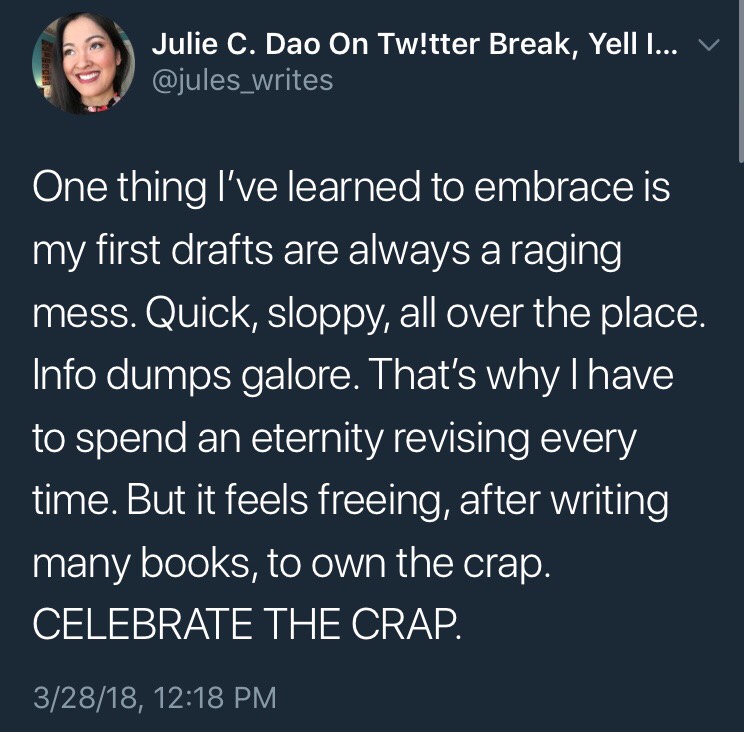
Not all first drafts are alike. Not even all of my first drafts are alike. Some are..draftier, for lack of a better word. Some are more polished. But they're all kinda bad.
Most of my first drafts are solid stories. My tendency to outline serves me pretty well in that way.
But this story is different.
I don't have a plan for BRUSHSTROKES in the way that I had one for CANUS. I have a couple of paragraphs of a summary and a list of the major characters. I know, sort of, where the story will eventually go. I have a pretty solid idea of what the first handful of chapters look like. And that's pretty much it.
Not having a plan has definitely made the process more stressful. There's nothing for me to look to if I get stuck or lose the thread of the story. It makes things feel messy.
Phoebe, my main character in the new MS is messy. She's complicated. And this MS requires a close perspective--BRUSHSTROKES is my first real attempt at first person narration.
I'm hoping that the lack of form, the lack of my usual structure will let me dig a little deeper into Phoebe. It'll mean more revision on the back end, I'm sure, but if I can find her voice, I think it'll be worth it.
But boy, is the process ugly. I'm trying to embrace the crap. I'm really trying.
Long term, I can't say how this experiment will work out. It's certainly let me put a lot of words on the page pretty quickly, but that might have more to do with the week off than anything. We'll see if the wordcount keeps up next week.
When's the last time you shook up your process or wrote something out of your comfort zone? How did it go? Let me know in the comments.
Sunday, April 1, 2018
Sunday, March 25, 2018
Building the World: Language
2018 Goals Update
Books read: 23
Words on LIBRARIUM: 4,646/4,646 (It's finally dONE THANK GOODNESS)
Words on BRUSHSTROKES: 1,020/? (probably around 80-85K)
I finally feel like I'm back in the saddle as far as writing goes. The last couple of weeks have been lackluster as far as my creative work--day job stuff has taken up more of my time and I've, frankly, been lazy and distractable.
One of the things I've been doing while not getting words on the page is playing Dragon Age: Inquisition (which is my least favorite of the DA games, but we no longer have a working controller for our Xbox 360, so it's the only option right now).
For those unfamiliar, Dragon Age is a series of fantasy role playing games (we know how I love my RPGS) set on the fictional continent of Thedas. This is, in general, a meticulously crafted world. The various nations each have their own history and sets of relationships and political structures. Each location has its own architectural style and fashion, its own set of norms and hobbies. It really is spectacularly well thought-out.
Except for one thing.
Language is one of the aspects of world building that I don't think gets the attention it deserves. And I guess, in some ways, I get it. Not all of us are Tolkien. Most of us don't particularly want to sit down and create an entire fictional language (you don't actually have to do that to have quality language world building--but I'll get to that later).
It's pretty easy to wave away language in settings that involve multiple countries or planets by saying that everyone speaks "Common"--I mean, that's the one language that your character automatically knows D&D. But just saying that there's a shared tongue ignores the way that language intertwines with history and politics.
Basically, a language doesn't just become common. It's a process that's wrapped up in economic and colonial relationships.
Allow me to get sociological for a minute.
What are some of the situations where a language becomes widespread? Which of our fictional nations' languages would be the one most likely to be picked up and used in other countries?
The languages of colonial powers tend to be more widespread. English is spoken around the world in no small part because for a while the English national pass-time was sailing around the world, conquering nations and making the native peoples speak and behave in an Anglicized manner. England's not the only example--the story of how Spanish became the dominant language in so many Central and South American nations is pretty similar. What nations or world in your fictional setting have the itch to claim land in other nations or on other planets? The colonized often have to learn the language of their colonizers. Which language is "common" will in some ways be a matter of which nation has power.
Trade will also have an impact on what languages people learn. Which nation holds the economic power? Who controls the shipping lines? If you want to make money--if you want to be able to trade with other nations, to expand your markets--you have to learn that nation's language. Again, power is at play. The nation (or group or whatever) that controls the trade lines doesn't need to learn others' languages because they are the folks you have to go through to make money. They're needed and as such they can dictate terms. Learn our language if you want access. Take it or leave it.
It seems like such a little thing, but something as simple as what language is most commonly spoken can add so much detail to a fictional world. Ignoring this part of world building pokes a hole in your world's history.
Now, when it comes to fictional languages--I definitely get the unwillingness to craft an entire language. I know some basic structural things about my alien species' languages in my space opera, but I don't have a dictionary or anything like that. But I don't necessarily need to have one. I wrote the whole book, even scenes that are spoken in one of the fictional languages, in English. With a few hints, the reader can assume what language is being spoken.
Movies do this all the time. US adaptations for Les Miserables, for instance, are typically scripted in English, but we don't assume that all of these 19th century French folks are actually speaking English. The same idea can apply for a fictional language. An author can drop some clues--mention the setting and origins of the characters, say something about the familiarity of a language or if someone struggles to find a word, or even flat out say that someone is speaking in a particular language--to plant the idea of what language is being spoken in the reader's mind. No need to come up with a new language. Unless you just want to.
Every aspect of your world is a chance to make the reader's experience of it more complete. Language is no exception.
So, maybe take some extra time to think about who's speaking what and why.
Books read: 23
Words on LIBRARIUM: 4,646/4,646 (It's finally dONE THANK GOODNESS)
Words on BRUSHSTROKES: 1,020/? (probably around 80-85K)
I finally feel like I'm back in the saddle as far as writing goes. The last couple of weeks have been lackluster as far as my creative work--day job stuff has taken up more of my time and I've, frankly, been lazy and distractable.
One of the things I've been doing while not getting words on the page is playing Dragon Age: Inquisition (which is my least favorite of the DA games, but we no longer have a working controller for our Xbox 360, so it's the only option right now).
For those unfamiliar, Dragon Age is a series of fantasy role playing games (we know how I love my RPGS) set on the fictional continent of Thedas. This is, in general, a meticulously crafted world. The various nations each have their own history and sets of relationships and political structures. Each location has its own architectural style and fashion, its own set of norms and hobbies. It really is spectacularly well thought-out.
Except for one thing.
Language is one of the aspects of world building that I don't think gets the attention it deserves. And I guess, in some ways, I get it. Not all of us are Tolkien. Most of us don't particularly want to sit down and create an entire fictional language (you don't actually have to do that to have quality language world building--but I'll get to that later).
It's pretty easy to wave away language in settings that involve multiple countries or planets by saying that everyone speaks "Common"--I mean, that's the one language that your character automatically knows D&D. But just saying that there's a shared tongue ignores the way that language intertwines with history and politics.
Basically, a language doesn't just become common. It's a process that's wrapped up in economic and colonial relationships.
Allow me to get sociological for a minute.
What are some of the situations where a language becomes widespread? Which of our fictional nations' languages would be the one most likely to be picked up and used in other countries?
The languages of colonial powers tend to be more widespread. English is spoken around the world in no small part because for a while the English national pass-time was sailing around the world, conquering nations and making the native peoples speak and behave in an Anglicized manner. England's not the only example--the story of how Spanish became the dominant language in so many Central and South American nations is pretty similar. What nations or world in your fictional setting have the itch to claim land in other nations or on other planets? The colonized often have to learn the language of their colonizers. Which language is "common" will in some ways be a matter of which nation has power.
Trade will also have an impact on what languages people learn. Which nation holds the economic power? Who controls the shipping lines? If you want to make money--if you want to be able to trade with other nations, to expand your markets--you have to learn that nation's language. Again, power is at play. The nation (or group or whatever) that controls the trade lines doesn't need to learn others' languages because they are the folks you have to go through to make money. They're needed and as such they can dictate terms. Learn our language if you want access. Take it or leave it.
It seems like such a little thing, but something as simple as what language is most commonly spoken can add so much detail to a fictional world. Ignoring this part of world building pokes a hole in your world's history.
Now, when it comes to fictional languages--I definitely get the unwillingness to craft an entire language. I know some basic structural things about my alien species' languages in my space opera, but I don't have a dictionary or anything like that. But I don't necessarily need to have one. I wrote the whole book, even scenes that are spoken in one of the fictional languages, in English. With a few hints, the reader can assume what language is being spoken.
Movies do this all the time. US adaptations for Les Miserables, for instance, are typically scripted in English, but we don't assume that all of these 19th century French folks are actually speaking English. The same idea can apply for a fictional language. An author can drop some clues--mention the setting and origins of the characters, say something about the familiarity of a language or if someone struggles to find a word, or even flat out say that someone is speaking in a particular language--to plant the idea of what language is being spoken in the reader's mind. No need to come up with a new language. Unless you just want to.
Every aspect of your world is a chance to make the reader's experience of it more complete. Language is no exception.
So, maybe take some extra time to think about who's speaking what and why.
Sunday, March 18, 2018
Personal Narrative
2018 goals update
Books read: 21
Words on LIBRARIUM: 3000/?--5000 maximum (this is more impressive when you consider that I started this week by cutting about 200 words from the story).
It's been a hectic couple of weeks.
I've been trying for the past few months to find a different day job. Adjuncting is stressful and not particularly lucrative, and the balance between how many classes I have to teach to pay my bills and how many classes I can teach effectively...doesn't really work out in my favor. I spruced up my resume and went on the hunt for new work. I finally found it, but some of the advice that I found along the way stuck with me.
I'm in a query mindset--CANUS is so close (*so close*) to being ready to go, so I'm trying to put together a great pitch letter. I'm finding that it's really not unlike looking for a job.
Books read: 21
Words on LIBRARIUM: 3000/?--5000 maximum (this is more impressive when you consider that I started this week by cutting about 200 words from the story).
It's been a hectic couple of weeks.
I've been trying for the past few months to find a different day job. Adjuncting is stressful and not particularly lucrative, and the balance between how many classes I have to teach to pay my bills and how many classes I can teach effectively...doesn't really work out in my favor. I spruced up my resume and went on the hunt for new work. I finally found it, but some of the advice that I found along the way stuck with me.
I'm in a query mindset--CANUS is so close (*so close*) to being ready to go, so I'm trying to put together a great pitch letter. I'm finding that it's really not unlike looking for a job.
The specific piece of advice that's sticking with me is this: your resume should tell a story. Whatever your work has been, you should be able to frame your work history as a story of what you want to achieve and how you hope to achieve it.
This is... complicated.
My work history doesn't make a lot of sense. I've gone from radio and television, to academics, to administration without much of a plan. I don't know what I want to be when I grow up. Well, I do, but there's not really a set path that leads to "financially independent author." My strategy has always sort of been "do what I have to so I can do what I want to." Helpful for keeping up with writing, but not great for presenting as a purposeful narrative to a potential employer.
You find ways, though. Tying something you witnessed in radio and TV to an academic curiosity; demonstrating the way that teaching experiences prepare you to deal with deadlines and crises in administrating. But it takes some mental acrobatics.
One of the elements in a query is the bio: just a few sentences that give the agent a sense of who you are, what you'd be like to work with, and what business you have telling this particular story.
It's that last part that trips me up--for the same reason as the "your resume should be a narrative" advice. CANUS takes place in the distant future. And in space. With alien species. How can I draw a line from that to my teaching job? How does my experience make me "uniquely qualified" to tell this particular story?
I get why it's important, obviously. You bring yourself to every story that you write. Who you are and what you've experienced shape what stories you tell and how you tell them. But those lines can be tough to draw. Especially when you're writing genre fiction.
There's nothing in my work history that ties to space travel, and I've never met an alien species. But I have studied the way that economic relationships shape power structures. I've studied the ways that access to particular technologies can change daily life and who gets the final say in a conversation over the direction of resources. I've studied relationships between colonized and colonizers. And all of that comes with me to my story, my world, and my characters.
Sometimes it's hard to see how the threads of your own story tie together--even when you spend a considerable amount of your time weaving together the stories of others. But once you see the connection, you can point it out to others. And you can go into your own work knowing why you should tell the story; what you can give that someone else can't.
Wednesday, March 7, 2018
#AMMConnect Post
I'm gearing up to try to get a mentor spot in the upcoming round of Author Mentor Match, so my weekly blog post is happening early. Consider this my #AMMConnect profile.
And forgive my overall lack of images. I'm new to the whole "create an aesthetic" thing.
Who am I?
In my day job, I'm an adjunct instructor (which is basically the teacher version of contract work--hired per class). I teach sociology classes, so I spend a lot of time trying to get my students to connect the dots between structure and individual. How does the way that our society chooses to do things shape what options are available to people at different societal positions? This ends up being a theme I play with in a lot of the work I do; my current WIP is no exception.
I made the decision to actively pursue writing in 2016. That year, I sent a novel I'd trunked to a small press, and it got picked up. Since then, I've had a couple of shorter works picked up by small presses (you can see the stuff I've got out on my website). The manuscript I'm submitting for AMM is a piece that's been in my head since high school, and I think I've finally got it close to where it needs to be.
What is my book?
My book is essentially what you'd get if Mass Effect spent less time on Reapers and more time examining colonialism and gentrification.
CANUS is an upper YA space opera in which humanity's reach has expanded across the galaxy. The Draconin Group is the corporation that made it possible--their faster-than-light technology isn't just the human's gateway to the galaxy; it's how all the species in the galaxy get things done.
Humans might be the powerhouse species in the galaxy, but that doesn't mean that things are sunshine and roses for all of them. AJ, narrator number one, is a human colonist who suspects that Draconin has been up to some shady--and murderous--business to get their hands on more land. Her search for proof lands her on Draconin's most wanted list. She has to run. Luckily for her, she manages to find a ship and a few people who share her interest in putting an end to Draconin's control of the galaxy.
Narrator number two is Hermes, an Arvian (one of my alien species) lives on a planet near the edges of the galaxy--one that desperately needs Draconin's flight tech. His homeworld's economy is collapsing, and the Draconin Group are the only ones offering options for Arvians to improve their standing. Hermes follows his older brother into Draconin's prestigious Hunter program. His assignment: to help capture and bring down AJ.
So: humans, aliens, spaceships, a dangerous colonizing power, complicated sibling relationships, and two people doing their best to navigate a situation where even the best options might end up destroying someone's life.
What's the catch?
Mmmm. Well, I've been through a handful of rounds of revision with this project. It's close, I know. The current draft is good (I've had some fantastic critique partners), but there are a handful of things that aren't clicking along the way that they could.
Why are you doing AMM?
Honestly, I want some help from a publishing insider. Again, I've had some awesome help getting this far, but my partners have been in the same position I am. I'd like to get some insight from someone who's further on their publication journey, who might have knowledge and resources that I lack.
Graphics
Look, I'll give you a few images here, but this is not a thing I'm good at.
(There is a lot more black in this than I thought. I promise there are colorful things in the MS.)
I'm looking forward to getting to know the other mentee hopefuls. If you want to find me elsewhere online, here's where to find me.
Twitter: @authorascrowder
Instagram: @ascrowder
And forgive my overall lack of images. I'm new to the whole "create an aesthetic" thing.
Who am I?
In my day job, I'm an adjunct instructor (which is basically the teacher version of contract work--hired per class). I teach sociology classes, so I spend a lot of time trying to get my students to connect the dots between structure and individual. How does the way that our society chooses to do things shape what options are available to people at different societal positions? This ends up being a theme I play with in a lot of the work I do; my current WIP is no exception.
I made the decision to actively pursue writing in 2016. That year, I sent a novel I'd trunked to a small press, and it got picked up. Since then, I've had a couple of shorter works picked up by small presses (you can see the stuff I've got out on my website). The manuscript I'm submitting for AMM is a piece that's been in my head since high school, and I think I've finally got it close to where it needs to be.
What is my book?
My book is essentially what you'd get if Mass Effect spent less time on Reapers and more time examining colonialism and gentrification.
CANUS is an upper YA space opera in which humanity's reach has expanded across the galaxy. The Draconin Group is the corporation that made it possible--their faster-than-light technology isn't just the human's gateway to the galaxy; it's how all the species in the galaxy get things done.
Humans might be the powerhouse species in the galaxy, but that doesn't mean that things are sunshine and roses for all of them. AJ, narrator number one, is a human colonist who suspects that Draconin has been up to some shady--and murderous--business to get their hands on more land. Her search for proof lands her on Draconin's most wanted list. She has to run. Luckily for her, she manages to find a ship and a few people who share her interest in putting an end to Draconin's control of the galaxy.
Narrator number two is Hermes, an Arvian (one of my alien species) lives on a planet near the edges of the galaxy--one that desperately needs Draconin's flight tech. His homeworld's economy is collapsing, and the Draconin Group are the only ones offering options for Arvians to improve their standing. Hermes follows his older brother into Draconin's prestigious Hunter program. His assignment: to help capture and bring down AJ.
So: humans, aliens, spaceships, a dangerous colonizing power, complicated sibling relationships, and two people doing their best to navigate a situation where even the best options might end up destroying someone's life.
What's the catch?
Mmmm. Well, I've been through a handful of rounds of revision with this project. It's close, I know. The current draft is good (I've had some fantastic critique partners), but there are a handful of things that aren't clicking along the way that they could.
Why are you doing AMM?
Honestly, I want some help from a publishing insider. Again, I've had some awesome help getting this far, but my partners have been in the same position I am. I'd like to get some insight from someone who's further on their publication journey, who might have knowledge and resources that I lack.
Graphics
Look, I'll give you a few images here, but this is not a thing I'm good at.
(There is a lot more black in this than I thought. I promise there are colorful things in the MS.)
I'm looking forward to getting to know the other mentee hopefuls. If you want to find me elsewhere online, here's where to find me.
Twitter: @authorascrowder
Instagram: @ascrowder
Sunday, March 4, 2018
Breather
2018 Goal Update
Books read: 18
Words on LIBRARIUM: 1800/? (5000 maximum)
Words on WD Contest story: 200/? (2000 maximum)
This hasn't been the best week for writing. In fact, I haven't actually written a word this week. Some of the lack of productivity has been due to a series of migraines (it's that time of year, I guess). Some of it has been because of the work load at my day jobs--and the work load that goes along with trying to find a different day job. But, if I'm honest, most of it boils down to my needing a break.
This time last week, I had just finished this round of revisions on CANUS. I did a little work on my two smaller projects to round out the week. My brain, though, hasn't been cooperating with me. Going from revisions to a first draft is always disorienting: I've been (re)polishing work for so long that the little things that you're not really supposed to worry about in a first draft scream at me. But I've been working non-stop really since last January, between revisions, short stories, the project that I still can't talk about, and the Mata Hari story ("Lady or the Dagger," which is now available!).
I mentioned in my 2017 reflection post that I wrote fewer words in 2017 than 2016, but that doesn't mean that I did less work. I'm proud of the work that I did, and I'm glad that some of it is now ready to be shared.
I started this blog back in April of 2016, when I decided to seriously pursue writing. Since then, I've been doing just that: devoting frequent time to my writing work (though I'm still not great a sticking to a schedule), pounding out new projects, perfecting larger projects, publishing pieces. I love the work. Even when I hate it, I love it. But we're approaching two years of almost non-stop work.
So I took this week off. On the one hand, I do think the break was earned. Of course, I still felt guilty about it the whole time.
I plan to ease back into work this coming week. It's a good time for it. I'll get feedback from my writing group on my LIBRARIUM story, which should spark some forward movement. And I should have some extra time to play around with the contest story.
I'm hoping the breather has helped me recharge a little. And I'm hoping that I can forgive myself for actually taking a moment to take a break.
Either way, it's time to get back in the saddle. The work won't do itself.
Books read: 18
Words on LIBRARIUM: 1800/? (5000 maximum)
Words on WD Contest story: 200/? (2000 maximum)
This hasn't been the best week for writing. In fact, I haven't actually written a word this week. Some of the lack of productivity has been due to a series of migraines (it's that time of year, I guess). Some of it has been because of the work load at my day jobs--and the work load that goes along with trying to find a different day job. But, if I'm honest, most of it boils down to my needing a break.
This time last week, I had just finished this round of revisions on CANUS. I did a little work on my two smaller projects to round out the week. My brain, though, hasn't been cooperating with me. Going from revisions to a first draft is always disorienting: I've been (re)polishing work for so long that the little things that you're not really supposed to worry about in a first draft scream at me. But I've been working non-stop really since last January, between revisions, short stories, the project that I still can't talk about, and the Mata Hari story ("Lady or the Dagger," which is now available!).
I mentioned in my 2017 reflection post that I wrote fewer words in 2017 than 2016, but that doesn't mean that I did less work. I'm proud of the work that I did, and I'm glad that some of it is now ready to be shared.
I started this blog back in April of 2016, when I decided to seriously pursue writing. Since then, I've been doing just that: devoting frequent time to my writing work (though I'm still not great a sticking to a schedule), pounding out new projects, perfecting larger projects, publishing pieces. I love the work. Even when I hate it, I love it. But we're approaching two years of almost non-stop work.
So I took this week off. On the one hand, I do think the break was earned. Of course, I still felt guilty about it the whole time.
I plan to ease back into work this coming week. It's a good time for it. I'll get feedback from my writing group on my LIBRARIUM story, which should spark some forward movement. And I should have some extra time to play around with the contest story.
I'm hoping the breather has helped me recharge a little. And I'm hoping that I can forgive myself for actually taking a moment to take a break.
Either way, it's time to get back in the saddle. The work won't do itself.
Sunday, February 25, 2018
Contests and a Giveaway
2018 Goal Update
Chapters left to revise: NONE! The MS is now with test readers.
Books read: 16
Words on LIBRARIUM: 1800
Words on WD Contest story: 200
I've managed to complete one of my goals for the year. It's been about a five month process, but this round of revisions for my manuscript is complete. As I told the two readers who are looking over the book for me now, I hate it again, so it's time to put it in someone else's hands.
With that big goal complete, it's time to work on other things. I'm hesitant to devote too much time to my Librarium story before the first round of feedback from the writing group, and I don't want to dive into BRUSHSTROKES until the semester ends and I can give it full focus. So, I thought I'd take a swing at one of my other goals--enter a writing contest.
To say that I've never entered a writing contest wouldn't be entirely accurate. My school district ran a yearly arts competition with a creative writing category. I placed a couple of times in elementary school. I entered a poetry contest at my junior high when I was in ninth grade. That one I won. There's a plaque in the school with my name on it and everything.
But that's really it as far as competition goes.
I don't really have a good explanation for what's stopped me from entering contests. I mean, imposter syndrome is the easy answer: deep down, I don't think I'm a real writer or a talented one, so I don't enter contests because losing one would give weight to those insecurities. But honestly, the same thing could be said about submitting work for publication--rejections aren't exactly great for self-esteem, either. I pitch to publishers and query agents pretty regularly (and get a fair share of rejections).
Maybe it's the winning thing that gets me? With pitches and queries, I'm not really being assessed in comparison. The agent or publisher looks at the work and decides if they want it pretty much independent of what other writers are doing. A contest, though, has a ranking system. There's a comparison.
I subscribe to the belief that comparison is the enemy of progress--I try not to compare myself to anyone other than the writer I was yesterday. It helps me keep my momentum. If I compare my work to the stuff I find on the shelves, my sense of my ability may be skewed one way or another, but I can pretty easily compare my older work and my current work and get a sense of how I've improved. A contest, though, is about that comparison. Was your story better than the others?
And I get that it's subjective. That good and great stories still lose. But my ego is fragile. I already feel like I'm faking my way through this whole writing thing. The last thing I need is something to topple my already precarious balance.
Ultimately, though, I can't get better if I don't take risks, if I'm not willing to put myself out there. So, this week, I started work on a piece for a contest. I don't know what will come of it, but I think the chance will be worthwhile.
In celebration of this risk (and of the Amazon Author Central page I finally got around to setting up), I'm giving away two copies of one of my favorite reads from 2017, This Savage Song.
To enter, click this link and follow me on Amazon. Winners will be chosen on March 26. While you're there, check out my list of available works.
Chapters left to revise: NONE! The MS is now with test readers.
Books read: 16
Words on LIBRARIUM: 1800
Words on WD Contest story: 200
I've managed to complete one of my goals for the year. It's been about a five month process, but this round of revisions for my manuscript is complete. As I told the two readers who are looking over the book for me now, I hate it again, so it's time to put it in someone else's hands.
With that big goal complete, it's time to work on other things. I'm hesitant to devote too much time to my Librarium story before the first round of feedback from the writing group, and I don't want to dive into BRUSHSTROKES until the semester ends and I can give it full focus. So, I thought I'd take a swing at one of my other goals--enter a writing contest.
To say that I've never entered a writing contest wouldn't be entirely accurate. My school district ran a yearly arts competition with a creative writing category. I placed a couple of times in elementary school. I entered a poetry contest at my junior high when I was in ninth grade. That one I won. There's a plaque in the school with my name on it and everything.
But that's really it as far as competition goes.
I don't really have a good explanation for what's stopped me from entering contests. I mean, imposter syndrome is the easy answer: deep down, I don't think I'm a real writer or a talented one, so I don't enter contests because losing one would give weight to those insecurities. But honestly, the same thing could be said about submitting work for publication--rejections aren't exactly great for self-esteem, either. I pitch to publishers and query agents pretty regularly (and get a fair share of rejections).
Maybe it's the winning thing that gets me? With pitches and queries, I'm not really being assessed in comparison. The agent or publisher looks at the work and decides if they want it pretty much independent of what other writers are doing. A contest, though, has a ranking system. There's a comparison.
I subscribe to the belief that comparison is the enemy of progress--I try not to compare myself to anyone other than the writer I was yesterday. It helps me keep my momentum. If I compare my work to the stuff I find on the shelves, my sense of my ability may be skewed one way or another, but I can pretty easily compare my older work and my current work and get a sense of how I've improved. A contest, though, is about that comparison. Was your story better than the others?
And I get that it's subjective. That good and great stories still lose. But my ego is fragile. I already feel like I'm faking my way through this whole writing thing. The last thing I need is something to topple my already precarious balance.
Ultimately, though, I can't get better if I don't take risks, if I'm not willing to put myself out there. So, this week, I started work on a piece for a contest. I don't know what will come of it, but I think the chance will be worthwhile.
In celebration of this risk (and of the Amazon Author Central page I finally got around to setting up), I'm giving away two copies of one of my favorite reads from 2017, This Savage Song.
To enter, click this link and follow me on Amazon. Winners will be chosen on March 26. While you're there, check out my list of available works.
Sunday, February 18, 2018
Small Press FAQ
2018 Goal Update
* Chapters left to revise: 1 (so close!)
* Books read: 15
* Words on LIBRARIUM: 1678/? (5000 maximum)
Last week, I signed my latest publishing contract, so I can officially announce that my story, THE LADY OR THE DAGGER will be included in the MATA HARI: THE EYE OF DAWN anthology coming soon from Pro Se Productions.
THE LADY OR THE DAGGER marks my third contract with a small press (and a fourth is on the way), so while I wouldn't call publishing old hat for me yet, I think I can reasonably be considered experienced in the realm of working with small presses. I sometimes get questions from other writers considering submitting work or pitches to small presses. Everyone's questions are different, but there are a few topics that come up pretty regularly. So, consider this my Small Press FAQ.
Contracts
Every press is going to have a different contract boilerplate, but there are a few things that you should be sure are present in your contract:
One of the main things I get asked about working with small presses is how does it compare to traditional publishing with big house publishers. There's only so much I can answer about this, honestly, since I haven't published anything with a major publisher, but there are a few comparisons to make.
Most of what small presses vs. self-publishing boils down to is the question of how much of the work the author wants to do or is able to do themselves. Small presses offer aid in cover design, formatting, editing and some help in the arenas of marketing and distribution. With self-publishing, the author takes on all the work and all of the expense of preparing, publishing, and selling a book. That's a lot to take on, and the monetary cost can get pretty high pretty quickly. But the author also gets all of the money from the sales. If the sales are high enough, they might make more money than they would with a publishing contract. Whether self-publishing works better than publishing with small presses is really a matter of cost-benefit analysis on the author's part.
Navigating publishing is complicated no matter which path you take, but I hope this post has answered some questions for those trying to decide which method will work best for their writing.
* Chapters left to revise: 1 (so close!)
* Books read: 15
* Words on LIBRARIUM: 1678/? (5000 maximum)
Last week, I signed my latest publishing contract, so I can officially announce that my story, THE LADY OR THE DAGGER will be included in the MATA HARI: THE EYE OF DAWN anthology coming soon from Pro Se Productions.
![]() |
| More details as they arrive |
Contracts
Every press is going to have a different contract boilerplate, but there are a few things that you should be sure are present in your contract:
- Rights: print, electronic, and (if applicable) audio. The contract to clarify what type of rights the publisher is seeking. Usually, this is going to be first rights for the various media, meaning that the publisher is the only one that can produce the work until the contract expires or after a specific period of time dictated by the publisher (when this will occur varies based on publisher, but most will not ask for "life of the work" rights--they'll establish rights for a number of years with the option for continuing and renegotiating). This section should also spell out what rights the author retains--things like copyright, which the author should always retain.
- Publisher obligations: things like the publisher's responsibilities regarding cover art, editing, binding, marketing, and other aspects of production. This part spells out what the publisher is going to do for you. Do they have in-house artists and designers that they contract for cover art? How many editing passes are they willing to do with an individual work? What is their timeline for publication (this will usually be framed as a tentative timeline--sometimes things come up that slow the process)? To what degree will the publisher aid in marketing the work?
- Royalties: the percentage of sales that go back to the author--how much money you make per unit sold. This is not the same thing as an advance, but I'll get into that later. This will usually be presented as a percentage of the profit. Sometimes the publisher will offer a percentage of every unit sold; sometimes they'll specify that the royalties are a percentage of the profits. The only real difference is that one delays payment until production cost is met. This section should also spell out when and how payment will be received.
- Buyout and Cancellation terms: if either party wants to exit the contract, what is the procedure for doing so? This will spell out what is expected of the author if they want to get out of the contract. Usually, this will involve some kind of payment to offset the cost the publisher took on in production. It should set up what you get to keep--can you use the cover art that was created, for instance? Likewise, this section will spell out under what conditions the publisher can exit the contract. Things like failure to produce the manuscript in a timely manner may be listed as cause for the publisher to revoke the contract.
- Miscellaneous: There are some other odds and ends that may be present in some contracts. For shorter fiction, there might be clauses about the publisher's ability to include the work in other collections. Most will spell out what non-royalty goodies the author gets--things like free or reduced-price copies of the work--or what expectations there are regarding conferences and author events.
One of the main things I get asked about working with small presses is how does it compare to traditional publishing with big house publishers. There's only so much I can answer about this, honestly, since I haven't published anything with a major publisher, but there are a few comparisons to make.
- Agents: While small presses allow authors to submit their work for themselves, larger publishing houses often require that work be submitted via a literary agent. There are some exceptions: Tor, for instance, allows unagented submissions. Most major publishers, though won't take submissions direct from an author. Not everyone is interested in signing with a literary agent. If you don't want to go through the querying process and seek out an agent, then small presses will probably work better for you. Or, if you want to build up your resume to make yourself more appealing to an agent, you might consider working with small presses first.
- Advances vs. Royalties: Small presses usually don't offer advances. The author makes money based on sales without getting any payment upfront. This is because small presses usually don't have the funds to risk on advance payments. Major presses, though, offer advances of varying sizes based on how well they think the work will sell. The author gets to keep the advance even if the book doesn't meet sales expectations, but no royalties are earned until the sales cover the production costs and the amount of the advance. Major publishers can do this because they will typically have a few books that will be major sellers--think like a tentpole blockbuster from a movie studio that covers its own cost as well as the cost of a few smaller, less profitable movies. Small presses are less likely to have those runaway bestsellers, so they prefer to pay out as sales roll in.
- Distribution: Where will your book be on shelves? Small presses tend to lean more on digital platforms. Usually, you'll be able to find your book through online retailers--Amazon, Smashwords, etc. Sometimes you'll be able to find your work on the online versions of some of the big box stores. What's less likely to happen, unless your sales are fantastic, is for you to see your book on physical shelves in major retailers. Small presses typically don't have the power to make deals with major retailers. Major publishers, though, do. Publishing through a large house drastically increases the likelihood of your book being available in chain bookstores, where it's a little easier for potential readers to stumble across it.
- Marketing: With small presses, the weight of marketing falls largely on the author's shoulders. Marketing is expensive, and there's usually not enough money for small presses to pay for major marketing campaigns for each book, though they will frequently offer resources that authors can make use of to market themselves and their books--lists of events, group ad buys, and the like. Major publishers don't always throw a ton of money at marketing for each book, but there's generally more money available for marketing. The author still bears significant responsibility for advertising their own work, but the major publishing house is still a powerful ally to have in the author's corner.
Most of what small presses vs. self-publishing boils down to is the question of how much of the work the author wants to do or is able to do themselves. Small presses offer aid in cover design, formatting, editing and some help in the arenas of marketing and distribution. With self-publishing, the author takes on all the work and all of the expense of preparing, publishing, and selling a book. That's a lot to take on, and the monetary cost can get pretty high pretty quickly. But the author also gets all of the money from the sales. If the sales are high enough, they might make more money than they would with a publishing contract. Whether self-publishing works better than publishing with small presses is really a matter of cost-benefit analysis on the author's part.
Navigating publishing is complicated no matter which path you take, but I hope this post has answered some questions for those trying to decide which method will work best for their writing.
Subscribe to:
Comments (Atom)


